Get Full Government Meeting Transcripts, Videos, & Alerts Forever!
Get email alerts on the Homelessness topic
No spam. Unsubscribe anytime.
Service providers urge council to fully fund Homeless Strategy Office and include it in proposed tax-rate election
Summary
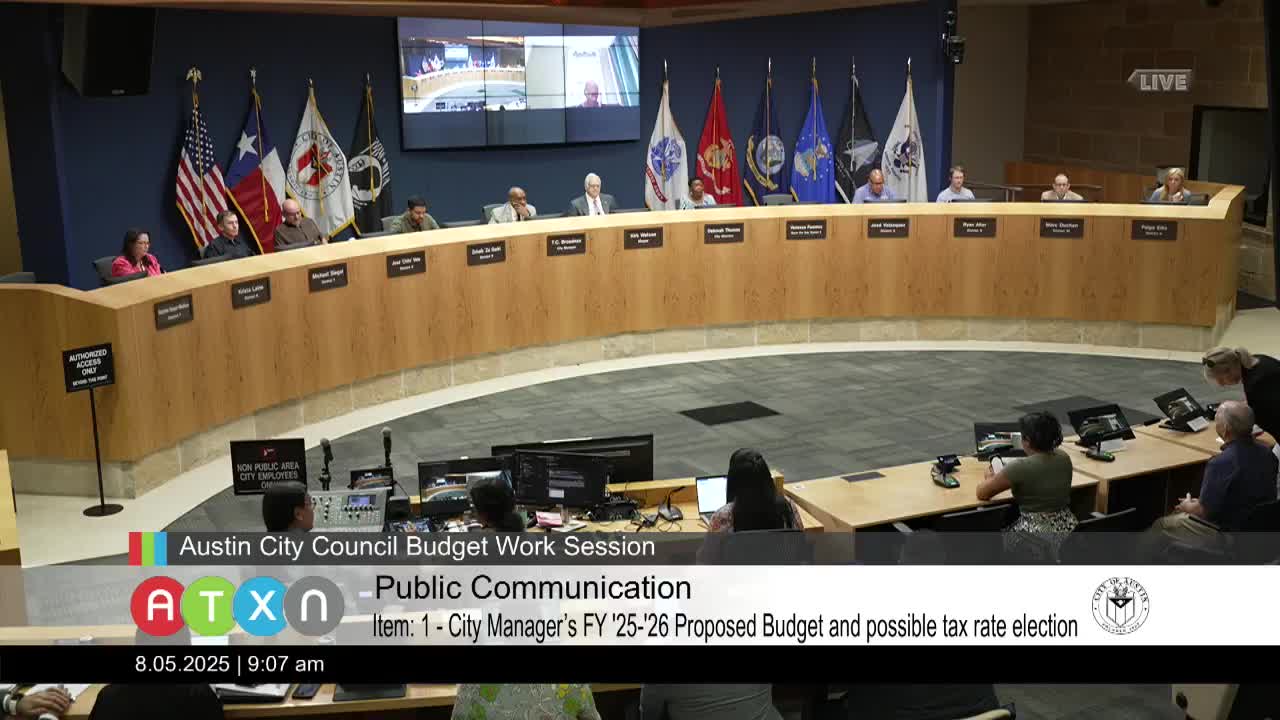
At an Aug. 5 budget work session, homelessness-service providers and residents pressed the Austin City Council to fund the Homeless Strategy Office (HSO) plan and to include sustained revenue in a potential tax rate election, while staff and some council members discussed funding timing and which HSO elements remain unfunded.
Speakers at the Austin City council's Aug. 5 budget work session urged the council to fully fund the Homeless Strategy Office plan and to put a tax rate election (TRE) on the ballot to provide ongoing revenue for shelter, housing vouchers and supportive services.
The request came from a coalition of service providers, housing advocates and residents who said temporary pandemic-era funding is ending and that failing to secure local, sustained revenue will push people back into homelessness and strain emergency services. “These amendments are not abstract numbers — they’re commitments to keep Austin a place where people can survive a crisis,” said Aloki Shaw, president of United Workers of Integral Care, calling for “at least $3,000,000 a year in ongoing funding for 24/7 EMCOT” and $2,500,000 for local housing vouchers.
Advocates said the funding is time-sensitive. Walter Moreau, director of Foundation Communities, described years of experience operating supportive housing and told the council that voters will want a concrete, costed plan if asked for ballot approval. “If we go to the voters for their support, they're gonna wanna know we've got a plan, and we do,” Moreau said.
Why it matters: Speakers said the current system depends on one-time federal and ARPA funds that are expiring and that a sustained local revenue source is needed to preserve gains in shelter capacity, rapid rehousing and supportive housing. Multiple providers stressed that investments in crisis response and housing reduce demand on police, emergency medical services and hospitals.
What was asked: Testimony and written proposals submitted by councilmembers and community groups requested continued funding for 24/7 mobile crisis teams (EMCOT), expansion of tenant-based rental vouchers to bridge expiring ARPA vouchers, and full staffing and service funding across the HSO pipeline — including prevention, diversion and landlord engagement programs that advocates said are not yet funded in the base budget.
Officials' response and next steps: David Gray of the Homeless Strategy Office told the council that upstream investments (prevention, diversion and landlord engagement) are not included in the base budget or the TRE scenarios but that staff plan to carry forward one-time funding into FY 2026; he warned that those will not be sustainable once the one-time funds are exhausted. Mayor Pro Tem Vanessa Fuentes and other councilmembers noted a sub-quorum proposal (submitted by Councilmembers Velasquez, Alter and Vela and circulated to colleagues) intended to ensure those missing pieces are funded in out years if the TRE proceeds.
Cautions and political context: Caritas of Austin and other providers noted political and legislative risks tied to a TRE. Joshua Houston of Caritas said state-level attention — including testimony in the Texas Senate local government committee on Senate Bill 9 — and federal funding uncertainty create additional risk for a large local tax proposal. “Given our precarious situation as a sector, we would rather have something than nothing,” Houston said.
Public-comment highlights and data cited by speakers: - Aloki Shaw (United Workers of Integral Care) asked the council to allocate at least $3,000,000 annually for 24/7 EMCOT and $2,500,000 for local housing vouchers (request text provided in public comment). He emphasized wage increases and retention as essential to program stability. - Foundation Communities said its supportive-housing portfolio (nine communities, roughly 1,000 residents) relies on about $2.5 million in city support against a $7,000,000 operating budget, illustrating the local subsidy need. - Multiple speakers — including Elizabeth Baker (The Other Ones Foundation), Atma Meek (The Other Ones Foundation peer-support staff), Chris Baker (Homeless Service Providers Consortium), Rachel Lair (Safe Alliance) and others — urged full operationalization of the HSO plan, warning that reduced funding would risk the system’s continuity and increase strain on public safety and health systems.
Implementation and timing: Budget staff and council members discussed process timing: the audit and finance committee meets later the same day to discuss TRE policy (not the amount), a Thursday work session is scheduled for council members to lay out proposed amendments and IFCs, and staff will post proposed amendments to the council message board and meeting materials before Thursday.
Clarifying details noted in testimony and staff responses: advocates provided dollar requests (e.g., $3,000,000 for EMCOT; $2,500,000 for vouchers) and said ARPA-funded emergency vouchers are expiring; David Gray confirmed some prevention/diversion funding exists as one-time carryforward for FY 2026 but is not in the base ongoing budget.
What the council did not vote on: There were no formal votes or final actions recorded at the Aug. 5 work session. Councilmembers asked staff for data and discussed scenarios; advocacy groups asked that any TRE scenario prioritize HSO elements that maintain system capacity.
What comes next: Councilmembers and staff signaled they will continue refining TRE scenarios and the amendment package. The council’s audit and finance committee will further discuss TRE policy at a 1:30 p.m. committee meeting, and the council planned a Thursday work session to lay out amendments and IFCs for public posting.