Get Full Government Meeting Transcripts, Videos, & Alerts Forever!
Get email alerts on the Personnel Compensation topic
No spam. Unsubscribe anytime.
Council hears proposal to use attrition to fund targeted market pay adjustments, not a uniform raise
Summary
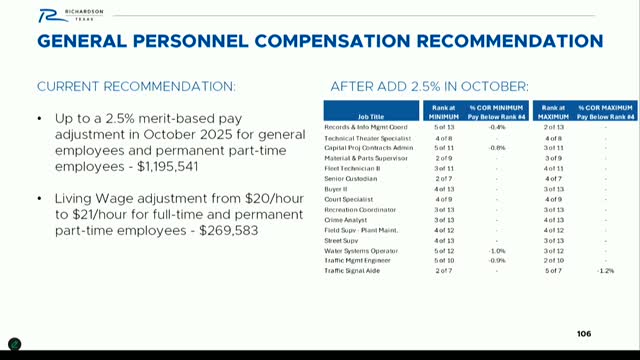
Staff proposed a targeted approach to close market gaps for frontline positions rather than a uniform 1% raise across non‑sworn employees; staff said about $80,000 in general‑fund savings from attrition would finance the adjustments.
City staff proposed a targeted set of market adjustments aimed at frontline and hard‑to‑fill positions rather than an across‑the‑board 1% increase for non‑sworn employees, telling council the approach reduces cost while addressing pay equity concerns.
Don Magner said the administration recommends 2.5% merit increases for sworn public‑safety personnel effective Oct. 1, plus an additional 2% on April 1, 2026; for non‑sworn positions staff recommended targeted market adjustments after a 2.5% baseline increase. Jose Marino, the city’s HR director, had reviewed market data to identify positions that would remain out of market after the baseline increase, Magner said.
Why it matters: the proposed surgical approach seeks to preserve internal equity while concentrating limited dollars on positions ranked lowest in the market analysis. Magner told council that a 1% across‑the‑board increase would cost roughly $770,000 across all funds and about $600,000 in the general fund. Instead, he said staff could use roughly $80,000 in general‑fund savings — identified through a conservative 7% attrition assumption and frozen positions — to move low‑ranked positions into better market placement.
Several council members asked whether the strategy would create operational strain by keeping positions frozen. Magner said he expected the savings to be realized more from natural attrition than from leaving critical positions vacant and noted the city’s historical average attrition rate is closer to 10% (he said the budget assumes 7%). Councilmember Barrios and others pressed for clarity on which positions would receive adjustments and whether the city is losing employees to private‑sector competitors; staff said most vulnerability remains among frontline technical positions (building and construction inspectors, trades, water operators, fleet and facilities technicians) while many professional positions are more fully staffed.
Ending: Council members expressed support for the targeted approach while asking staff to ensure operational continuity and to provide a list of the position titles and estimated adjustments so council could review the operational implications before final budget adoption.