Get Full Government Meeting Transcripts, Videos, & Alerts Forever!
Get email alerts on the Municipal Budget topic
No spam. Unsubscribe anytime.
Richardson council reviews FY26 budget proposals, including 6% water/sewer increase and fee changes
Summary
At a budget workshop, staff outlined the fiscal 2025–26 operating and capital proposals that would raise retail water and sewer rates by 6% and raise several user fees, while holding the proposed property tax rate steady. Council discussed mandates, capital needs and a two‑year approach to wholesale rate increases.
Richardson City Council heard a detailed presentation on the proposed fiscal year 2025–26 operating and capital budget, including a recommended 6% retail increase for water and sewer service and a package of modest fee increases for drainage and solid waste.
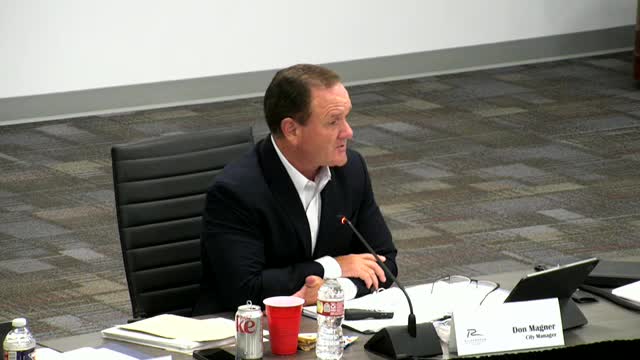
City staff presented the package at a budget workshop, saying the water and sewer recommendation responds in part to wholesale cost increases the city is receiving from the North Texas Municipal Water District and from sewer treatment partners. “We are recommending a 6% increase in water and sewer,” staff member Don Magner said during the presentation. Staff also proposed a $1 monthly increase to the residential drainage fee (bringing it to $6.25 per month) and a $0.50 monthly increase for residential solid waste service.
The nut graph: the changes are intended to preserve fund balance targets while covering higher wholesale charges and new regulatory requirements. Magner said the city faces a two‑year wholesale cost challenge — he cited an approximately 4% wholesale water increase and about a 15.5% sewer treatment increase reported by regional providers — and proposed spreading impacts to reduce next year’s pressure.
In the presentation, budget staff described ongoing implementation of EPA-related requirements for water systems, including a new lead-and-copper inspection requirement and the city’s Capacity, Management, Operation and Maintenance (CMOM) program. The water fund proposal includes an estimated $20 million of debt associated with restarting CMOM work, as well as a $2,000,000 pay‑as‑you‑go capital allocation and a target of roughly 91 days of fund balance. Bob, the budget staff member who provided fund detail, said about 97.5% of the water fund’s projected $119.9 million in revenue comes from service fees and that the packaged 6% retail increase would generate a large share of a projected $6.5 million revenue increase.
For drainage, staff noted state statute requires a reasonable and equitable methodology for drainage fees; staff said they had reviewed the statute and sought legal input before proposing the uniform increase for residential and commercial customers. Magner said most of the added drainage fee revenue would be dedicated to capital projects rather than operations.
On solid waste, staff recommended the $0.50 residential increase and targeted market-based commercial adjustments to keep fees competitive and recover costs; the solid waste presentation also included several service-fee changes, such as a proposed $50 charge for overloaded containers and increases to special pickup fees, intended to encourage customers to choose the appropriate service level.
The golf fund was presented with no rate increases; staff said both courses are expected to be open for the full year and that the fund is budgeted to meet its target fund-balance days. The hotel/motel fund shows a projected occupancy decline of roughly 4.4% compared with FY25; staff attributed part of that change to prior-year optimistic revenue estimates and to shifts in the presentation series at the Eisemann Center. Staff proposed raising the Eisemann Center facility maintenance fee by $1 and simplifying the venue’s fee schedule.
Council members asked about alternatives such as tiered water rates, targeted senior or veteran utility discounts, and regional opportunities tied to large events such as the FIFA World Cup. Magner and other staff said the city will study tiered-rate options and consider partnerships and targeted assistance programs, but they did not put any new discount program into the FY26 baseline budget.
The presentation closed with staff saying the combined effect of the proposed tax, fee and service changes would increase the typical taxpayer’s annual costs (taxes plus water, sewer, drainage and residential solid waste) by about $237 under the assumptions in the presentation. Staff recommended keeping the property tax rate unchanged from the rate used to build the proposal.
Ending: Council asked staff to return with follow-up analysis on tiered rates, targeted assistance options and specific capital project timing; staff said they would present a formal proposed budget and two public hearings on the tax rate and the budget in September.