Get Full Government Meeting Transcripts, Videos, & Alerts Forever!
Get email alerts on the Rikers Closure Mental Health topic
No spam. Unsubscribe anytime.
City Council and advocates press Adams administration to implement FY26 mental‑health investments to close Rikers
Summary
New York City Council leaders and a coalition of advocates called on Mayor Eric Adams’ administration to immediately implement more than $50 million in FY26 mental‑health and reentry investments aimed at reducing the jail population and advancing closure of Rikers Island.
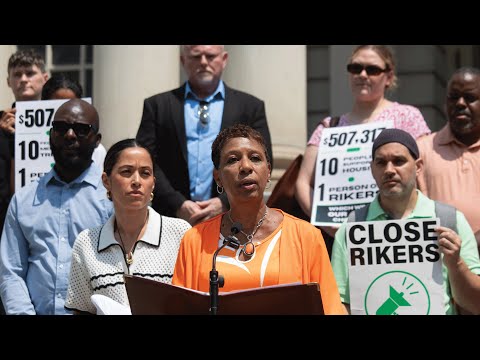
New York City Council Speaker Adrienne Adams and council members, joined by service providers and family members impacted by incarceration, on Saturday urged Mayor Eric Adams’ administration to move immediately to implement mental‑health and public‑safety investments included in the city’s fiscal 2026 budget intended to reduce the jail population and advance closure of Rikers Island.
The council and advocates said the FY26 budget includes more than $50 million in new funding for justice‑involved supportive housing, Assertive Community Treatment (ACT) and Intensive Mobile Treatment (IMT) teams, crisis respite centers, recidivism‑reduction programs and other community‑based services—investments they say are critical to keeping people out of jail and replacing Rikers as a de facto mental‑health facility.
"Rikers is not a place for healing," Speaker Adrienne Adams said. "It has essentially been the city's largest mental health facility that has long been defined by crisis, violence, and neglect." She and other council members emphasized that the council secured the new investments during budget negotiations and called on the mayor to release funds and activate programs without delay.
Advocates and providers on the steps outside City Hall highlighted specific program types and operational obstacles they say must be addressed. Darren Mack, co‑director of the Freedom Agenda, urged the city to expand use of the "6A" early‑release tool for people serving sentences of a year or less, saying the city used that mechanism in 2020 during the COVID‑19 emergency to release more than 300 people and that recidivism among those released was low: "Fewer than 1 percent of people released were rearrested for violent felonies and only 5 percent for any felony at all," Mack said.
Council Member Carlina Rivera said the city’s jail population has grown to more than 7,000 people and criticized the administration for what she described as delays and a lack of urgency that could prevent the city from meeting a 2027 target mentioned in the meeting for closing Rikers. "We have to redirect funds to alternatives to incarceration, supervised release, reentry programs, and supportive housing," Rivera said.
Speakers and service providers also pointed to operational delays that have left planned treatment capacity unused. Stanley Richards of the Fortune Society and the Independent Rikers Commission urged the Adams administration to open hundreds of existing beds that advocates say are available at Bellevue, Woodhull and North Central Bronx hospitals but have not been staffed or made operational. "We need accountability and urgency to prioritize DOC staffing and crack down on the unnecessary and belated requests for design changes," Richards said.
Program advocates described evidence for community‑based approaches. Nadia Chiat, senior director of policy and advocacy at CASES, cited ACT and IMT teams and other community programs as proven to reduce incarceration while improving public safety: "We have literally decades of evidence showing that these are the services that can decarcerate our city while improving public safety," she said. Providers including Bronx Connect and Urban Youth Alliance described reentry services, job support and community‑based violence‑interruption efforts and urged multi‑year funding.
Speakers repeatedly cited the scale and severity of needs inside city jails: multiple speakers said more than half of people incarcerated on Rikers have a mental‑health diagnosis and that a substantial share have serious mental‑health conditions or substance‑use disorders. Coalition speakers also pointed to deaths in custody—one speaker said 42 people have died in jail‑related deaths over the past four years, including four since mid‑June—and used those counts to underscore urgency.
No formal votes or legislative actions were recorded at the rally. Organizers and council members asked that the Adams administration release the FY26 funds to providers, staff out planned hospital and borough‑based beds, expand use of existing release tools such as the 6A program, and prioritize hiring and operational steps needed to bring programs online.
Advocates said implementation will require coordinated action across the Department of Correction, the city’s health and hospital systems, and contracted providers. Several speakers noted that board of corrections recommendations and requests to expand 6A use had not been fully adopted by the Department of Correction in recent months.
The coalition called for immediate operational steps, continued multi‑year funding commitments, and clear timelines from the administration. Council members said they will continue oversight and pursue legislation to expand supportive housing access for people returning from incarceration. "These investments are only as strong as our follow‑through and the partners who are supposed to meet us at the table," Carlina Rivera said.
Next steps identified by speakers included rapid disbursement of FY26 funds to community providers, activation of outposted hospital beds, expansion of ACT/IMT teams and supportive housing placements, and expanded use of early‑release tools where appropriate. Organizers said they will continue to press the administration and the council for timelines and accountability.