Get Full Government Meeting Transcripts, Videos, & Alerts Forever!
Get email alerts on the Student Performance And Curriculum topic
No spam. Unsubscribe anytime.
Goose Creek CISD leaders cite steady STAR results, outline curriculum and intervention changes
Summary
District staff told the board they maintained overall "approaches" performance while the state fell, described rescoring of English I and II tests, and outlined curriculum, staffing and intervention plans including Bluebonnet materials, structured literacy and an Amira pilot.
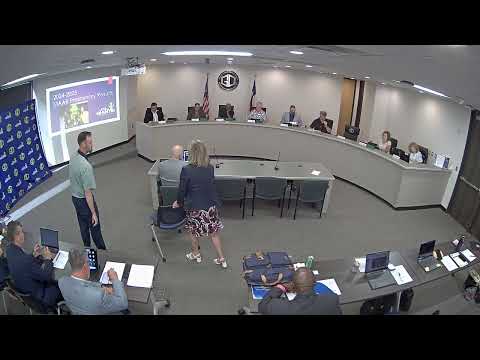
Goose Creek CISD administrators told the Board of Trustees their district held steady on overall STAR (STAAR-equivalent) measures for 2024-25 while the statewide averages declined, and laid out curriculum and intervention changes intended to raise “meets” and “masters” performance.
The report, led by Ms. Jackson and members of the Curriculum and Instruction team, summarized multi-year changes to state testing, a rescoring effort for some English end-of-course (EOC) tests, and steps the district will take before the 2025-26 school year. Ms. Jackson told trustees, “I think that you're gonna be pleasantly happy with this information.”
District leaders said Goose Creek maintained 62.5% at the “approaches” level districtwide while the state dropped from 75% to about 62%; district “meets” moved slightly from 34.5% to 34.8%. Sarah Lawrence, the associate director for ELA, said elementary grades — particularly grades 3 and 4 — showed the biggest gains, and that the district closed gaps on extended constructed responses at seven of eight tested grades.
Why it matters: Board members pressed for concrete steps to raise “meets” and “masters,” which carry more weight for accountability and college- and career-readiness. Administrators said they will focus on higher‑quality instructional materials (HQIMs), coaching, and targeted intervention rather than changing broad strategy.
Key details and evidence
- Test-design changes: Administrators reviewed the STAR/STAAR redesign that began in 2022–23 (integration of extended constructed responses and other item types) and noted the state’s later adjustments to scale score cut points and increased machine/AI scoring. Ms. Jackson explained the distinction between raw-score shifts and percent-based results after the state changed thresholds.
- Rescoring EOC English tests: District staff identified 51 English I and II tests for human rescoring after discrepant AI results. After rescoring, the district reported a 23.5% increase in students meeting the standard on those rescored exams; staff said the rescoring cost about $2,000 and helped students avoid retesting for graduation requirements.
- Curriculum and professional development: The district plans a heavier rollout of the Bluebonnet curriculum across campuses, centralized distribution of materials, expanded PD for assistant principals, and new emphasis on pedagogy over mere lesson internalization. Ms. Jackson said Bluebonnet pallets were reallocated to campuses quickly after receipt.
- Literacy strategy and pilots: The district will move toward structured literacy and will pilot the Amira reading intervention in grades 6–8 next year. Sarah Lawrence said structured literacy and vertical alignment from elementary through high school are priorities to address downstream EOC declines.
- Middle school efforts: Administrators credited “LIFT lessons” and a partnership with Texas A&M for stabilizing middle school results despite previously reduced instructional minutes and staff reductions.
- Math and other subjects: The math associate director said math shows regression at several levels and outlined plans to add intervention time in elementary schedules and to use Bluebonnet materials for consistent instruction. Science and social studies presenters reported gains at specific grades and described targeted PD and vertical alignment work.
- College and career readiness and graduation: District CCMR (college, career and military readiness) remained at 94% districtwide; graduation rate rose from 94.9% to 96.1%. The presenters noted district rates remain above the state average, and the strategic plan will continue to target 100% CCMR.
Board reaction and next steps
Trustees praised staff for sustaining scores amid statewide drops, asked for implementation timelines, and requested more frequent data briefings. Administrators said they will convene teams to analyze campus-level data and return with action plans; one explicitly noted a July 31 internal deadline for campus teams to present analyses to district leaders.
Ending note: Presenters emphasized long-term work — coaching, PD, and materials implementation — rather than short-term fixes; they framed the changes as a sustained cultural shift toward higher expectations and aligned instruction.