Get Full Government Meeting Transcripts, Videos, & Alerts Forever!
Get email alerts on the Public Safety Levy topic
No spam. Unsubscribe anytime.
Meridian council authorizes public-safety levy question for Nov. 4 ballot, adopts spending-limitation resolution
Summary
Meridian City Council voted unanimously to place a levy question on the Nov. 4, 2025, ballot to fund police, firefighters and a city prosecution unit and adopted a companion resolution specifying how revenues would be budgeted.
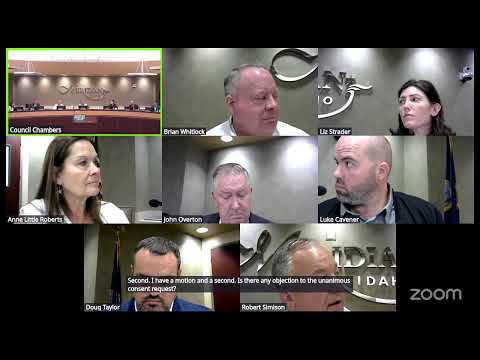
The Meridian City Council voted unanimously at a special meeting to place a public-safety levy on the Nov. 4, 2025 ballot and to adopt a companion resolution that limits how levy revenue can be budgeted.
The council approved two resolutions: one calling the levy election pursuant to Idaho Code section 63-8021G and a second requiring revenue from the measure be budgeted for specific public-safety purposes. Council members said the levy is intended to address a shortfall in funding for police, fire and prosecution services and to avoid reductions in existing service levels.
Ken Fries, a Meridian resident who testified during the public hearing, said he supports the levy but cautioned that some residents are concerned about rising assessments and taxes. "I am in favor of the levy," Fries said, but added many neighbors worry about higher assessments and overall affordability. Ralph Chapelle, another resident, urged the council to oppose the measure, saying the levy would burden people on fixed incomes. "I urge you to vote no on this matter," Chapelle said.
Council members who spoke described a complex mix of causes for the budget pressure. Several pointed to legislative changes that reduced the portion of property tax revenue the city receives from new growth as a central factor, saying development no longer pays for the services it creates in the same way it used to. Council members also cited inflation, rising personnel costs and the cost of bringing additional fire stations and staffing online.
Council member remarks also highlighted what proponents see as the levy’s aims: funding to retain and properly staff firefighters (with discussion of four-person effective response teams), competitive pay for police, and creation of a city prosecution unit to handle misdemeanor and citation cases locally. Council members repeatedly emphasized that the ballot question moves the funding decision to voters.
The council made several budget-related approvals during the meeting. Members approved an amendment to fiscal year 2025 revenues and expenditures and gave tentative approval to the fiscal year 2026 proposed revenues and expenditures. One council member cited the levy request amount the council has identified: $5,018,125.71, which the council said is intended to cover identified needs if voters approve the measure.
Formal actions taken on the levy and budgets were unanimous. Council members said staff and legal advisers prepared the ballot language and the policy-limiting resolution, and the council directed staff to continue public outreach and education ahead of the election.
Council members also asked for public engagement and said they will continue meetings and outreach to answer resident questions between now and election day. If voters approve the levy, council members said the city will proceed with the budgets and staffing plans described to the public; if voters reject it, the council signaled it will face further budget choices.
Votes at a glance from the meeting are listed below in the actions section.
The council closed the public hearing on the levy and moved on to other business, including scheduling workshops and asking staff to continue public information efforts.