Get Full Government Meeting Transcripts, Videos, & Alerts Forever!
Get email alerts on the Community Reinvestment Area topic
No spam. Unsubscribe anytime.
Columbus officials propose administrative updates to CRA program, outline $25 million housing development agreement
Summary
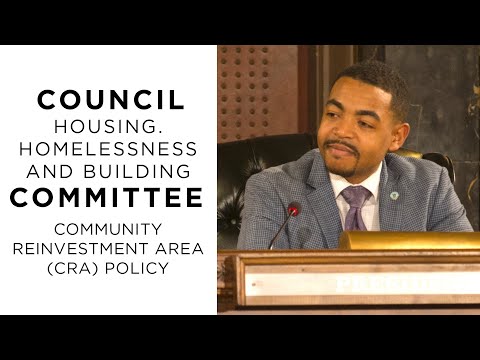
Columbus City Council’s Housing, Homelessness and Building Committee heard a presentation from the Department of Development on administrative and legislative updates to the city’s Community Reinvestment Area (CRA) residential tax incentive and on a proposed housing development agreement with Nuveen that would use bond funds to support 1,268 affordable units.
Columbus City Council’s Housing, Homelessness and Building Committee heard a presentation Oct. 26 from the Department of Development on legislative and administrative updates to the city’s Community Reinvestment Area (CRA) residential tax incentive and details of a proposed housing development agreement with private partner Nuveen that would use bond funds to support 1,268 affordable units.
The Department of Development’s deputy director, Aaron Prosser, and Jeremy Heater Gerrit, program manager for the residential tax incentive program, told committee members the administration is not recommending changes to the CRA’s affordability thresholds now because construction costs, land values and interest rates have risen since 2022 and left “less capacity” to capture deeper affordability without making the incentive nonviable. Prosser cited staff analysis showing higher input costs and Jeremy Gerrit described the program’s role in the city’s broader housing strategy, including the use of a 15-year property tax abatement for new or rehabilitated residential construction.
Why it matters: The CRA is one of the primary voluntary tools Columbus can use to include income-restricted units in high-demand neighborhoods; state law limits the city’s ability to require affordability through zoning. Committee members and staff framed the updates as efforts to keep the incentive usable for developers while improving transparency and program administration so eligible affordable units come online and residents can find them.
Key proposals described by staff included: - Expanding the CRA geography to incorporate recently annexed parcels; staff estimate about 1,300 potential housing units could be eligible if annexed parcels are added to the CRA. - Legislative changes to simplify documentation for projects that are already demonstrably affordable (e.g., some LIHTC-supported projects), reducing lengthy CRA agreements to shorter forms where appropriate. - Standardizing the application fee structure to rely on project unit counts with a cap. - Centralizing the statutory “housing officer” designation to the director of development or the director’s designee to shorten internal approval paths. - Extending the minimum program review cycle from three years to five years (staff said the current three-year cadence provides insufficient impact data because of transition provisions and long construction cycles).
Staff also described non-legislative process improvements already under way: an online application portal, simplified cost certification and reduced photo/document requirements. Gerrit said those changes have raised the program’s approval rate “over 4 times” compared with prior years.
Numbers and program performance: Department staff said the incentive has helped produce about 16,000 housing units since 2019, with roughly 1,200 units explicitly required to be affordable at 60%, 80% or 100% of area median income (AMI) because of the CRA rules. Staff also said an additional ~1,400 units were developed by affordable housing partners for which the CRA helped the financing “pencil out.” As of year-end 2024, staff reported only about 1.5% of city parcels were receiving an abatement even though the incentive is available on roughly 85% of parcels.
Fee-in-lieu and monitoring: The committee discussed the CRA’s fee-in-lieu option, introduced in the 2022 update. Gerrit said approximately 22% of required affordable units have been fulfilled by fees rather than unit set-asides; staff said historically those fees were distributed to community partners but were centralized within the Department of Development in 2022 so the city can align expenditures with program goals. Under current practice, rental projects submit an annual compliance report (due each March) with lease-up and unit-type data; homeownership affordability is enforced by a recorded restrictive covenant that activates on resale rather than by annual monitoring.
Housing development agreement with Nuveen: Staff described a proposed housing development agreement (HDA) with Nuveen covering three projects: renovation of an existing property called Wedgwood, a new construction project on Norton Road and redevelopment at the Latitude 525 site. The HDA would commit roughly $25 million in proposed bond funds toward the capital stack for those projects, and staff said the package aims to deliver 1,268 total units targeted at an average of about 60% AMI across the portfolio. City staff stressed the HDA is conditional on Nuveen completing the remaining financing and does not legally obligate the city if the partner cannot finalize the capital stack.
Concerns raised: Committee members and public speakers pressed staff on several issues: the visibility of affordable units (how residents find or apply for in-building set-asides that are intermingled with market-rate units), how compliance is monitored after lease-up, whether fee-in-lieu payments are being used for direct services (rental assistance, preservation, or new construction), and whether the administration should seek deeper affordability than current rules allow.
Area commission and density concerns: Roy Lowenstein, speaking with his neighborhood commission hat on, said his commission wants the city to press for 60% AMI as the effective definition of affordability and urged caution about high-density proposals — specifically referencing earlier community conversations about a Sawyer Towers redevelopment plan and urging continued negotiation with the developer. Staff and Council leaders said continued engagement with the nearest area commission is expected and that the HDA for Nuveen is intended to be flexible pending outcomes of local negotiations and required federal financing steps.
Public testimony: Michael Wilkos, vice president at United Way of Central Ohio and chair of the Continuum of Care planning body, told the committee he supports renewing and expanding the CRA and the Nuveen agreement, saying the community faces a documented shortage of affordable housing and “build more housing” is a necessary response. Wilkos noted measures that predict homelessness increases — a rental vacancy below 5% and rents rising faster than incomes — and urged action to expand supply.
What’s next: Staff said the legislative package before council would include the geography change and the administrative code clarifications; actual affordability thresholds were not proposed to change in this update. Staff also said an annual program report is due at the end of every September under current code and that they will provide committee offices with sample monitoring reports, CRA agreements and the director’s rules that govern program administration.
The committee did not record a formal vote during the hearing; staff presented proposals and took questions. Council members said they want greater transparency about where affordable units are located and clarity on the intended uses for any fee-in-lieu revenues as the proposals move toward formal legislation.