Get Full Government Meeting Transcripts, Videos, & Alerts Forever!
Get email alerts on the Speed Limits topic
No spam. Unsubscribe anytime.
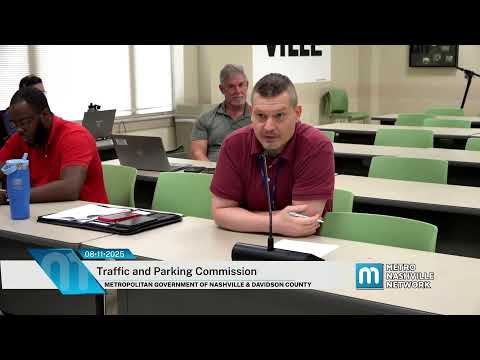
Traffic & Parking Commission lowers Ewing Drive speed limit to 35 mph after public safety debate
Summary
After public testimony about crashes and pedestrian risk, the Traffic & Parking Commission approved lowering the posted speed limit on Ewing Drive from 40 to 35 mph and asked NDOT to return with options to further reduce speeds and add safety measures.
The Traffic & Parking Commission on Friday approved lowering the posted speed limit on Ewing Drive between Knight Drive and Dickerson Pike from 40 mph to 35 mph, after multiple residents and safety advocates urged the panel to pursue stronger measures to reduce crashes and pedestrian risk.
Residents and cycling advocates pressed the commission during public comment to set the limit at 30 mph and to pursue physical traffic calming. "Ewing Drive should be set to 30 miles an hour for several reasons," said Ben Hubert, who told the commission the corridor experienced "more than 500 crashes on this 3 mile section of roadway" over the last five years and two deaths in the last year. Charles Weingartner, a member of Nashville’s Vision Zero advisory committee, said data from cyclists’ apps show heavy bicycle use along the corridor and argued lowering speeds would “drastically improve everyone’s safety.”
The staff recommendation from the Nashville Department of Transportation (NDOT) — presented by Darren Pack and planner/ Vision Zero coordinator Martinez — was to lower the posted limit to 35 mph based on the department’s speed study and established practice. NDOT reported 50th-percentile speeds around 40 mph and 80th-percentile speeds about 45 mph at multiple measured points along the corridor. NDOT also told the commission the road likely has an average daily traffic (ADT) exceeding 5,000 vehicles per day, a volume NDOT says makes the corridor ineligible for vertical traffic-calming measures (for example, raised crosswalks or rubber speed cushions) under current guidance.
Commissioners asked NDOT several follow-up questions about alternatives to vertical cushions, data collection methods and the likely effect of simply changing posted speeds. NDOT said other options remain under consideration — including wider edge striping, radar feedback signs and changes to striping — but that rubber speed cushions are unlikely to be feasible because of traffic volumes and manufacturer guidance. "There are other things that we would like to try on this road," Pack said, "but speed cushions are probably not the correct tool to use out of our toolbox." Martinez said the Vision Zero advisory committee requested the initial speed study; the advisory body does not vote on speed limits.
Commissioners divided over whether to lower the limit to 30 mph immediately. Several commissioners and members of the public said lowering only the posted sign without engineered changes may create a larger speed differential between drivers who obey the new limit and drivers who continue at previous speeds. Others said lowering the posted limit is a step the commission can take today under its charter, while further engineering work is NDOT’s purview. Commissioner Kornitick asked NDOT to return with examples and data showing the real-world impacts of larger speed differentials after sign-only reductions.
The commission voted to reduce the posted speed limit to 35 mph. The motion passed after a voice vote. Commissioners also approved a separate motion to add a follow-up agenda item for the next meeting: staff were asked to return with additional information about (1) what would be required to move the posted limit to 30 mph, (2) which traffic-calming measures would be feasible at various posted speeds, (3) relevant comparative studies (for example, the Broadmoor Drive changes mentioned by public commenters), and (4) a clearer map of council districts bordering the corridor. NDOT staff cautioned that a full new speed study after a posted-speed change may require months to produce post-change spot-speed data, but commit to providing available materials and clarifying which analyses would require more time.
Throughout the discussion, residents described on-street crashes, mailbox strikes and instances in which vehicles entered yards. "I think the cushions is really what we need," said one resident who said he has lived on the road for nearly 40 years and described near-miss and severe crashes. NDOT and staff did not dispute the crash history cited by speakers but emphasized that engineering eligibility for certain physical measures depends on measured ADT, speed percentiles and equipment/manufacturer guidance.
The action leaves the posted speed limit at 35 mph while NDOT develops follow-up options. Commissioners asked NDOT to return with the additional materials requested and invited further public comment when the item returns. The commission also recorded public interest in pursuing engineering changes beyond signage to reduce serious injury and fatal crashes.
Votes at a glance: - Item 5.7 — Reduce posted speed limit on Ewing Drive from 40 mph to 35 mph (Requested by NDOT & Vision Zero). Outcome: approved (voice vote). - Follow-up motion — Add next-month agenda item for NDOT to report on feasibility and impacts of lowering Ewing Drive to 30 mph and on traffic-calming measures (nonbinding request for staff analysis). Outcome: approved (voice vote).