Get Full Government Meeting Transcripts, Videos, & Alerts Forever!
Get email alerts on the Nullification topic
No spam. Unsubscribe anytime.
Defending Utah founder urges local officials, residents to use “nullification” to enforce constitutions
Summary
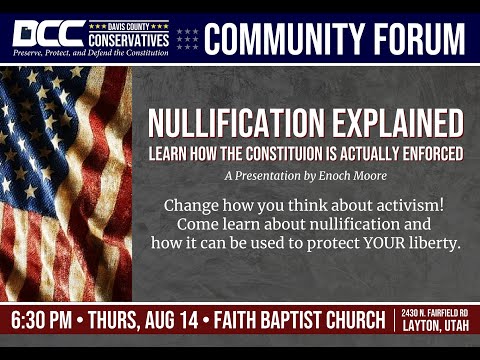
At a Davis County Conservatives meeting, Enoch Moore of Defending Utah presented nullification as a local tool to resist policies he and attendees view as outside constitutional bounds, and urged building local expertise to support elected officials who refuse unlawful directives.
Enoch Moore, founder of the nonprofit Defending Utah, told a Davis County Conservatives meeting that local officials and residents should use “nullification” to push back against laws and administrative actions they believe violate the U.S. or Utah constitutions.
Moore defined nullification as actions that make a law “void” or “unenforceable” in practice and framed it as a constitutional enforcement tool that can be exercised at personal, government and community levels. “Nullification is what we need to understand,” Moore said, adding that the oath of office empowers representatives to refuse acts they believe conflict with the constitution.
Moore spoke at length about natural law, constitutional principles and federalism, and said local education and organizating are prerequisites to effective nullification. He described instances in Utah where city councils reconsidered proposals after being presented constitutional limits on mixing public and private funds, and he recounted a 2014 effort to introduce a state bill that would have nullified aspects of the Affordable Care Act in Utah before the bill was changed in committee.
Moore urged attendees to build local organizations that can advise elected officials and said small towns often are more receptive to nullification arguments than larger cities. “If you start local, you can create a town or a few towns that are a paradise for the Constitution,” he said.
During a question-and-answer period, attendees pressed Moore on specific topics raised in his presentation, including “15-minute cities,” regional governance, surveillance infrastructure such as facial recognition and license-plate readers, and the legal limits on public–private partnerships. Moore recommended a case-by-case approach: evaluate local facts, draft a plan, and educate councils and residents before pressing a nullification action.
Moore also offered examples of community nullification — coordinated local refusal to comply with mandates or policies — and said many enforcement questions boil down to whether local representatives are willing and able to assert constitutional limits rather than deferring to attorneys or external agencies.
The presentation closed with audience discussion of next steps for local advocacy and technical questions about how to challenge surveillance tools and regional planning efforts.
Moore spoke from his role as a long-time activist and author; he recommended resources and offered mentorship through his American Committees Association. The meeting host encouraged participants to follow up with Moore for materials and training.
The talk was delivered in a public meeting setting and included extended audience Q&A; the presentation did not produce any formal motions, votes, or binding actions by any government body.