Get Full Government Meeting Transcripts, Videos, & Alerts Forever!
Minnesota Department of Agriculture details detection, quarantine and management after emerald ash borer found in Itasca County
Summary
At a virtual informational meeting the Minnesota Department of Agriculture described emerald ash borer biology, how to identify infestations, the emergency quarantine for Itasca County and treatment/removal options for landowners and communities.
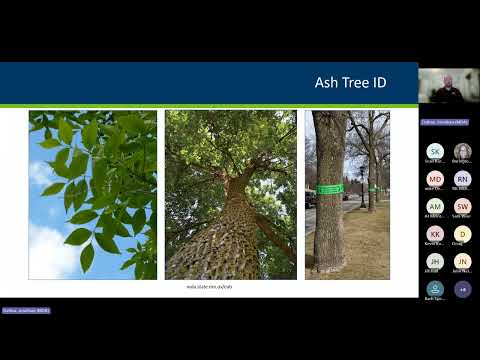
Jonathan Ostos, Emerald Ash Borer technical assistance coordinator for the Minnesota Department of Agriculture’s (MDA) Plant Protection Division, held a virtual informational meeting after the recent detection of emerald ash borer (EAB) in Itasca County and reviewed what residents and land managers should look for, how the state is regulating movement of potentially infested material and options for managing trees.
The meeting laid out why the discovery matters: EAB is an invasive metallic wood-boring beetle that has killed large numbers of ash trees across North America and now occurs in much of Minnesota. Ostos said the MDA has added an emergency quarantine around the new find to limit human-assisted movement of ash wood, firewood and mulch and described how landowners, communities and businesses can detect infestations and respond.
EAB life cycle, host trees and detection Ostos summarized EAB biology and detection: adults typically emerge in late spring to summer, and the agency tracks emergence using growing degree days (about 450 GDD with a 50°F base). Females lay roughly 60 to 90 eggs; larvae feed under the bark in S-shaped galleries that disrupt water and nutrient transport and eventually girdle mature ash trees. In Minnesota the pest can have a one- or two-year life cycle depending on climate, and populations often reach damaging levels within several years after establishment.
He emphasized the most reliable field signs: the S-shaped larval feeding galleries under the bark and larvae with two small spine-like projections near the tail end. Surface signs that help people detect EAB from the ground include woodpecker “blonding” (patches of removed bark),…
Already have an account? Log in
Subscribe to keep reading
Unlock the rest of this article — and every article on Citizen Portal.
- Unlimited articles
- AI-powered breakdowns of topics, speakers, decisions, and budgets
- Instant alerts when your location has a new meeting
- Follow topics and more locations
- 1,000 AI Insights / month, plus AI Chat