Get Full Government Meeting Transcripts, Videos, & Alerts Forever!
Get email alerts on the Police Accountability topic
No spam. Unsubscribe anytime.
St. Mary's County oversight board reviews PERF study on Maryland Police Accountability Act, flags data and cost gaps
Summary
St. Mary's County Police Accountability Board members reviewed a Phase 2 Police Executive Research Forum study on implementation of the Maryland Police Accountability Act of 2021, which PERF said showed inconsistent reporting, potential lower sustain rates under the PAA versus the LEOBR and significant trial-board costs in some jurisdictions.
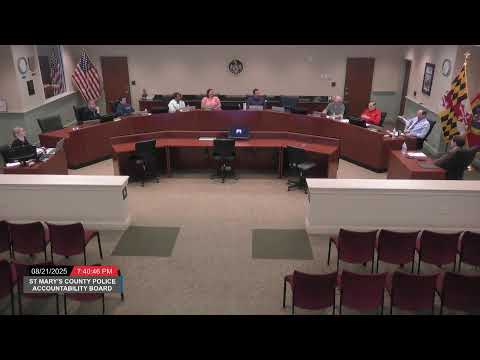
St. Mary's County Police Accountability Board members reviewed a Phase 2 study from the Police Executive Research Forum (PERF) on Aug. 21, 2025, that examined how the Maryland Police Accountability Act of 2021 (PAA) has been implemented across the state and identified inconsistent data, unclear statutory definitions and significant fiscal strain tied to trial boards.
Board Chairman Nick Cromwell opened the new-business discussion by introducing the PERF report, which PERF designed to answer whether officers are charged and disciplined more often under the PAA versus the Law Enforcement Officers' Bill of Rights (LEOBR), whether disciplinary outcomes are more severe, whether trial boards are more likely to sustain charges and whether existing timelines and resources allow Administrative Charging Committees (ACCs) to meet statutory deadlines.
John Houser, county deputy attorney, who summarized PERF's Phase 2 findings for the board, said, “the data that PERF came up with was spotty and inconsistent at best.” Houser described key caveats PERF flagged: jurisdictions record different event types, use different names and classifications for allegations and outcomes, and many PAA cases remained unresolved in the dataset PERF received. Houser said PERF excluded Baltimore City as an outlier in several measures because it accounted for a disproportionate share of statewide cases and would distort statewide rates.
PERF's preliminary numeric comparisons in the dataset it reviewed showed a lower sustain rate under PAA than under LEOBR (about 22% sustained under PAA versus about 32% under LEOBR), and lower documented rates of termination and suspension under PAA (PERF's sample showed terminations of roughly 1% under PAA compared with 12% under LEOBR, and suspensions about 8% under PAA versus 18% under LEOBR). PERF and county staff repeatedly cautioned these figures are provisional and limited by incomplete reporting.
The study also flagged trial-board resourcing as a statewide problem. PERF reported that trial boards are costlier and harder to staff under the PAA — PERF estimated a Baltimore City trial board can cost about $17,000 each and said some jurisdictions expect hundreds of potential trial boards annually, producing sizable unbudgeted costs. Houser summarized PERF's fiscal recommendation: the state should assess the financial impact of PAA implementation and consider funding or other mitigation strategies for jurisdictions that face material new costs.
Board members discussed PERF's recommendations that the state adopt uniform data definitions and reporting requirements so counties can be compared and aggregated reliably. Houser said PERF proposed a set of roughly 30 discrete data points and uniform naming conventions jurisdictions should track.
Discussion turned to complaint intake and the statutory standard for complaints. Cromwell noted a statutory provision cited during the meeting — described by board members as "3-101" in the discussion — that, in the board's view, requires a complaint to identify the officer, describe the alleged facts and provide a complainant contact. Several board members and Sergeant Ray of the sheriff's office raised concerns about an observed increase in complaints they characterized as frivolous or intentionally delay-inducing because, under the PAA, complainants are not required to swear to their statements. Sergeant Ray said, “there's no recourse for our agencies, and these people can sit there and then and expend an enormous amount of time and effort and resources for our agencies, for our ACC, for our PAB.”
Members proposed options for the board's annual report to the county commissioners including asking lawmakers in Annapolis to revisit whether unsworn or anonymous complaints are creating predictable burdens; suggested process changes such as a short "cooling-off" period for complainants (two to five days) before investigations proceed; and discussed operational steps like stricter intake checks for the statutory three required complaint elements. County legal staff cautioned that refusing complaints for a missing data element could conflict with the statute's intent and risk optics that the board was turning away complainants.
Why this matters: Board members said inconsistent statewide reporting and unresolved cases limit any definitive conclusions about whether the PAA has led to more or less accountability. Local relevance: Saint Mary's County board members noted the county has had no trial boards to date and described local recordkeeping and body-worn camera practices as working more smoothly than in larger jurisdictions, but they said statewide data and funding gaps could still affect county operations.
Board members asked staff to consider PERF's recommendations in the board's forthcoming annual report to the commissioners and to propose specific items staff could include in a November draft for the board's December sign-off.
Sources: discussion and case counts summarized by county deputy attorney John Houser, comments from Sergeant Ray and remarks by Police Accountability Board Chairman Nick Cromwell during the Aug. 21, 2025 meeting.