Get Full Government Meeting Transcripts, Videos, & Alerts Forever!
Get email alerts on the Cannabis Regulation topic
No spam. Unsubscribe anytime.
Planning commission deadlocks on recommendation for cannabis microbusiness at State Highway 16 parcel
Summary
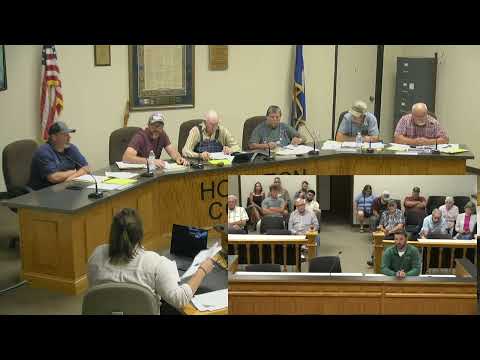
The Houston County Planning Commission split on whether to recommend approval of an interim use permit for a cannabis microbusiness in Houston Township, ultimately failing to forward a recommendation on a tie vote after proposing conditions aimed at limiting odor and securing the site.
The Houston County Planning Commission split on a recommendation to the County Board over an interim use permit application for a cannabis microbusiness proposed on State Highway 16 in Houston Township. The application sought permission for a cultivation-focused microbusiness (no retail) in the Agricultural Protection District.
Applicants and presentation Applicants listed in the notice were Seth Brown and Doreen Keenan; at the hearing presenters identified themselves as Dorian (applicant representative) and Seth. They described the business name as Greenhub and said they would focus on cultivation in secure greenhouses rather than retail. The applicants proposed three 10-by-20 greenhouses (about 600 square feet total) in their initial plan, said they would collect rainwater for irrigation, and described multiple security features including layered entry/airlock zones and third-party monitored cameras. They also proposed carbon filtration on greenhouse exhaust to reduce odor.
Public concerns and staff review Multiple neighbors and residents spoke in opposition or raised concerns about the location: odor control, security fencing, visibility from Highway 16, flood risk and drainage, and whether the small, narrow parcel and required setbacks made the site appropriate for structures. Staff said the parcel contains a limited building envelope largely within mapped floodplain; staff reported prior discussions with the DNR that characterized the area as flood fringe (allowing certain raised structures with elevation and fill standards) but noted survey and building-permit level review would be required to set final elevations and any fill required.
Commission discussion, conditions and votes Planning commissioners held a roll-call vote on the required findings of fact; the roll call passed for the findings (individual yes/no recorded on the record). The commission then discussed and proposed five additional conditions intended to mitigate neighborhood concerns: requiring carbon filtration on greenhouse exhaust, planting and maintaining odor-masking plants (examples cited: lavender, calendula, basil), an eight-foot perimeter security fence with angled barbed top and locked gate around the grow area, and other standard compliance language. When commissioners voted on the recommendation motion — to forward a recommendation of approval to the County Board with the stated five conditions — the vote resulted in a tie and the motion failed (the commission did not forward a recommendation to the County Board).
Key details - Applicant plan (as presented): three 10x20 greenhouses (about 600 sq ft total). Applicants said they would not conduct retail on-site and would seek state licensing from the Office of Cannabis Management (OCM) after local approval. - State and local review: staff emphasized that OCM preapproval and subsequent state inspections are part of the licensing pathway; county land-use and building-permit rules, DNR and floodplain standards, and MPCA/other regulatory requirements apply as relevant. - Neighbors’ concerns: multiple neighbors cited proximity to Highway 16, presence of a daycare in the broader area (staff said the daycare was outside statutory buffer distances), floodplain/drainage and culvert impacts, and the adequacy of the applicant’s existing security fencing.
Outcome and next steps - The planning commission approved findings of fact on the record but did not pass a recommending motion to the County Board; the recommendation failed on a tied vote. Planning staff noted the County Board can still consider an application and that applicants may revise the site plan and return for further review. The applicants also must obtain state-level OCM approval before operating.
Why it matters This decision underscores the planning commission’s role in weighing neighborhood impacts, floodplain constraints and state licensing pathways for new cannabis operations. Commissioners and neighbors focused on the location’s hydrology, long-term security and odor management rather than on the applicants’ broader business plan.
Ending note Because the planning commission did not forward a recommendation, the application may return to the commission with revised plans or the applicants may pursue County Board consideration; state OCM approval remains required before any licensed operation may open.