Get Full Government Meeting Transcripts, Videos, & Alerts Forever!
Get email alerts on the Ecological Management topic
No spam. Unsubscribe anytime.
Commission considers regenerative practices for pollinator gardens; volunteers and staff support pilot with Be Happy Lands
Summary
Open Space commissioners and volunteers discussed expanding regenerative land stewardship in county pollinator gardens, seed harvesting and mechanical weed control at Down Valley; a local consultant, Katrina Blair of Be Happy Lands, offered a low-cost consulting option and the group discussed piloting her methods at Mill Creek Park.
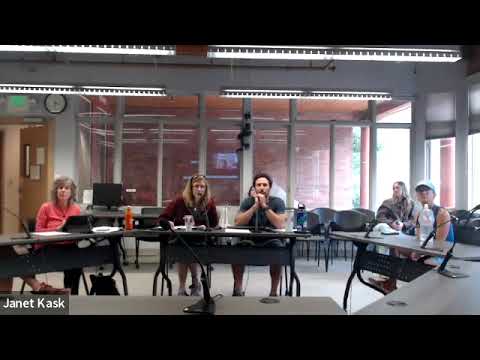
During the July 28 meeting San Miguel County Open Space commissioners and volunteers discussed whether to adopt regenerative land-stewardship methods for pollinator gardens across county open spaces and to pilot those methods at Mill Creek Park.
Jacqueline “Jack” Hudson, a volunteer who helps manage the Down Valley Pollinator Garden, described mechanical weed removal practiced at that site and the garden’s weekly care. “I control my weeds mechanically... I pull them, and I get as much root system as I possibly can,” Hudson said. Participants said the Down Valley Garden currently covers roughly 7,500 square feet and that volunteer seed-harvests are used to reseed other local trails: staff reported seed collected at Down Valley was used to reseed the Idarado Legacy Trail.
The commission reviewed a proposal and informational letter from Katrina Blair of Be Happy Lands, which practices what participants called regenerative methods including biochar, mulching and selective seed collection. Blair was described as offering consulting at a modest fee — “maybe, like, a two-hour consultant job would be, like, $250” — and larger crew work for towns at higher cost; commissioners asked staff to request a formal proposal and to consider a pilot program.
County staff and volunteers discussed the limits of nonchemical management. Julie (county staff member) described an integrated-pest-management approach in which some noxious weeds still require herbicide in certain scenarios but emphasized care around pollinator areas. “I do put out signs when I'm applying herbicides at the park,” Julie said. She noted that signage and even roping are used but that members of the public sometimes ignore posted warnings.
Volunteers and staff outlined practical composting rules and weed disposal precautions discussed at the meeting: plant material that has gone to seed (for example, mature whitetop/hoary cress seed heads) should be placed in trash rather than compost; immature leafy material can be composted. Participants discussed opportunities for education — labeling species in the garden and opening structured site visits — so residents can replicate native-plant techniques at home.
The commission asked staff to solicit a written proposal from Be Happy Lands for either consulting time or a workday, and discussed a staged pilot for Mill Creek Park if the county chooses to test regenerative methods in a small area before broader adoption.
Ending: Staff will request a formal proposal from Be Happy Lands and return recommendations to the commission; volunteers will continue seed-harvest and mechanical-control work at Down Valley while the county considers a pilot program.