Get Full Government Meeting Transcripts, Videos, & Alerts Forever!
Get email alerts on the Public Safety topic
No spam. Unsubscribe anytime.
Monroe County Fire Rescue updates board on TraumaStar billing, collections and new helicopters; county recovering about half of air transport charges
Summary
Monroe County Fire Rescue briefed the Board of County Commissioners on Aug. 20 about TraumaStar — its air‑ambulance program — reporting new helicopters are arriving, that fiscal 2023‑24 collections recovered roughly half of billed air transport charges, and that federal reimbursement limits and the No Surprises Act constrain revenue recovery.
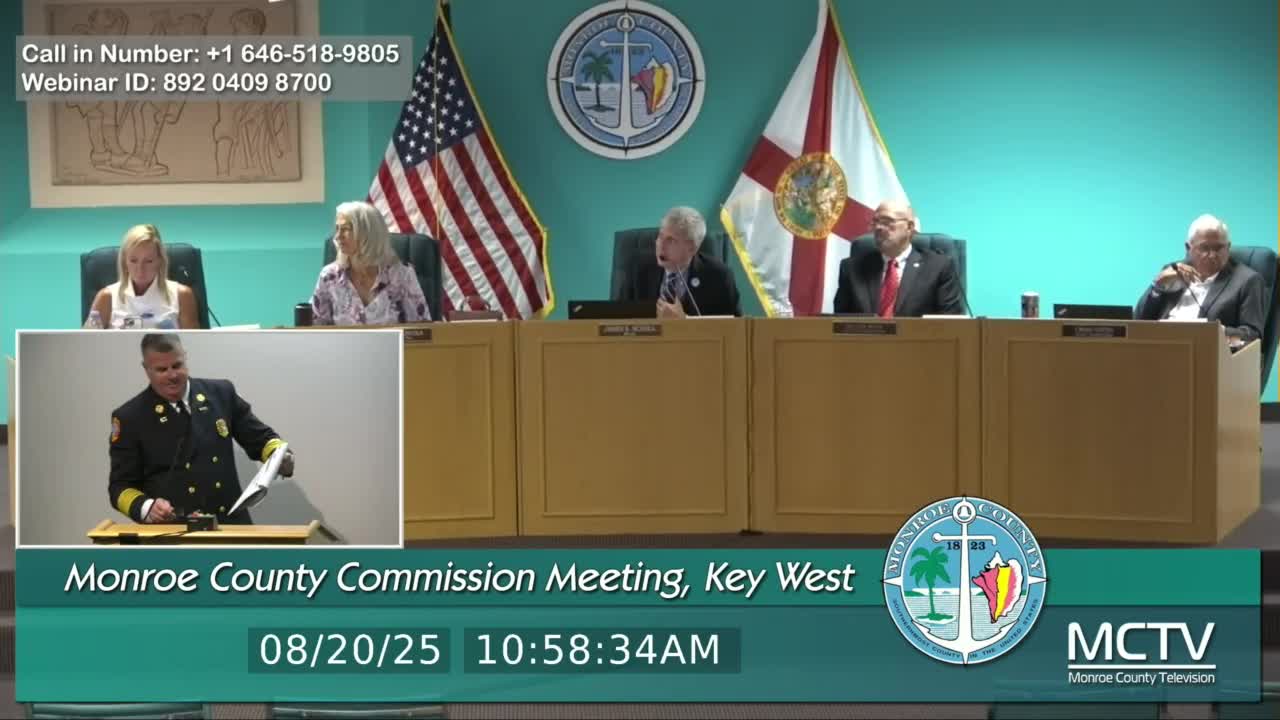
Monroe County Fire Rescue on Aug. 20 updated the Board of County Commissioners on TraumaStar air ambulance operations, billing and collections and an ongoing program to replace aging helicopters.
Most urgent operational news: the Sheriff’s Office confirmed delivery of the first replacement helicopter is expected imminently (flight originating from Philadelphia); two more aircraft will arrive in the coming weeks and months. Fire Rescue said the new fleet should increase flight availability and reduce maintenance downtime caused by the aging Sikorsky aircraft the county has been using.
Billing and collections: Chief and Fire Rescue billing staff walked commissioners through TraumaStar’s billing mix and the legal and contractual limits on reimbursement. In fiscal year 2023‑24 the county billed approximately 798 flights. Payers included Medicare/Medicaid/managed Medicaid (~59% of flights), commercial insurers (~13%) and the remaining mix of indigent/self‑pay/active billing cases. Chief reported a county recovery rate of roughly 51% for TraumaStar revenue in recent years, above the national average benchmark noted in their briefing (33.7%). Recovery varies greatly by payer: Medicare/Medicaid reimburse at fixed statutory rates (e.g., Medicare liftoff and mileage formulas; Medicaid rates are lower), managed care varies, and private commercial carriers typically reimburse a higher share (often 60–75% on average) but are negotiated or disputed case by case.
Legal limits and collection challenges: the county emphasized constraints that limit collections: (1) Medicare and Medicaid statutory rates are fixed and do not increase if the county raises its billed charges; (2) the federal No Surprises Act (effective 2022) bars balance billing of patients who have private insurance for air ambulance services in many cases and limits the county’s ability to recover additional amounts from patients after insurance denial; and (3) indigent and homeless patients often lack recoverable assets or addresses. To bolster cash recovery the chief told the board Monroe County in‑house billing efforts benchmark above national performance and that collection staff are supported by a private collection firm for difficult accounts.
Financial detail and examples: the chief presented sample amounts used in county billing: the county’s standard liftoff charge was listed at about $12,000 and per‑mile charges were shown on example flights (example totals reached ~$19,000). Medicare/Medicaid reimbursement examples showed much lower effective proceeds (e.g., Medicare partial reimbursement and Medicaid far lower than billed). The chief said that, overall, approximately 44.4% of billed amounts are realistically recoverable on a national average because of payer mix and legal limits; the county’s in‑house recovery performance was described as about 51%.
Policy and program actions: Fire Rescue will (a) evaluate its current Certificate of Public Convenience and Necessity (COPCN) approvals and renewals to make sure providers in Monroe County are actively providing services at required standards; (b) seek board authorization to allow the director of emergency services to negotiate and accept periodic settlements with foreign or overseas payers where such settlements are deemed appropriate rather than litigate; and (c) evaluate service demand over the upcoming 12 months after the new helicopters enter service to determine longer‑term fleet needs and budget impacts.
Training and workforce note: the chief also reported a planned Fire Academy class; the Department opened three testing dates and had 90 applicants — the department expects to fill a typical 30‑student academy class and to offer an expanded cohort if applications warrant sufficient qualified candidates.
What the board asked: commissioners asked about how air vs. ground transport decisions are made (on‑scene paramedics/crew or hospital physicians decide depending on patient condition and destination) and whether private contractors choose patients selectively. Staff said hospital physicians and on‑scene clinicians determine transport mode; Fire Rescue will follow up on whether private hospital transport providers decline specific patients.
Next steps: Fire Rescue will return with a formal evaluation after the new rotorcraft are in service and will present a COPCN and contract compliance report as staff continues auditing COPCN holders.