Get Full Government Meeting Transcripts, Videos, & Alerts Forever!
Get email alerts on the Housing Policy topic
No spam. Unsubscribe anytime.
County eliminates 1-for-1 exchange for early‑evacuation ROGO units; board reserves remaining allocations with Lower‑Keys set‑aside
Summary
Monroe County eliminated the 1‑for‑1 exchange rule for the governor’s early‑evacuation workforce ROGO allocations and directed that at least 107 of the remaining 214 early‑evacuation allocations be allocated to projects in the Lower Keys; commissioners then reserved units for several specific projects under the new rule.
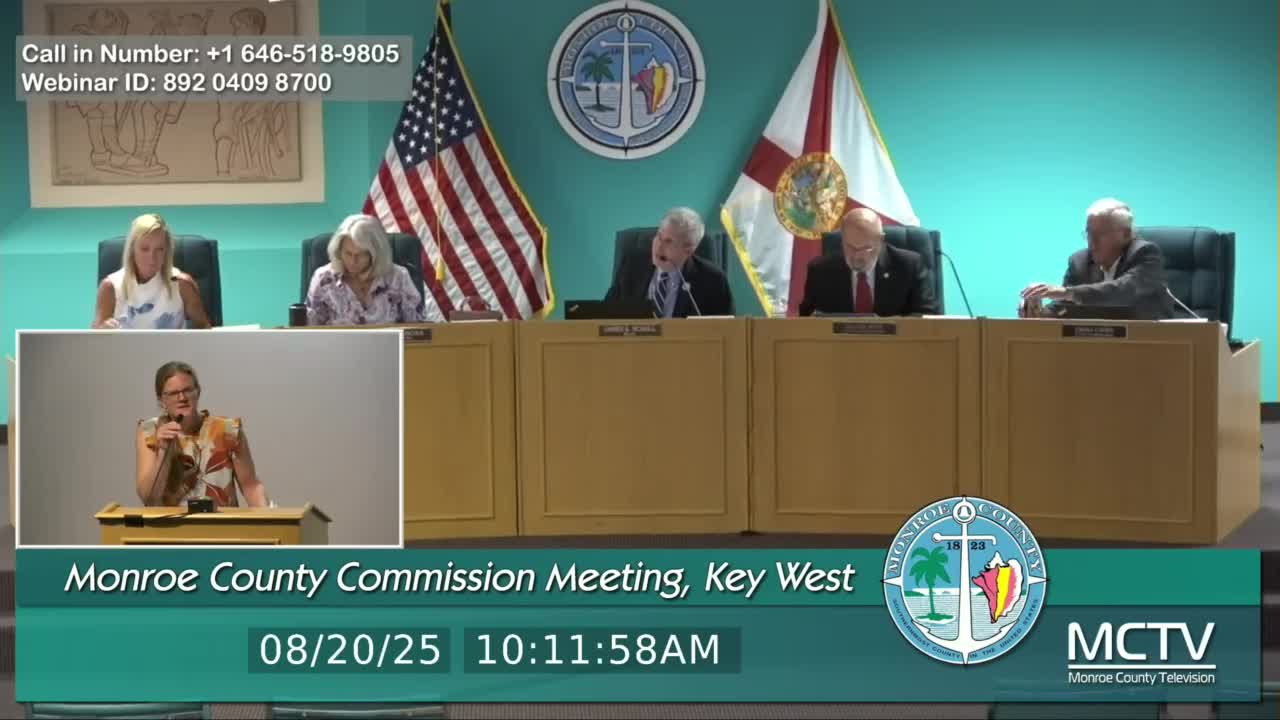
The Monroe County Board of County Commissioners on Aug. 20 adopted amendments to the Comprehensive Plan and Land Development Code that remove the county’s 1‑for‑1 exchange requirement for the governor’s early‑evacuation workforce housing ROGO allocations and set a local distribution requirement for the remaining allocations.
Key change: Commissioners removed the exchange mechanism that previously required early‑evacuation ROGO allocations to be used only by swapping with existing allocations on built or permitted projects. The amendments instead allow early‑evacuation allocations to be awarded directly to new projects subject to deed restrictions and other conditions already in code. The Land Development Code change mirrors the Comprehensive Plan change and adds certainty about on‑site management signage and an exception for government‑owned or housing‑authority developments.
Distribution rule: To preserve access across the county, the BOCC also required that at least half of the remaining early‑evacuation allocations — 107 of the 214 still available — be distributed to projects in the Lower Keys sub‑area (this includes county and incorporated jurisdictions in the Lower Keys when the county transfers units under the policy). The board directed staff to reflect that requirement in both the Comprehensive Plan footnote table and the Land Development Code tables.
Votes and reservations: With the new policy in place the board approved several specific reservations on Aug. 20: - 19 early‑evacuation units reserved for a Marathon project (j12), - 19 reserved for the county‑proposed TDC housing project (j13), - 28 early‑evacuation units were not needed at the county’s recently purchased South Cliff Estates; those 28 units will be reclassified as non‑early ROGO and the board reserved the 28 non‑early units for future county use in the Lower Keys (j14), - 2 early‑evacuation units were reserved for a private mixed‑use project that must meet inclusionary requirements (j15), and - 79 early‑evacuation units were reserved for a Key Largo project proposed by Gorman & Company; staff recorded that, following the board’s Lower‑Keys allocation requirement, the county will have 67 remaining early‑evacuation allocations for the Lower Keys after the approvals.
What it means: The policy change shortens the path for projects to use early‑evacuation ROGO allocations and directs the county to prioritize at least half of the remaining pool for the Lower Keys — a response to board concerns about housing availability where tourism jobs are concentrated. Staff told commissioners the changes will move some units to new projects rather than require existing project swaps and that procedural language about on‑site management and government‑owned housing was clarified to allow alternate enforcement when a jurisdiction or housing authority operates the units.
Next steps: Staff will transmit the adopted Comprehensive Plan amendment to the state land planning agency as required, and will return the Land Development Code text for final local adoption consistent with the transmitted Comprehensive Plan changes. Staff will also update reservation records and deed‑restriction templates to reflect the board’s Lower‑Keys set‑aside and the land‑use and enforcement clarifications.
Limitations: Each reserved allocation requires eventual permitting and compliance with deed restriction, management, evacuation procedures, and affordability terms. Several reservations included financing and construction contingencies; staff will continue to monitor pro forma and financing outcomes for the projects that received reservations.