Get Full Government Meeting Transcripts, Videos, & Alerts Forever!
Get email alerts on the Board Communications topic
No spam. Unsubscribe anytime.
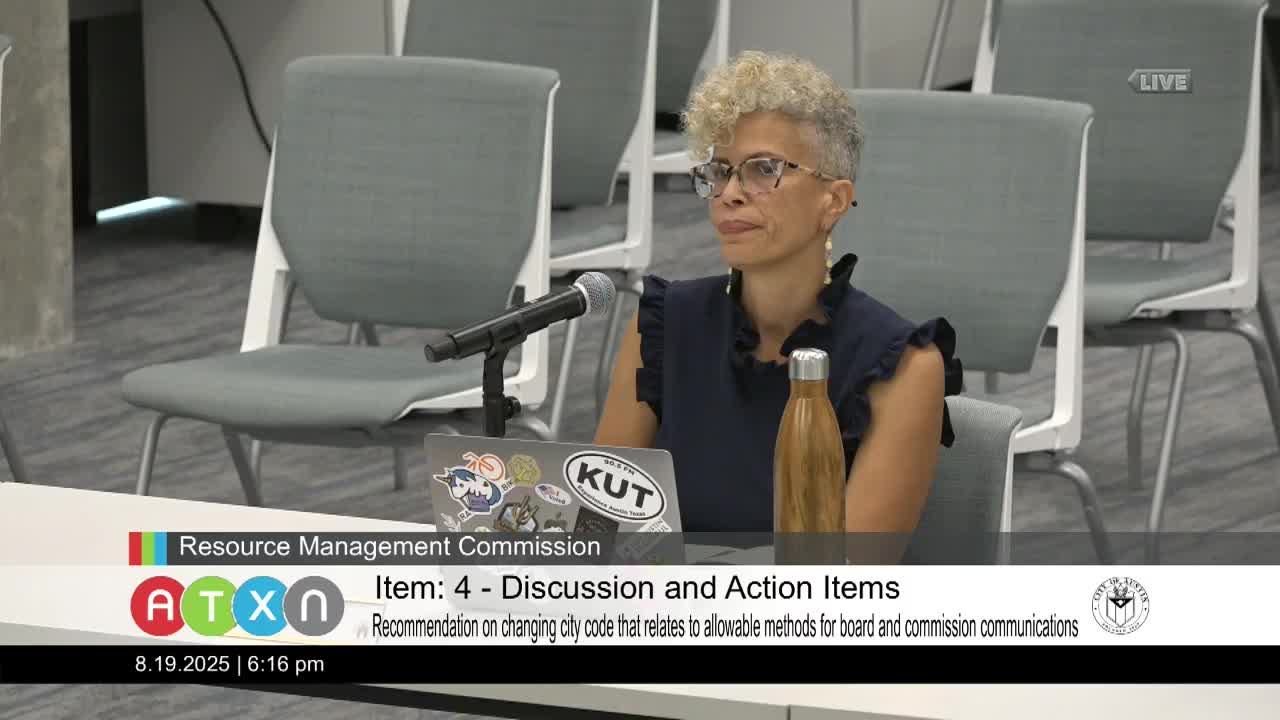
Commission recommendation to let staff email commissioners’ personal addresses fails 5-1
Summary
A proposal asking City Council to change city code to allow communications to and from commissioners’ personal email addresses failed 5-1 after commissioners debated record-keeping and public-records concerns.
The Resource Management Commission considered and rejected a recommendation asking City Council to change city code so staff communications to volunteer board and commission members could be sent to both official city email addresses and personal email addresses.
Commissioner Silverstein introduced a near-copy resolution previously adopted by the Electric Utility Commission asking that staff be permitted to send communications to personal email addresses as well as city accounts. “I have a heck of a time remembering to look at my city email,” Silverstein said, citing difficulties with the city email login process.
Commissioner Zagan said the idea sounded useful but asked whether making emails public in real time could avoid quorum problems. The staff liaison and legal counsel cautioned that Texas open-meetings rules and discovery requirements limit how board communications may be conducted; legal counsel said the issue implicates the Texas Open Meetings Act and noted commissioners had signed an agreement to use city email accounts.
When the commission voted on the recommendation (the “be it resolved” language asking council to allow communications to both official city and personal addresses), five commissioners voted in favor and one voted opposed; the motion failed 5-1. Commissioner Geary explained her no vote by saying city email accounts are set up to protect commissioners and to ensure public-record handling of requests for communications. “I’d rather keep it separate,” she said, adding that city email makes records retrieval straightforward.
Commissioners discussed possible compromises, including an opt-in approach that would allow individual commissioners to provide a personal address if they chose to do so. Several commissioners asked staff liaison Natasha Goodwin to consider operational alternatives such as calendar invites or reminders that surface material posted to city accounts. The Electric Utility Commission has already sent a similar recommendation to City Council; changing practice would require a city ordinance amending the usage agreement commissioners signed.
Why this matters: the discussion centered on balancing convenience for volunteer members with public-records requirements and open-meetings constraints. Commissioners asked staff to explore less intrusive reminders and process options while noting any change to email practice would require a council ordinance.