Get Full Government Meeting Transcripts, Videos, & Alerts Forever!
Get email alerts on the Water Infrastructure topic
No spam. Unsubscribe anytime.
NJDEP urges Trenton to explore regional water authority; council, residents push back
Summary
Trenton City Council held a special Aug. 18 meeting at which New Jersey Department of Environmental Protection Commissioner Sean LaTourette said independent assessments find Trenton Water Works at high risk of systemic failure and recommended a public, multiyear study to explore restructuring the system as a regional public utility.
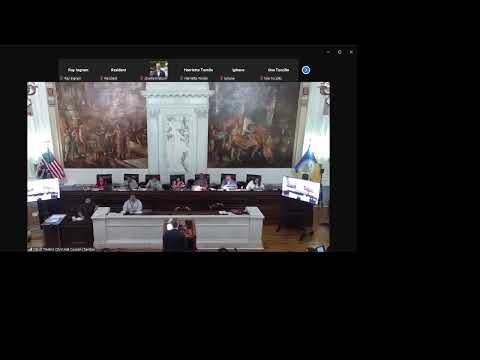
Trenton City Council held a special meeting Aug. 18 to hear New Jersey Department of Environmental Protection Commissioner Sean LaTourette outline the department's findings about Trenton Water Works and to answer questions from council members and residents.
LaTourette told the council the DEP had concluded, based on multiple independent assessments, that Trenton Water Works “is at an extremely high risk of systemic failure” and that the city “cannot repair” the system by itself. He said those third-party reviews recommend exploring restructuring Trenton Water Works as a public, regional utility and proposed a roughly 18–24 month public process to evaluate options, including extensive community engagement and a steering committee of local leaders. “I am not here to fight with you,” LaTourette said. “I’m here to collaborate with you.”
Why it matters: LaTourette and DEP staff framed the proposal as a voluntary, democratic exploration intended to identify governance, technical and financial approaches that could stabilize the system long-term. DEP officials said the agency has been providing stabilization support — including contractors and limited equipment at state expense — but that state help alone is not a durable solution. Independent reports cited by LaTourette list decades of recurring compliance and capital problems, and the assessments found that a restructured public utility could be technically and financially sustainable if properly governed and capitalized.
Key facts reported at the meeting
- Assessments and enforcement history: LaTourette summarized a history of citations and enforcement activity dating back to 2009 and noted enforcement actions in 2013, 2014, 2017 and 2018, plus litigation the agency initiated in 2020. DEP has procured three outside evaluations referenced at the meeting: a technical/managerial/financial (TMF) capacity assessment, a 360-degree governance review and an engineering-focused comprehensive performance evaluation; council members were told the engineering evaluation was not yet complete. LaTourette said the assessments concluded the system lacks sufficient technical, managerial and financial capacity in its current form.
- Current water quality vs. systemic risk: DEP staff told council members that recent sampling shows Trenton’s tap water meets regulatory standards "in this very moment," but LaTourette and other DEP staff emphasized the distinction between isolated sampling results and sustained, reliable compliance across operations, monitoring and long-term capital investment. “The question is not about the water quality in this very moment,” LaTourette said; he added the agency’s concern is the system’s ability to maintain that standard consistently.
- Proposed public process: LaTourette described a two-year, public-facing process DEP recommends to explore regionalization. Steps would include a steering committee of elected and staff representatives from Trenton and neighboring jurisdictions; a comprehensive needs assessment (assets, liabilities, valuation); evaluation of governance and operational models; and financial planning tied to capital and operating priorities. DEP officials said the process would include town halls, a project website, surveys and other community outreach tools.
Council, staff and resident reactions
Council members and waterworks staff repeatedly pushed back on the notion that regionalization is a foregone conclusion and said they were surprised by the tone of recent DEP correspondence and media statements. Council members demanded clarity about what regionalization would mean for local control, jobs, bond revenues and the city’s ability to capture water‑utility income that currently supports city services.
Trenton Water Works employees and managers — including Director Sean Semple, plant supervisor Tayah Brown Humphrey and chief chemist Daisha (Diasia) Brooks — spoke at length about on‑the‑ground improvements, ongoing training programs and steps already taken to stabilize operations. Semple asked what would happen to the system during a multi‑year study and urged clarity about near‑term protections for the plant’s workforce and operations.
Residents who spoke at public comment also opposed loss of local control. Several said regionalization felt like a thinly veiled attempt to transfer Trenton’s publicly owned utility to outsiders, and speakers repeatedly invoked the 2010 referendum that blocked a sale to a private company. Others urged the council to pursue additional state and federal funding instead of governance change.
Formal action during the meeting
The council unanimously approved Resolution 25‑313, an application to the Local Finance Board requesting permission to exceed the municipal appropriations cap by $12,603,064.03 so the city can appropriate needed funds in the coming budget cycle. Assistant Business Administrator Colin Cherry explained to council that the application is meant to allow the city to use appropriations beyond the cap and that, according to city staff, approval would not increase municipal property taxes for Trentonians. The motion was moved by Councilwoman Feliciano, seconded by Councilwoman Figueroa Kettenberg, and passed by roll call vote (Edwards, Feliciano, Figueroa Kettenberg, Frisbie, Harrison, Williams, Gonzales — all voting yes).
What DEP said it could and could not do
LaTourette repeatedly said DEP seeks to be a partner and that the agency’s role is regulatory and supportive, not to “take” the waterworks. DEP staff said they have used state funds for emergency stabilization, have had staff on site and have solicited technical contractors at state expense; they also said some funding programs require the utility to demonstrate eligibility and submit timely applications. LaTourette said the regional model could improve the utility’s ability to attract financing (for example, by separating water utility debt from the city’s general obligation debt) but that any governance model would have to be defined through the proposed public process and approved by the affected communities.
Questions left open
Council members asked for a full listing of DEP‑funded stabilization work and a clear explanation of what, if any, capital appropriations the state would provide directly. Multiple council members and residents asked what protections would exist for Trenton workers and for the city’s ability to retain revenue streams and oversight if regional governance were pursued.
Council next steps and public engagement
Council members said they will continue to review the TMF and 360‑degree reports distributed to the city and requested the (not‑yet‑finished) engineering/performance evaluation when it is complete. LaTourette said he will remain available and that the DEP would participate in the public engagement if the city opts to pursue the DEP‑recommended study. The council also advanced the budget‑related Resolution 25‑313 during the same meeting.
Ending note
The meeting made clear the political and practical stakes of any change to Trenton Water Works: DEP officials urged a deliberative, publicly visible process to explore options; council members and many residents insisted they will defend local control and seek hard assurances about jobs, revenues and governance before supporting any structural change. The DEP and the city agreed to keep talking.