Get Full Government Meeting Transcripts, Videos, & Alerts Forever!
Get email alerts on the Governance topic
No spam. Unsubscribe anytime.
Portland council deadlocks on committee-structure overhaul; several amendments fail
Summary
The Portland City Council continued debate on reorganizing its committee structure but failed to pass motions to table or amend the proposal. Multiple amendments — including reductions to four committees and changes to chair assignments — were rejected in roll-call votes.
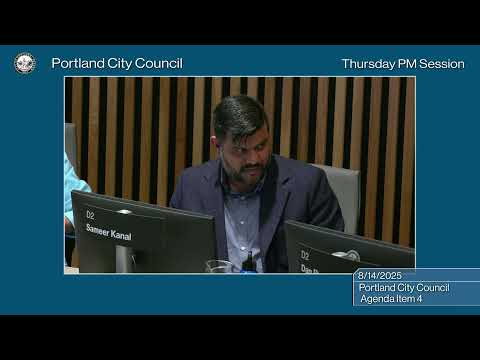
The Portland City Council continued its special meeting on Aug. 14 to finish consideration of a resolution to change the council's committee structure, but councilors were unable to reach agreement on major reforms and rejected several amendments by recorded votes.
Councilor Ryan urged a "bold reset" of priorities and described the proposal as a way to "land a unified focused plan" with measurable targets. Council President (presiding officer) told colleagues she views committees as "a critical piece of the work we do" but said any changes "need to be changes that we can all feel will move us to a better place." The meeting was a continuation of an agenda item started the previous day; the council had one item on today’s agenda: the committee-structure resolution.
Why it matters: Council procedure determines how the body divides policy work, conducts oversight and schedules public meetings. Reform supporters argued fewer, better‑focused committees or a committee of the whole could streamline work and reduce staff burden. Opponents said the proposals risked omitting important subject-matter forums (notably climate and homelessness) or creating procedural instability during a transition year.
Most contested points were whether to reduce the number of policy committees from five to four, where to place homelessness and climate work, whether chairs should be guaranteed by district, and whether the vice president or council president should have prescribed committee roles. Councilors described trade-offs between concentrated oversight, staff workload and preserving standing venues for technical land-use and budget reviews.
Council action at a glance: The council considered — and rejected — multiple procedural and substantive motions during the session. A motion to "lay the matter on the table" failed in a roll-call that resulted in 5 yes, 6 no and 1 absent, returning the body to debate. A proposal to move from five to four committees (an amendment titled in proceedings as the "Pearl Guinea" amendment) failed on a roll-call vote, 2 yes and 10 no.
Three amendments filed by Councilor Dunphy that would have (a) guaranteed each district at least one policy-committee chair, (b) required the vice president to chair one policy committee, and (c) limited service and chairing patterns for the president and other councilors were each rejected in roll-call votes. Recorded outcomes: Dunphy amendment b failed (3 yes, 9 no); Dunphy amendment c failed (1 yes, 11 no); Dunphy amendment d failed (2 yes, 10 no).
Council debate reflected a wide range of views. Councilor Clark and others urged patience and a pause so the council could return after its two‑week recess to develop consensus. Councilor Murillo and others opposed combining climate and housing without guarantees that climate work would receive sustained attention. Councilor Green proposed a separate amendment to create a Committee of the Whole to handle governance, budget and appointments; councilors asked for additional legal review and discussion before advancing that approach.
The meeting closed with the council president saying further debate would be scheduled without "unnecessary delay," and the matter was tabled for later consideration rather than finalized at this session.
Votes and formal actions recorded during the meeting are summarized below. Quotations are taken from council remarks reported in the meeting transcript.