
Adams County considers mandatory business licensing, short-term rental rules and oversight of private social clubs
Get AI-powered insights, summaries, and transcripts
Sign Up Free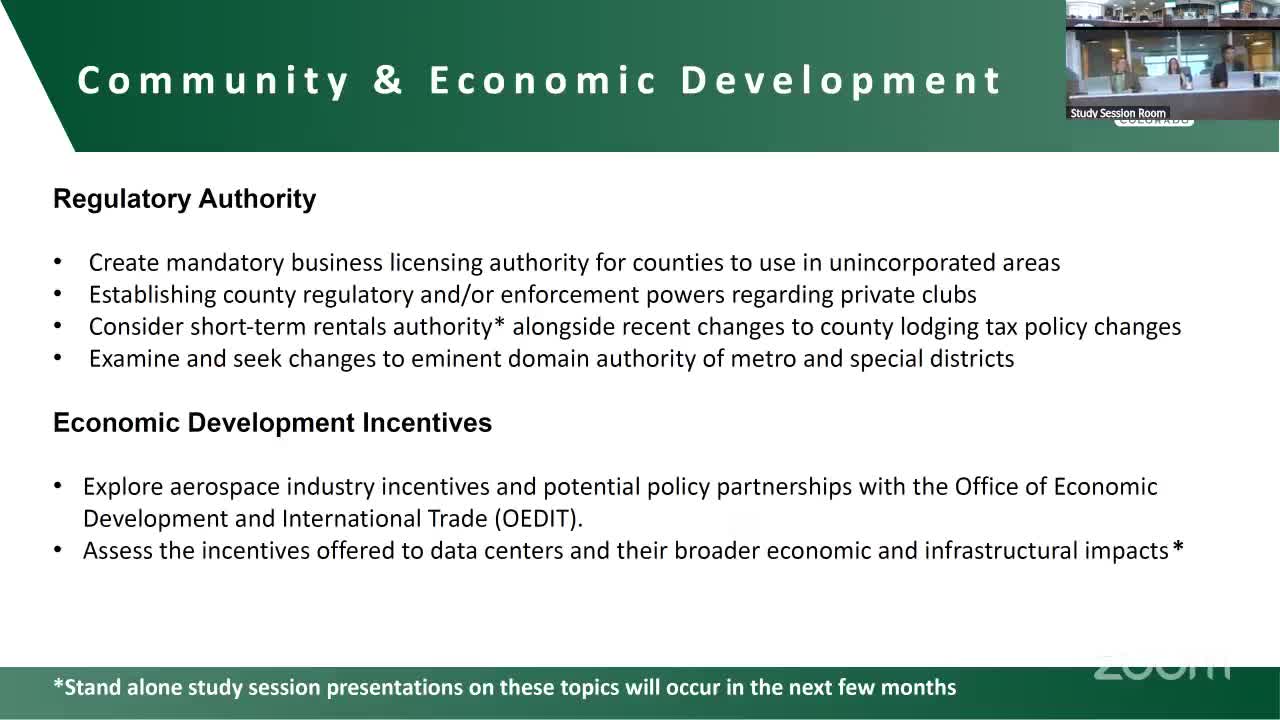
Summary
Staff presented a suite of regulatory ideas including mandatory business licensing in unincorporated areas, expanded oversight for private social clubs, and coordination of short-term rental licensing with the recently raised county lodging tax cap.
Adams County staff presented regulatory and economic development concepts and asked commissioners whether they want staff to pursue state legislation or internal county policy changes in several areas: mandatory business licensing, oversight of private social clubs, short-term rental (STR) regulation and the possibility of a county lodging tax.
Staff explained that counties lack the same statutory authority as municipalities to require mandatory business licensing. The presentation framed mandatory licensing as a tool to improve regulatory compliance, create a comprehensive business registry and increase consumer protection in unincorporated areas. Staff cautioned that implementing mandatory licensing would create administrative costs and could draw opposition from business groups or municipalities.
On private social clubs (sometimes described in the meeting as “private” or “gentlemen’s” clubs), staff told commissioners that counties lack clear inspection and licensing authority over clubs that claim a private‑club status. The sheriff’s office has reported enforcement challenges when access requires probable cause. Commissioners asked staff to research how peer counties handle private clubs and whether business‑licensing authority or adjusted definitions for “adult-oriented businesses” would help.
Staff also tied STR regulation to the county lodging tax question. The 2023 change in state law raised the maximum county lodging tax from 2% to 6%; because Unincorporated Adams County has few hotels, staff said applying lodging tax to STRs could be a way to generate revenue, but it would require a ballot measure.
Staff recommended initial research and peer coordination through CCI and other counties, and a later, narrower conversation on which of these regulatory changes the county should pursue as legislative priorities.
Ending: Commissioners directed staff to research other counties’ approaches, refine options (including administrative cost estimates and stakeholder outreach plans) and return with recommendations for whether to pursue statutory changes or county-level policy actions.