Get Full Government Meeting Transcripts, Videos, & Alerts Forever!
Get email alerts on the Landfill Methane Rng topic
No spam. Unsubscribe anytime.
Reno County approves agreement with Meadowlark to capture landfill gas for renewable natural gas
Summary
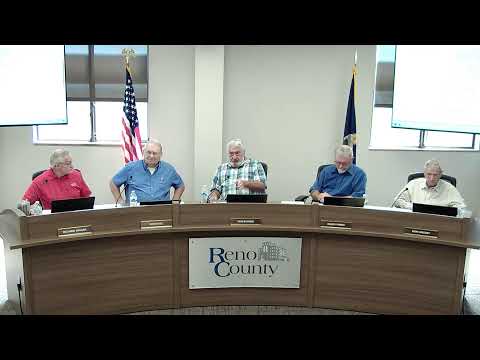
Reno County commissioners unanimously approved an agreement with Meadowlark to capture methane and other recoverable gases from the county landfill and route processed fuel to the regional pipeline system.
Reno County commissioners unanimously approved an agreement with Meadowlark to capture methane and other recoverable gases from the county landfill and route processed fuel to the regional pipeline system.
The agreement allows Meadowlark to design, permit, construct and operate an on-site renewable natural gas plant and related gathering pipelines on county property. County staff and Meadowlark representatives said the company will finance the project and be responsible for permitting and day-to-day operation; the county retains final approval of any plant or well-field design and requires financial security to cover site remediation if Meadowlark abandons the project.
County staff opened the agenda item by describing the project as novel for Reno County and said the county has negotiated protections into the final agreement. County staff member Patrick said the project is "a new thing. New things are always scary," and added that staff had tried to address risks through contract language and oversight provisions.
Meadowlark and its engineering contractor provided technical details. John Bolte, an engineer with Small Lehi Engineering, said the plant would be sited on roughly a three-acre lot adjacent to Clark Road and the county's existing landfill flare; the plant would "tee into" the landfill gas collection system rather than replace it, with the flare retained as a standby. Bolte described the plant as a two-stage pressure-swing adsorption system that removes hydrogen sulfide and volatile organic compounds, then reduces carbon dioxide and nitrogen to produce pipeline-quality methane. "We basically tee into that, intercept that, and then bring that new raw gas flow, into the plant for processing," Bolte said.
Meadowlark described a planned pipeline route of roughly 9,100 feet that would cross existing rights-of-way and private easements to reach a Kansas Gas Service injection point. Company representatives said the target steady-state injection flow is about 400 standard cubic feet per minute (SCFM) — roughly in the mid‑tens of thousands of cubic feet per hour — and that, once fully commissioned, the project could produce materially more than the guaranteed baseline payment in the contract.
Norman, a Meadowlark representative, told the commission the company had agreed to several changes requested by the county since a May briefing: an escalator to the guaranteed minimum payment, county control of well-field design and operation oversight, enumeration of Meadowlark responsibilities for permitting and construction, and a requirement for financial security in case Meadowlark stops work. "Meadowlark as a company would be responsible for the permitting, the construction, the operation, and the day to day management of this business on your property," Norman said.
Commissioners asked about emergency response and fire suppression. Bolte said the plant design would be coordinated with the local or state fire marshal, include emergency shutdown (ESD) systems and controls, and provide training and access plans for local fire departments. He said the planned gathering pipeline would be polyethylene (4-inch) at modest pressure to simplify crossings and to limit volumes in the event of third-party damage; a remote compressor would boost pressure at the Kansas Gas Service tie-in.
Meadowlark said the design-to-construction timeline is roughly 18 months from the start of building, subject to conditions including permits, easements, economic liability reviews and a title commitment. Meadowlark offered to brief the county on progress on a regular cadence during design and construction.
After discussion the commission voted to approve the agreement and authorized the county to sign. The vote was recorded as follows: Commissioner Parks — yes; Commissioner Vincent — yes; Commissioner Winger — yes; Commissioner Hurst — yes; Commissioner Boatner — yes.
The agreement is contractual and contingent on permits, easements and title work. County staff emphasized they will monitor compliance with state environmental requirements; Commissioner Hurst and other commissioners noted that state agencies such as the Kansas Department of Health and Environment regulate waste and air permitting and would be the authority on permit compliance.
The commission requested ongoing briefings as Meadowlark proceeds through permitting and design.
Ending: County staff said they will return to the commission with updates during the design and preconstruction phases; Meadowlark representatives said they will seek permit approvals and easements and aim to begin construction after completing the listed conditions.