Get Full Government Meeting Transcripts, Videos, & Alerts Forever!
Get email alerts on the Human Services topic
No spam. Unsubscribe anytime.
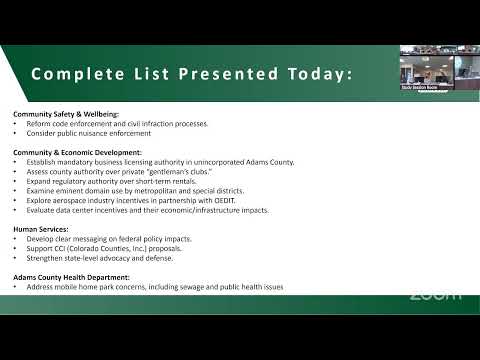
Adams County human services urges state education on HR 1 impacts; CBMS weaknesses seen as risk to benefits administration
Summary
Human services staff asked commissioners to support a defensive state advocacy push against HR 1, highlighted risks to Medicaid, SNAP and WIOA programs, and urged investment to fix CBMS to avoid inappropriate coverage losses.
Adams County human services leaders told commissioners the county must press the state legislature to understand the operational and fiscal consequences of H.R. 1 (federal reauthorization changes) and closely monitor the special session and regular session activity that could affect county-administered programs.
Staff described three main program areas at risk: Medicaid, SNAP and WIOA. They said the combination of more complex federal eligibility rules and tighter state budgets will increase county workload, potentially requiring additional training and FTE if new requirements are implemented without new funding.
County staff emphasized that some federal and state proposals will increase administrative complexity and therefore costs. They said that added complexity can harm clients: cumbersome redetermination processes and system errors can result in improper benefit terminations with long-term consequences for children and families.
A recurring topic was CBMS, Colorado’s benefits-management system. Human services staff said repeated outages and software errors raise the county’s error-rate exposure; staff framed investment in CBMS as a way to reduce improper terminations and state-level fiscal penalties under heightened error-rate scrutiny.
In preparation for the special session, staff said they will compile county-level talking points and data — including Adams County reinsurance information provided by the Department of Insurance — and coordinate with the county’s lobbyists and federal advocates. Staff also described two planned outreach events: a federal‑level workforce awareness event (late September) and an October 8 “Human Services 101” briefing for the state delegation, intended to show staff and client impacts and the fiscal streams involved.
Ending: Commissioners asked staff to proceed with legislative education and outreach, continue to compile county data for delegates, and to prioritize advocacy that avoids unfunded mandates or rushed program changes during a period of constrained state budgets.