Get Full Government Meeting Transcripts, Videos, & Alerts Forever!
Get email alerts on the Code Enforcement topic
No spam. Unsubscribe anytime.
Adams County staff to prioritize civil-infraction reforms, begin broader outreach on nuisance enforcement
Summary
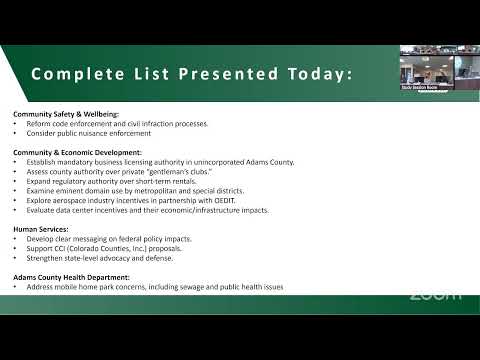
County staff recommended pursuing changes to the civil-infraction process as the top legislative priority and to begin stakeholder outreach on broader public-nuisance and prosecutorial authority for nuisance actions.
Adams County commissioners were briefed on staff recommendations to make statutory changes to the county civil-infraction process and to open stakeholder conversations about expanding nuisance-enforcement powers.
County staff told commissioners that fixing the civil-infraction statute could be a near-term, achievable change that would give code enforcement more practical tools — including clearer evidence standards, higher fines than the current $100 cap, and broader use of photographic and third‑party documentation — without immediately seeking sweeping new prosecutorial powers.
Staff emphasized that civil-infraction fixes are already the subject of proposals circulating among other Front Range counties and through the Colorado Counties, Inc. (CCI) process. One presenter said staff intends to pursue alignment with Morgan and Grand County proposals and to participate in a CCI working group if the board directs it.
Commissioners and county attorneys discussed a second, larger bucket of changes: expanding county authority over public-nuisance prosecutions and streamlining enforcement to function more like municipal systems. Staff and the county attorney team warned that expanding nuisance powers could require revising multiple state statutes, possibly producing a long, complex bill that may not be ready for the 2026 session.
Several commissioners urged a phased approach. Commissioners expressed support for pursuing the civil-infraction fixes as a first step while beginning outreach with peer counties, the district attorney's office, sheriff's office and other stakeholders to map gaps and design a longer-term approach on public nuisance enforcement. One county official framed it this way: staff should “sharpen the tools that we have” and see whether those changes reduce the need for more expansive statutory revisions.
Staff also recommended building a stakeholder meeting — including judges, the district attorney, sheriff, county attorneys and code enforcement — to identify practical gaps, coordinate responsibilities and avoid repeating past failures to enforce problem properties. Commissioners said they wanted executive-level participation in those stakeholder conversations and asked staff to pursue outreach while drafting the civil-infraction package.
County staff will return with draft language and an outreach plan to CCI and CCAT (county attorneys’ association) and expects to advance civil-infraction changes as the near-term priority while continuing stakeholder engagement on the broader nuisance enforcement topic.
Ending: Commissioners asked staff to proceed with drafting civil-infraction reforms and begin multi‑jurisdictional outreach on nuisance enforcement, with a staged strategy that aims for achievable statutory fixes first and more comprehensive changes later.