Get Full Government Meeting Transcripts, Videos, & Alerts Forever!
Get email alerts on the Stormwater Parkway Retrofit topic
No spam. Unsubscribe anytime.
Creeks Division pilots parkway stormwater retrofits; first installation cost about $6,400
Summary
Tim Burgess of the Creeks Division presented a pilot parkway retrofit designed to capture sidewalk and street runoff and described a programmatic approach for citywide low-impact-development parkway retrofits.
Tim Burgess of the Creeks Division presented the stormwater parkway retrofit program to the Sustainability Council Committee on Aug. 7, describing a pilot installation and a citywide approach to capture and infiltrate runoff in parkways (the planting strip between the sidewalk and the street).
Burgess explained the problem the program addresses: urban pavement accelerates runoff, increasing creek erosion and reducing groundwater recharge. Low-impact-development retrofits in parkways can capture sidewalk or curb runoff, boost infiltration, reduce peak flows and improve water quality by allowing soils and vegetation to process pollutants.
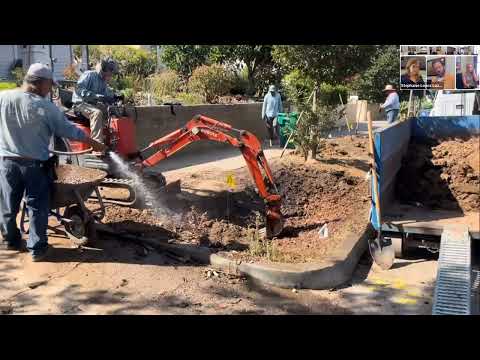
Staff presented a recently completed pilot on a wide parkway in a residential area. The construction cost for that pilot was about $6,400 (excavation, soil removal and basic grading), and staff said the excavation work was done the day before the meeting. The resident who requested the retrofit will plant the bed; the city will monitor functionality and maintain the installed infrastructure as described by staff. Burgess said the city will encourage native plants and that maintenance responsibility generally sits with the adjoining property owner per municipal code.
Staff outlined three levels of intervention: (1) remove pavement from narrow parkways and regrade to accept sidewalk runoff; (2) grade an existing, vegetated parkway to accept sidewalk runoff; and (3) larger designs that accept curb/gutter street runoff (which require more engineering and may be less scalable). Using conservative assumptions (50-foot frontage per parcel and a 5-foot parkway width), staff estimated a theoretical citywide capture potential of roughly 155 acres of sidewalk-area capture across 27,000 parcels; staff noted the median frontage is larger (66 feet) and that site constraints (utilities, trees, slopes) will affect feasibility.
Public comment included a question from Noah of Build the Ocean asking whether revegetation would be part of retrofits and whether native species would be used. Burgess said native plants are preferred and that the city would encourage them; he added the property owner is typically responsible for ongoing maintenance.
Committee members expressed support for the pilot and the program approach, noting potential benefits for groundwater recharge, erosion reduction and community demonstration. Burgess said the program's outreach will include newsletter items, social media, City TV segments and targeted neighborhood meetings, and staff will maintain a database of parkway characteristics to focus outreach where retrofits are most feasible.
This item was an informational presentation; there was no committee vote to approve a program budget or new ordinance during the session.