Get Full Government Meeting Transcripts, Videos, & Alerts Forever!
Get email alerts on the State Legislation topic
No spam. Unsubscribe anytime.
Lobbyist warns Fort Pierce commissioners that 2026 property-tax proposals could cut local revenue
Summary
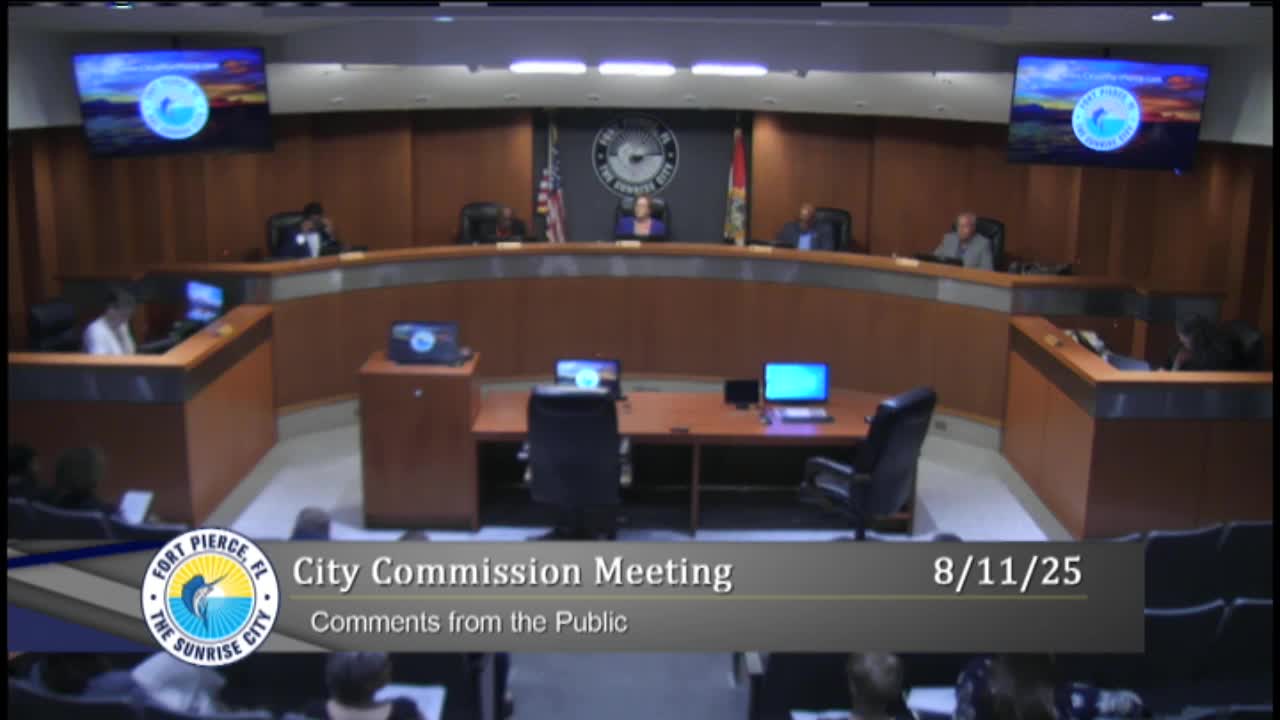
At the Aug. 11 Fort Pierce City Commission meeting, Grey Robinson lobbyist Ryan Matthews briefed commissioners on the 2025 Florida legislative session and warned that proposals in 2026 could threaten municipal ad valorem revenue and other local funding sources.
Ryan Matthews, government affairs and lobbying deputy section chair at Grey Robinson, told the Fort Pierce City Commission on Aug. 11 that while the 2025 Florida legislative session returned some appropriations to Fort Pierce, the larger political fight in Tallahassee could pose a near-term threat to local government revenue sources.
Matthews said the city secured two line‑item appropriations this year — funding for Thirteenth Street and police department support — but that the 2025 session overall was unusual and prolonged. He described a 105‑day session, friction between the governor and the legislature, and a number of high‑profile bills that failed or were vetoed. “We had 1,959 bills filed, only 269 passed,” Matthews said in his presentation, adding that “there were 2,550 appropriations in the Senate” and that the final budget contained significant vetoes.
Matthews singled out property‑tax proposals as the biggest local risk for 2026. He said constitutional amendments or other proposals under consideration could substantially reduce ad valorem revenues that fund municipal services. Matthews told commissioners that in prior modeling a wholesale elimination of property taxes would require a dramatic increase in other state taxes to make up the gap: “You would have had to increase sales taxes to, I think, 12% to make up for that shortfall,” he said. He added that roughly 60% of Fort Pierce’s revenue is based on real estate taxes and suggested that an effective reduction could force “a significant reduction in services.”
Commissioners pressed Matthews for specifics about how Tallahassee might replace lost revenue. He responded that as of the meeting there was no definitive replacement plan in the House or Senate: “There is no proposal that would increase sales tax or increase some other revenue source that would make up that ultimate shortfall,” he said. He and several commissioners urged stronger public education and outreach to help residents understand how property‑tax revenue funds police, fire and other core services.
Matthews also described other items likely to return in 2026, including proposed changes to community redevelopment agency (CRA) law, sovereign immunity cap increases, and proposals that could limit local authority to transfer utility revenue to general funds. He said FPUA (Fort Pierce Utilities Authority) and local officials should expect continued scrutiny from the state chief financial officer’s office and that the state’s Office of the Governor and legislative leadership may press for more conservative budgeting and reserve building.
Why it matters: Commissioners said they plan to coordinate education and outreach to residents and to work with legislative allies to explain local government budgets. Several commissioners said the city must prepare for multiple scenarios next year, including potential constitutional amendments on property taxes.
Commissioner response: Commissioners Broderick, Gaines and Johnson thanked Matthews for the briefing and emphasized the need to inform residents about the potential local impacts. Several asked Matthews to prioritize CRA and sovereign‑immunity proposals in 2026 monitoring and advocacy.
What’s next: Matthews urged the city to engage with the Florida League of Cities and the select House committee on property taxes, and to stay ready for interim committee meetings beginning Oct. 6 that could shape proposals for the January 2026 legislative session.