Get Full Government Meeting Transcripts, Videos, & Alerts Forever!
Get email alerts on the Rezoning Florence topic
No spam. Unsubscribe anytime.
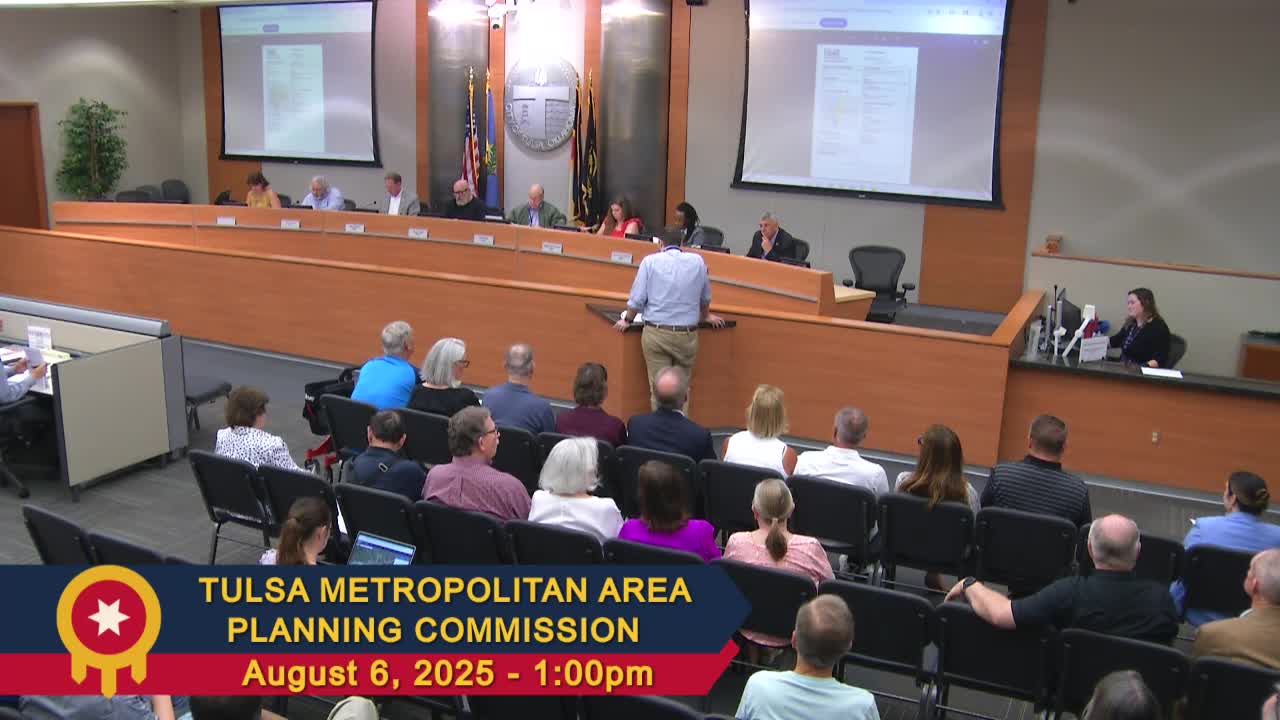
Planning commission approves Office Light rezoning in Florence that retains multifamily allowance over neighborhood objections
Summary
The Tulsa Metropolitan Area Planning Commission voted to approve an Office Light rezoning and optional development plan in Florence that keeps multifamily housing as an allowed use despite substantial neighborhood opposition.
The Tulsa Metropolitan Area Planning Commission voted to approve a rezoning request and optional development plan (ODP) that would allow Office Light uses — and retain multifamily residential as an allowed use — on a tract in the Florence area after several hours of public comment and heated exchanges between neighbors and the applicant.
The commission approved the staff-recommended rezoning to OL with the submitted ODP following a failed motion to amend the plan to explicitly exclude multifamily housing. The vote followed more than a dozen residents testifying about environmental, traffic and property-value concerns and the applicant stressing that his firm intends primarily to sell lots rather than build multifamily dwellings.
Neighbors said the parcel is surrounded on four sides by single-family residences and that the site backs onto Chelsea Pond, a neighborhood-maintained pond and wetland area. “Their intention is to sell lots, and that is very clear,” said Sally Reynolds, president of the Chelsea Pond Property Owners Association. “The applicant has breached their agreement with us because they are here today submitting an application that includes multifamily when there was clear agreement from them to not include multifamily.”
The applicant, developer Tony Lombardi, told the commission his firm’s plan is to subdivide and sell lots. “We're selling land,” Lombardi said. “We're not planning on building anything right now.” He said deed restrictions would limit what his firm would build and that future builders would be subject to the city's permitting and building approval processes.
The public record included repeated concerns that higher-density uses could increase trespass and liability at the adjacent pond and wetlands, increase traffic on two-lane East 101st Street, and strain nearby schools. Julie Kenebel, a resident adjoining the property, urged the commission to delete permitted uses that allow “3 or more households on a single lot” and mixed‑use buildings, arguing those uses would permit apartments and condos near the neighborhood pond.
Staff said the ODP includes use limitations, screening and setbacks intended to reduce negative impacts on surrounding single-family neighborhoods. The planning staff also noted previous proceedings: a similar request had been approved by the Planning Commission earlier but was denied by City Council; the applicant then returned with the revised ODP that includes multifamily allowances.
During deliberations a commissioner moved to approve the application with an amendment excluding the residential categories that would allow multifamily (two households on a lot and three or more households on a lot). That amendment failed. A subsequent motion to approve the application as recommended by staff carried.
The commission's approval is a recommendation to City Council; rezoning decisions for the city are finalized by council. The commission record shows the matter will return to City Council where councilors and members of the public may again weigh in.