Get Full Government Meeting Transcripts, Videos, & Alerts Forever!
Get email alerts on the Water Infrastructure Asset Management topic
No spam. Unsubscribe anytime.
Wyoming agencies outline funding options, launch pilot asset‑management program for water systems
Summary
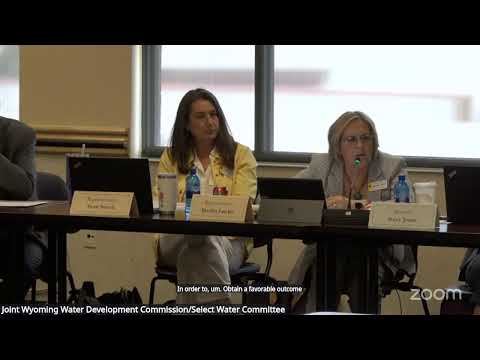
Jason Mead of the Wyoming Water Development Office told the Agriculture, State & Public Lands & Water Resources Committee that the meeting’s opening subject was water and wastewater infrastructure and that three state agencies would explain their roles, funding sources and technical assistance programs.
Jason Mead of the Wyoming Water Development Office told the Agriculture, State & Public Lands & Water Resources Committee that the meeting’s opening subject was water and wastewater infrastructure and that three state agencies would explain their roles, funding sources and technical assistance programs. Officials from the Department of Environmental Quality, the Office of State Lands and Investments and the state’s grants management office outlined how federal capitalization grants, state matching funds and other programs are used and where gaps remain.
The agencies emphasized why this matters: Wyoming is heavily composed of small water systems — state staff said 83% serve fewer than 500 people — and many systems lack the financial and staffing capacity to plan, operate, maintain and replace critical assets. Committee members were shown how federal SRF (State Revolving Fund) capitalization grants, the Infrastructure Investment and Jobs Act (IIJA) supplemental allocations, Mineral Royalty Grant awards and State Lands capital construction loans are combined into funding packages, but officials said demand commonly outstrips available principal‑forgiveness funds and that federal SRF requirements (Build America, Buy America, Davis‑Bacon wages, environmental reviews) can deter small systems from applying.
As part of a multi‑agency response, DEQ, State Lands and Water Development described a pilot asset‑management project contracted with Cayuga Solution. The pilot will develop standardized inventories, condition assessments and multi‑year replacement plans for six drinking‑water systems (Afton, Burns, Chugwater, Sheridan, Rawlins/Rollins and Aspen Pines Water & Sewer District). The agencies said the project will produce a statewide data foundation for prioritizing projects, estimating long‑term needs, and linking investment scenarios to different funding strategies.
The presentation included a demonstration of an Infrastructure Renewal Intelligence System that catalogs pipes, pumps, tanks, meters and other components, assigns condition scores, models expected remaining useful life and produces prioritized replacement schedules. Officials said the system can import existing SCADA or CMMS exports, record purchase prices and replacement costs, and roll individual provider data up to a statewide view to evaluate regionalization options and to estimate funding shortfalls under different investment levels.
Separately, the governor’s newly formed Grants Management Office (the Wyoming Grants Assistance Program, YGAP) described services to help municipalities, special districts and nonprofits identify federal and private funding opportunities, build grant applications, and strengthen project implementation capacity; staff said those services are free to eligible Wyoming entities. The office reported receiving more than 55 technical‑assistance requests related to water and sewer infrastructure in its first year and said it will help communities “stack and braid” federal, state and philanthropic funds and assist with grant lifecycle tasks such as procurement, reporting and audit readiness.
Agency staff and the committee discussed practical barriers small communities face: limited utility rates that often do not cover depreciation, high contractor and materials inflation that pushes bids beyond initial estimates, operator workforce shortages and turnover in elected and administrative local leaders. Officials said the SRF funds are substantial and that Wyoming’s drinking‑water and clean‑water SRF accounts hold hundreds of millions in capital, but principal‑forgiveness levels have been reduced statewide and eligibility rules and federal compliance burdens make program navigation and project delivery challenging for many towns.
Committee members and presenters agreed the pilot asset‑management work should be expanded statewide, and they discussed possible next steps including identifying funds to extend asset‑management planning to wastewater and stormwater systems. Agencies said the pilot is scheduled to conclude in late summer/early fall (project timeline being finalized) and that further procurement and funding steps would be needed to scale up. Representative Lloyd Larson and others signaled interest in drafting legislative direction or funding requests after agencies provide cost estimates.
The agencies urged that improved data and planning be the first step to any long‑term policy or appropriation, noting that “you can’t manage what you can’t measure.”
For local officials and ratepayers, the agencies said the near‑term effect will be clearer project lists, better ability to identify which projects merit principal forgiveness or grant support, and stronger evidence to support regionalization discussions or targeted state assistance.