Get Full Government Meeting Transcripts, Videos, & Alerts Forever!
Get email alerts on the School Finance topic
No spam. Unsubscribe anytime.
Indiana property-tax overhaul will shrink IPS property revenues, analyst warns
Summary
Policy analyst Jason O'Neil told the Indianapolis Local Education Alliance that Senate Enrolled Act 1 will reduce local property tax revenues for Indianapolis Public Schools and change how operations funds are shared with charter schools, requiring careful planning by the alliance and IPS.
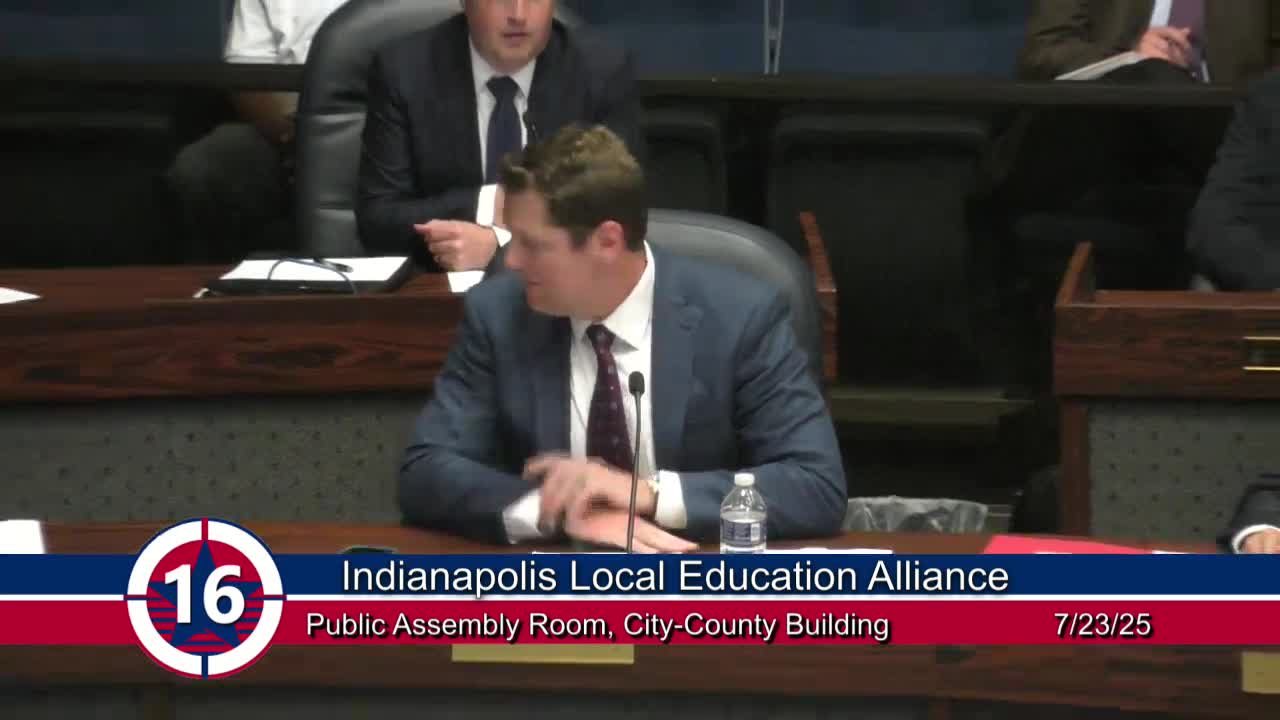
Jason O'Neil, managing director of Policy Analytics, told the Indianapolis Local Education Alliance on a night focused on school finance that the property-tax changes passed this year in Senate Enrolled Act 1 will reduce local property-tax revenue for Indianapolis Public Schools and alter how operations funds are shared with charter schools.
"Senate Enrolled Act 1 introduced a property tax credit for homeowners equal to 10% of the property tax liability up to $300," O'Neil said, summarizing a set of changes he called "over 200 pages long." He added the law phases in new deductions and other credits that will reduce assessed value and thus local tax collections for taxing units in coming years.
The change matters because IPS receives substantial revenue from local property taxes. Andrew Stroop, IPS deputy superintendent, said district revenues come from three main sources: federal grants, state tuition support and local property taxes. "State tuition support is essentially 43% of our revenue in 2024," Stroop said, and property taxes and other local taxes made up about 35% of IPS revenue in the district's 2024 snapshot presented to the alliance.
Why it matters: O'Neil and IPS staff told the alliance the combination of the new state credits and deductions, continuing circuit-breaker limits and the new formula in SEA 1 that allocates a proportional share of the operations fund to charter schools will, together, reduce the dollar amount of property-tax revenue that remains with IPS as a corporation. O'Neil presented a preliminary revenue projection showing a decline in IPS non-debt property-tax revenues through the implementation period and a growing share allocated to charter schools under the new methodology.
O'Neil described specific provisions that will affect fiscal planning. Among them: a new homeowner credit (10% up to $300, phased in deductions for homesteads and non‑homestead residential property through 2031, exemptions for some personal property, and a restructuring of local income tax beginning in 2028. He said the Legislative Services Agency estimates roughly a $5 million revenue reduction for IPS in 2026 versus baseline because of the law's changes.
Alliance members asked clarifying questions about mechanics. One member asked whether the changes meant referenda would lose meaning as a revenue source; O'Neil said referenda remain allowed, but that the formula and caps mean future revenue growth will depend more on tax-base growth than on rate increases in many places. He noted operating referendum revenue is rate-driven and will still produce revenue while the referendum is in effect, and that the district's operating referendum expires in calendar year 2026 (with IPS still receiving about half the referendum revenue in fiscal 2027 because of fiscal-year timing).
IPS CFO Weston Young explained that at present charter schools continue to receive the per-pupil charter school grant in addition to any property-tax share under SEA 1. He said there was no active plan in statute to immediately end the charter school grant, though that could change legislatively.
Alliance members and staff emphasized implications for planning. Mayor Hogsett and others noted the state law included no new dedicated state funding to offset implementation losses for local units; local entities will need to plan for reduced property-tax yields and altered responsibilities if charter schools receive a larger proportional share of operations funds.
The presentation closed with a reminder that the alliance's work includes producing a comprehensive plan for public schools within the Indianapolis boundary by Dec. 31, 2025, and that the finance topic will require ongoing, deeper analysis in the coming months.
Ending: Alliance members agreed to follow up with additional data requests and mapping of tax increment finance (TIF) districts inside IPS boundaries; the alliance will dig further into district- and school-level finance breakdowns in future meetings.