
Taylor County discusses seizing wastewater pipeline easement to preserve regional infrastructure and recruit industry
Get AI-powered insights, summaries, and transcripts
Sign Up Free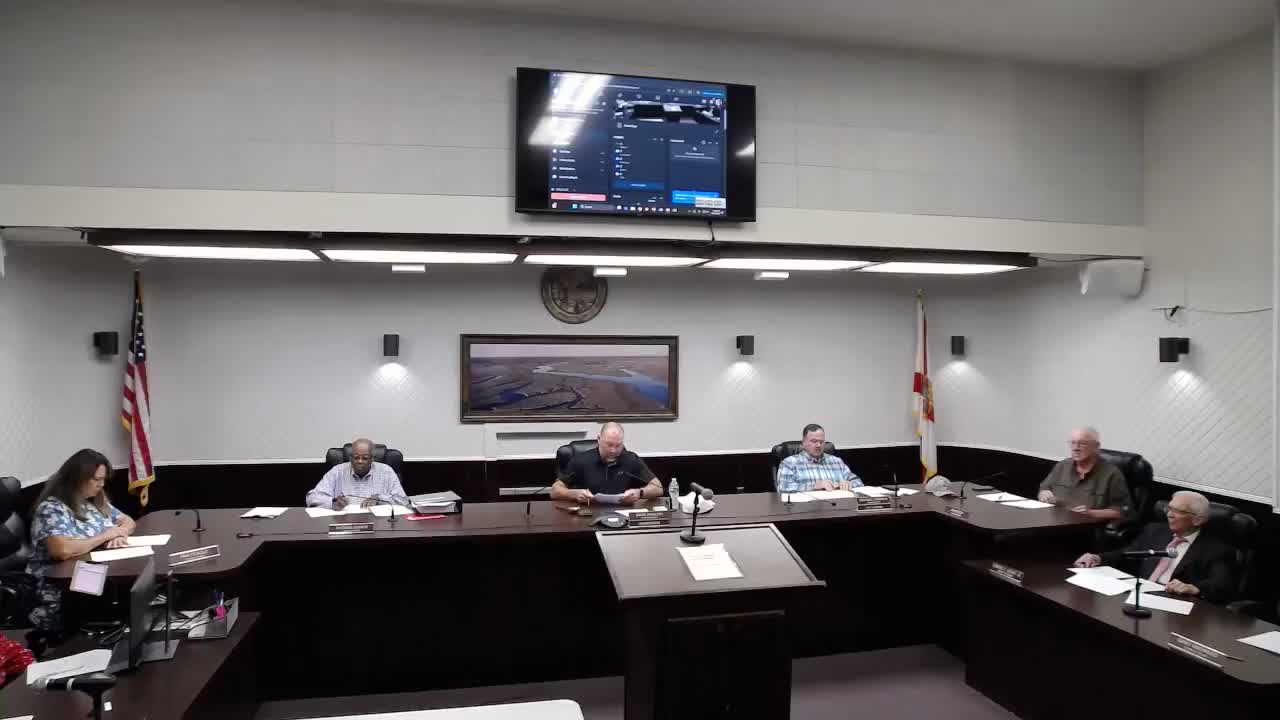
Summary
At a July 29 workshop, Taylor County commissioners heard presentations about the former Georgia Pacific wastewater pipeline and treatment plant, including options to acquire the easement through eminent domain or to join an existing federal lawsuit; no formal action was taken.
Taylor County commissioners heard detailed briefings July 29 on the county’s options for preserving a wastewater pipeline and treatment-plant asset that speakers said could support industrial recruitment across North Florida.
Andy (property owner) and representatives from the North Florida Economic Development Partnership told the commission the pipeline and the former Georgia Pacific (GP) treatment plant are regional assets that could be used to handle industrial wastewater and help attract employers. Diane Schultz of the North Florida Economic Development Partnership said the region markets such assets to recruiters and noted the partnership receives a $250,000 grant from Florida Commerce for area marketing.
The discussion centered on two paths the county could pursue: (1) using eminent domain to acquire the easement that carries effluent from the closed plant, or (2) the county joining an ongoing federal lawsuit between 4 Rivers and Georgia Pacific that concerns the easement. County Attorney Conrad summarized the condemnation process in court, saying a county that files a taking must first prove a “public use and . . . a necessity,” obtain a notice of taking, deposit estimated compensation with the clerk, and be prepared for appraisal and jury processes that can increase costs and require paying the opposing party’s attorney fees.
John (City Manager of Perry) described local utility capacity. He said the city’s water system is permitted up to 5,000,000 gallons per day (gpd) but that realistic withdrawable capacity is “more like 2, 2 and a half million gallons a day,” and that the city currently uses about 1.2 million gpd. On wastewater, John said the city’s permit is for 1,250,000 gpd; during heavy rain events plant flow can reach about 3,000,000 gpd. He estimated about 400,000–500,000 gpd of usable wastewater capacity on a normal day. Andy and other speakers also cited larger historical and permitted figures for the mill’s system, saying the pipeline and treatment system have handled tens of millions of gallons per day in the past; those larger historical numbers were presented as background and vary across speakers’ remarks.
Speakers described additional infrastructure that would support new industry: Duke Energy site–rating work and connections, a nearby fiber-optic trunk line that links Dillard and Eglin Air Force bases, and natural-gas capacity reported by Florida Gas Transmission. Jeff Hendrick and Diane Schultz said the development team has submitted about 18 leads for the property and that prospective companies routinely ask for more water and wastewater capacity when they screen sites.
Experts and outside participants urged caution and further study. Bob (remote participant) told the commission that groundwater monitoring plans tied to the plant had been deemed inadequate and warned of potential long-term liability if the county were to assume ownership without thorough investigation. A representative who identified themselves as Dee Fragg said they “don’t know enough about it” and advised caution about immediately joining litigation.
Speakers described possible funding sources that the county could pursue to hold or rehabilitate the asset, including a state “local government emergency bridge loan” program (a loan the presenter said can be interest-free for up to 10 years) and other Florida Commerce disaster- or economic-development funds. Diane Schultz and others said the North Florida Economic Development Partnership and state officials have expressed interest in supporting projects that create regional jobs.
No formal action was taken at the workshop. Commissioners asked staff to return with more information and emphasized that any formal step—such as engaging counsel to file condemnation or joining litigation—would require a future motion and vote by the board. One commissioner noted that the city and county could strengthen a joint approach if both governing bodies decided to act together.
What happened next: the item remained a workshop discussion; the commission did not direct immediate litigation or filing for eminent domain during the meeting.