Get Full Government Meeting Transcripts, Videos, & Alerts Forever!
Get email alerts on the Affordable Housing topic
No spam. Unsubscribe anytime.
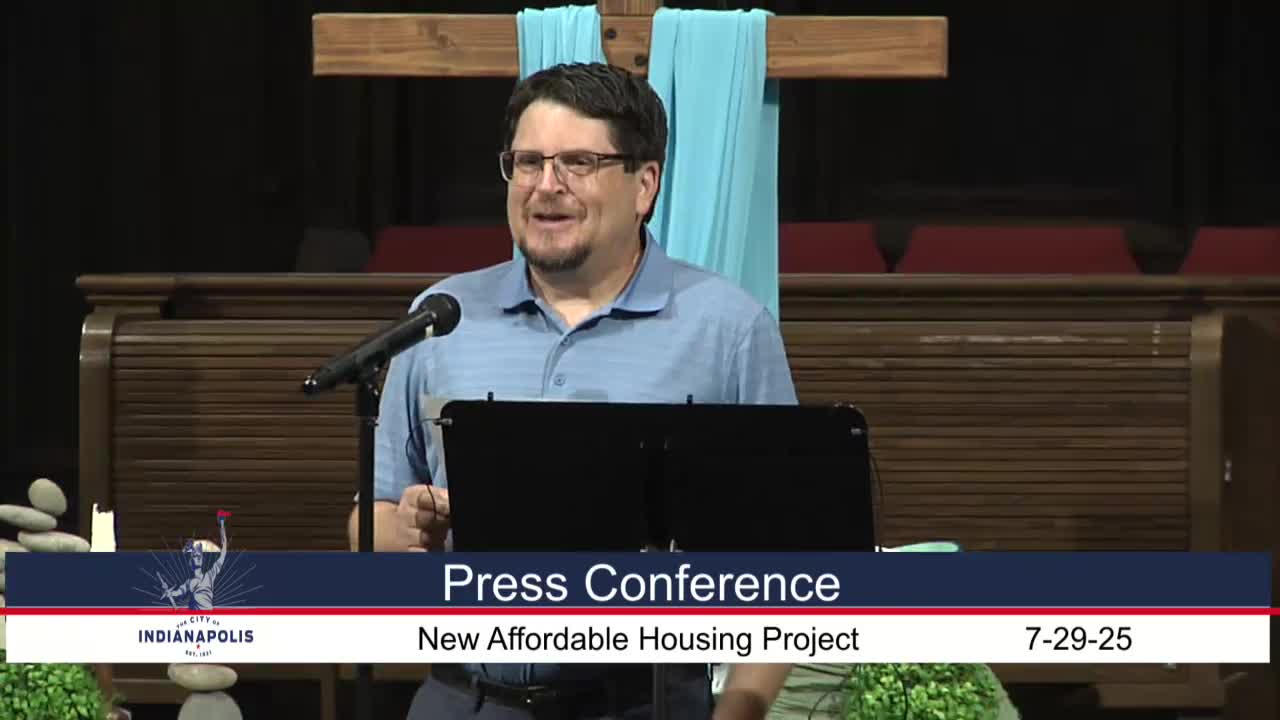
Groundbreaking held for Central at 29 affordable housing project in Mapleton-Fall Creek
Summary
City and community leaders gathered at Broadway United Methodist Church for a ceremonial groundbreaking for Central at 29, a 57-unit affordable housing development in the Mapleton-Fall Creek neighborhood of Indianapolis that includes 11 units set aside with supportive services for people who have experienced homelessness.
City and community leaders gathered at Broadway United Methodist Church for a ceremonial groundbreaking for Central at 29, a 57-unit affordable housing development in the Mapleton-Fall Creek neighborhood of Indianapolis that includes 11 units set aside with supportive services for people who have experienced homelessness.
The Rev. Aaron Hobbs, senior pastor at Broadway United Methodist Church, opened the program, saying, "Perseverance pays off. Today is 14 years in the making." Hobbs and other speakers framed the project as the result of long-term neighborhood organizing and partnership among faith-based organizations, community development groups and public agencies.
Matt Rayburn, deputy executive director and chief real estate development officer for the Indiana Housing and Community Development Authority, said IHCDA is supporting the project with multiple financing tools. "IHCDA is pleased to support this development with an award of low income housing tax credits, National Housing Trust Fund, and project based rental assistance," he said. Rayburn and other presenters said the project will serve a range of income levels from about 30% of area median income up to 80% of AMI.
Mayor Joe Hogsett said projects such as Central at 29 are part of the city's approach to improving housing access and addressing chronic homelessness. "We wholeheartedly believe that everyone has a right to a safe place they can call home," he said, and noted the development will include 57 units, with 11 set aside for residents experiencing homelessness.
George Tabith, senior vice president of real estate development for The Community Builders, described the building mix and amenities: 57 apartments with one-, two- and three-bedroom units, community space, a resident lounge, patio, playground and buildingwide Wi-Fi. Tabith said units will be reserved at multiple income tiers (50%, 60% and 80% of AMI were mentioned for portions of the building) and stressed the project's supportive-services partnership with Rafael Health Center, a federally qualified health center located within roughly a mile of the site.
Speakers named several organizations and funding partners that helped the development reach closing after a long planning period: Mapleton-Fall Creek Development Corporation; The Community Builders (developer); Rafael Health Center (service partner); Indiana Housing and Community Development Authority (tax credits, National Housing Trust Fund, project-based rental assistance); Indianapolis Neighborhood Housing Partnership (INHP) (sustaining grants); the Indianapolis Foundation (gap funding); the Indianapolis Urban League and the Indianapolis African American Quality of Life initiative (final capital); Merchants Bank (permanent lender and tax-credit syndicator); Marus Construction (builder) and RDL Design (architect). The ceremony program also acknowledged technical assistance from the Corporation for Supportive Housing.
Organizers repeatedly described Central at 29 as the product of multi-year, multi-partner effort. David (last name not provided), a representative of the neighborhood development group, thanked past and present board members and four executive directors who worked on the project over its 14-year history. State Rep. Greg Porter offered remarks highlighting neighborhood persistence and partnership.
The program concluded with an invitation to move to the site for a ceremonial groundbreaking; no construction completion date was announced during the remarks. Several speakers noted the project includes a supportive housing element intended to provide long-term stability for people with disabilities who have experienced homelessness. Specific operational details—such as the timeline for lease-up, ongoing service provider staffing levels, and a permanent on-site case-management plan—were not specified in the remarks.
Community members, neighborhood leaders and city staff characterized the project as expanding housing options for families and individuals in the Mapleton-Fall Creek area and as part of a broader local push to add affordable units amid citywide growth.