Get Full Government Meeting Transcripts, Videos, & Alerts Forever!
Get email alerts on the Housing topic
No spam. Unsubscribe anytime.
Land use committee presses for clear housing metrics, KPI dashboard and surplus-property strategy
Summary
Richmond City land use committee and administration staff agreed to align presentations around measurable housing key performance indicators, track ARPA deadlines and explore using surplus city property and bond proceeds to support affordable and mixed‑income housing goals.
Richmond City land use committee members and city staff agreed at a committee meeting to rework the committee's presentation schedule so that housing presentations consistently report against measurable key performance indicators (KPIs) and to coordinate policy work on surplus property and funding strategies to support affordable housing production.
Committee members said they want presentations that tie projects directly to the city's housing goals, and staff described the metrics and funding constraints they are tracking. Housing department staff told the committee that KPI tracking began in July of the current fiscal year and that all ARPA-funded projects must be under construction and completed by Dec. 31, 2026. "All of our ARPA projects need to be under construction and completed by the end of next year, 12/31/2026," Housing Department staff said.
Why it matters: Committee members said the change will let the public and council see whether the city is meeting production goals and whether policy or funding changes are needed. The committee emphasized that better, consistent reporting will make council advocacy for funding and policy changes (including use of surplus property and bond proceeds) more concrete.
Housing targets, preservation and funding constraints Housing Department staff said the department currently projects roughly 1,000–1,100 new units in the pipeline per year if current funding levels remain unchanged, and that the city's Affordable Housing Performance Grants have produced nearly 3,000 units now in various stages of predevelopment, financing or production. "I would rather underpromise and overdeliver than to overpromise," Housing Department staff said when describing the department's approach to goal-setting.
Staff and committee members described an increased emphasis on preservation of existing homeowner-occupied housing and assistance such as roof, window and door repairs as part of the preservation program. The committee asked staff to supply a breakdown of KPI targets by category (new multifamily rental, multifamily preservation, new single-family ownership, single-family preservation) so the public can see progress by subcategory.
Surplus property, bonds and mixed-income policy Committee members and staff discussed directing proceeds from surplus-property disposition to a dedicated housing fund rather than returning them to the general fund. Staff said the city previously accessed roughly three years of a five-year bond program, about $30,000,000, and is evaluating whether targeted use of surplus property and a revolving loan fund could reduce future bond needs.
Councilwoman Robertson asked how the committee should incorporate an explicit inclusion or mixed‑income policy so affordable units do not concentrate in the same neighborhoods. "If this council's policy is inclusiveness, then how do we incorporate that into the strategy?" Robertson asked. Housing Department staff said many funding streams (federal programs and most grant sources) are tied to income limits (commonly 0–80% AMI), so achieving a broader spectrum of affordability will require policy changes that allow flexible local funding and use of bond proceeds to support higher AMI tiers where appropriate.
Preservation versus production and program strategy Staff said preservation programs are being strengthened to keep long-time homeowners in place and to prevent displacement. The committee pushed for a public dashboard that will surface KPIs in real time so residents and council members can check progress without waiting for committee meetings. Staff said the mayor and multiple departments are coordinating to put KPIs on the proposed public dashboard.
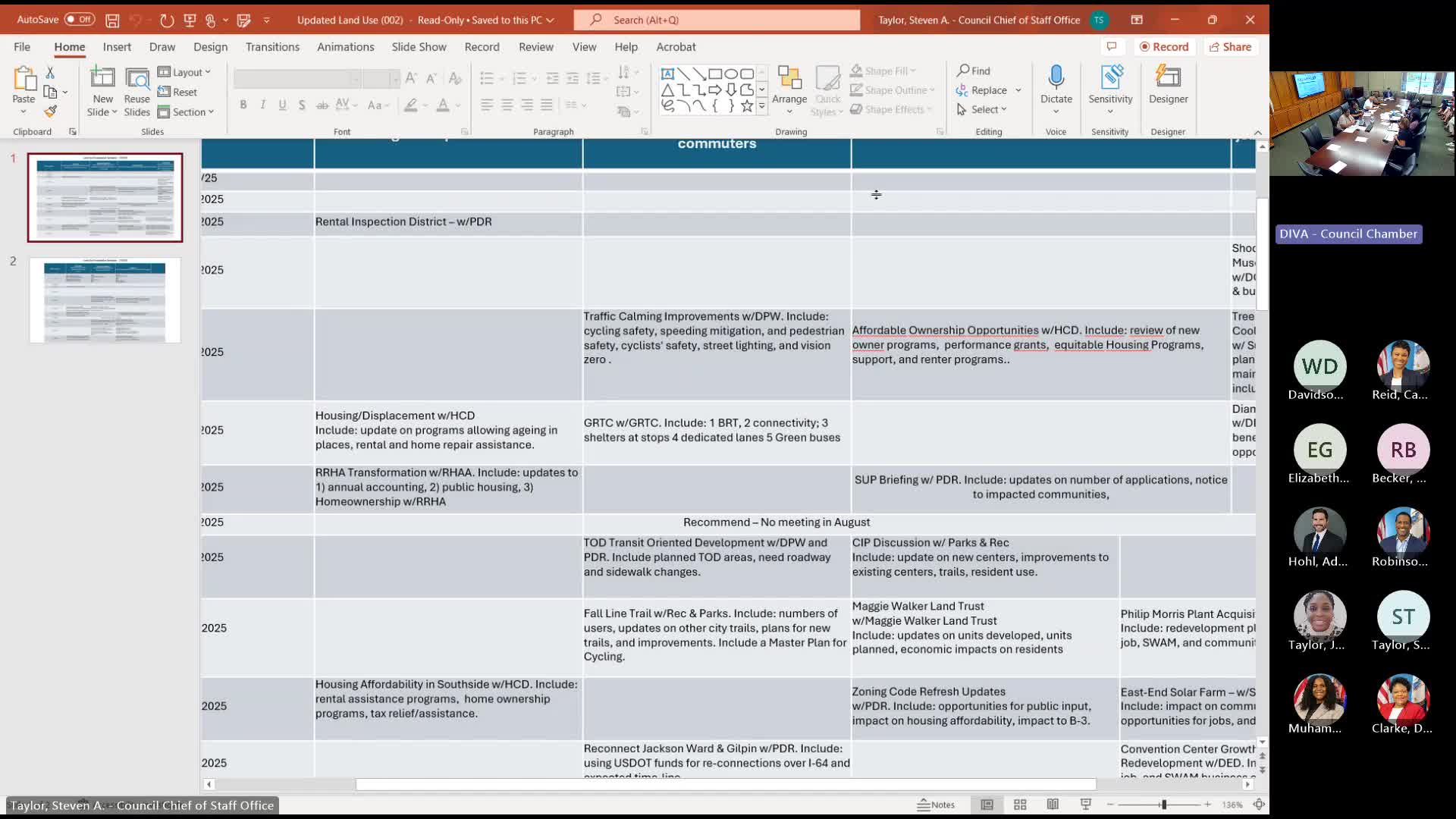
Next steps and schedule The committee asked staff to return with a presentation schedule in which housing briefings explicitly map projects and funding to KPI categories (production, preservation, single-family, multifamily). Staff said they will provide unit goals by category, a projection through 2033 that the department has compiled, and the list of policy changes (administrative and legislative) that would be needed to support an inclusion/mixed‑income strategy. The committee plans regular quarterly check-ins tied to the KPI dashboard timeline.
Ending Committee members said they will use the revised presentation schedule to reduce duplicative briefings and focus committee time on policy recommendations and measurable outcomes.