Get Full Government Meeting Transcripts, Videos, & Alerts Forever!
Get email alerts on the Education Charter Opportunity topic
No spam. Unsubscribe anytime.
State Board of Education rules for Opportunity Public Charter Schools draw extended committee scrutiny over funding, residential models
Summary
The State Board of Education presented rules implementing the new Opportunity Public Charter School model. Lawmakers pressed officials about funding mechanics, residential (boarding) models and treatment of remaining Achievement School District schools; the committee recorded differing recommendations between chambers and requested follow-up.
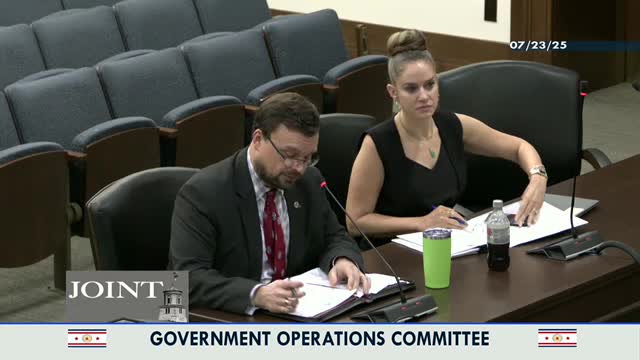
NASHVILLE — The State Board of Education briefed the Joint Government Operations Committee on July 23 about proposed rules implementing the Opportunity Public Charter Schools (OPCS) provisions enacted in 2024.
The rules define OPCS as charter schools serving grades 6–12 in which at least 75% of students are “at risk” (a statutory definition that includes criteria such as retention, chronic absenteeism, justice involvement, pregnancy, and history of abuse or neglect). The package outlines enrollment preference order for OPCS, residential program verification and requirements, and how funding follows students during the first year after a district-to-district transfer.
“Students who transfer to an opportunity public charter school located in an LEA other than the LEA in which the student resides, for the first year the student would bring the amount generated under TISA from the sending district,” Nathan James of the State Board said, explaining how funding would be allocated.
Nut graf: Committee members pressed officials on several operational issues: who calculates and disburses interim funding adjustments; whether residential (boarding) charter models would receive additional funding to cover boarding costs; and how remaining Achievement School District (ASD) schools will be handled as the ASD transitions under recent legislation.
Questions and responses - Funding and timing: Department of Education and State Board officials said the Office of Local Finance calculates TISA allocations and that interim allocations and adjustments are made multiple times per year; committee members asked for assurances funds would be available to schools in real time when students transfer midyear. - Residential (boarding) schools: The rules allow residential models only for OPCS. Board counsel said there is no extra, dedicated TISA funding in the rules for boarding costs; any additional funding would depend on separate programs or deal-specific arrangements (for example, low-income housing tax credit compliance periods tied to affordable housing deals). - Achievement School District: Legislators asked why references to the ASD remained in the rules; board staff said statutes governing the ASD remain in effect until 2026–27, so the rules must reflect current law and the board expects to return with further rule updates as statutes change.
Outcome: The package prompted extended discussion. The committee’s House members gave a positive recommendation; the Senate recorded a motion to pause/withhold recommendation in a roll call (resulting in a split roll with four ayes and one no recorded in that roll). Committee chairs requested additional written information from the State Board and the Department of Education about funding flows, the financial model for residential programs, and protections for students who were previously served by ASD schools.
What’s next - State Board and Department of Education staff agreed to provide requested follow-up to Chairman Lafferty and committee members.
Sources: presentation and Q&A with State Board of Education staff and Department of Education representatives at the Joint Government Operations Committee rule-review meeting, July 23, 2025.