Get Full Government Meeting Transcripts, Videos, & Alerts Forever!
Get email alerts on the Housing Project Based Vouchers topic
No spam. Unsubscribe anytime.
Tennessee Housing Development Agency seeks to project-base vouchers starting at 5% to spur affordable housing development
Summary
THDA told the Joint Government Operations Committee that it will start project-basing up to 5% of its Housing Choice Voucher allocations, with a goal to seek up to 20% under HUD rules. Agency leaders said the change aims to create more affordable units for the roughly 600 voucher holders statewide who cannot find landlords accepting vouchers.
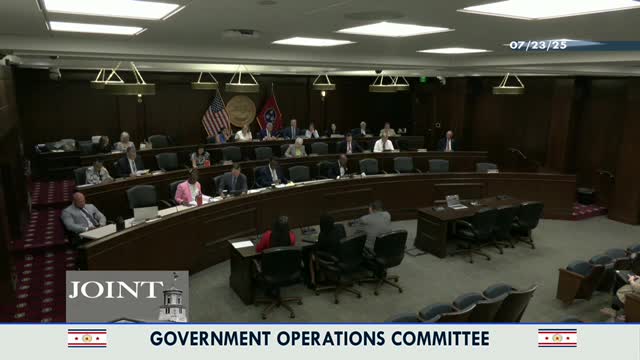
NASHVILLE — The Tennessee Housing Development Agency appeared before the Joint Government Operations Committee on July 23 to present rule changes to its Housing Choice Voucher (HCV) administrative plan that would authorize project-based vouchers (PBVs) as a development tool.
“HUD allows a PHA to project base a percentage of its housing choice vouchers,” Pascual McLeod, THDA assistant director for Section 8, told the committee. She said THDA plans to begin by project-basing an initial 5% of its voucher allocation and could seek authorization to increase to the HUD ceiling of 20%.
Nut graph: THDA said the change is intended to increase the supply of units that will accept vouchers — particularly in areas without a local public housing authority — and to reduce the number of voucher holders who cannot find landlords. THDA told lawmakers it currently has about 600 voucher holders who have been unable to secure housing; the agency also reported about 9,000 families on a waiting list.
What the rule does - Adds a Project-Based Voucher chapter to THDA’s HCV administrative plan to enable allocation of vouchers to specific developments so the subsidy is attached to units rather than individual voucher holders. - Proposes an initial cap set by THDA at 5% of its voucher inventory, with plans to request increases from HUD up to 20% if demand and developer interest justify it.
Questions from lawmakers and agency responses - Representative McKenzie asked whether the change would help people statewide, including rural areas. McLeod said the program would primarily serve counties outside metro areas and participants on THDA’s HCV waiting list would be eligible to apply to PBV waiting lists. - Representative Clemens asked if the rule would cut the number of vouchers; THDA responded no. - Representatives and senators asked about vacancy payments (a policy some PHAs use to pay subsidy for a vacant PBV unit until it is re-rented). THDA said it did not adopt a vacancy-claim payment in the administrative plan; landlords will be responsible for maintaining waiting lists. - Representative Hardaway and others asked whether Davis-Bacon prevailing-wage rules would increase construction costs; THDA said they must follow federal law but did not quantify cost impacts. - Lawmakers asked about federal funding risk and whether funds could be clawed back; THDA staff said they had no guarantee the federal appropriations process would not change HUD funding and agreed to provide contingency information to committee staff.
Numbers and clarifications from the hearing - THDA said HUD permits up to 20% project-basing but the agency plans to start at 5%. - THDA reported it has approximately 600 voucher holders currently unable to find a landlord and about 9,000 families on its waiting list. - THDA said vacancy claim payments were not adopted in its plan; administrative-fee reserves hold unused HUD administrative fees.
What’s next - The committee voted to give the rule a positive recommendation; members requested additional written follow-up on contingency planning for federal funding, vacancy-payment policy rationale, and details about how PBV units will be allocated and monitored. THDA said it will provide follow-up to Chairman Lafferty and committee staff.
Attribution: testimony and Q&A at the Joint Government Operations Committee, July 23, 2025. Exact quotations are taken from the committee transcript.