Get Full Government Meeting Transcripts, Videos, & Alerts Forever!
Get email alerts on the Capital Scoring Methodology topic
No spam. Unsubscribe anytime.
Milwaukee County committee reviews revised capital project scoring and design‑first approach
Summary
The Capital Improvements Committee reviewed its scoring criteria for the 2026–2030 capital improvements plan, including new climate and racial‑equity factors and a ‘design‑first’ approach intended to reduce contingency costs and improve cost accuracy.
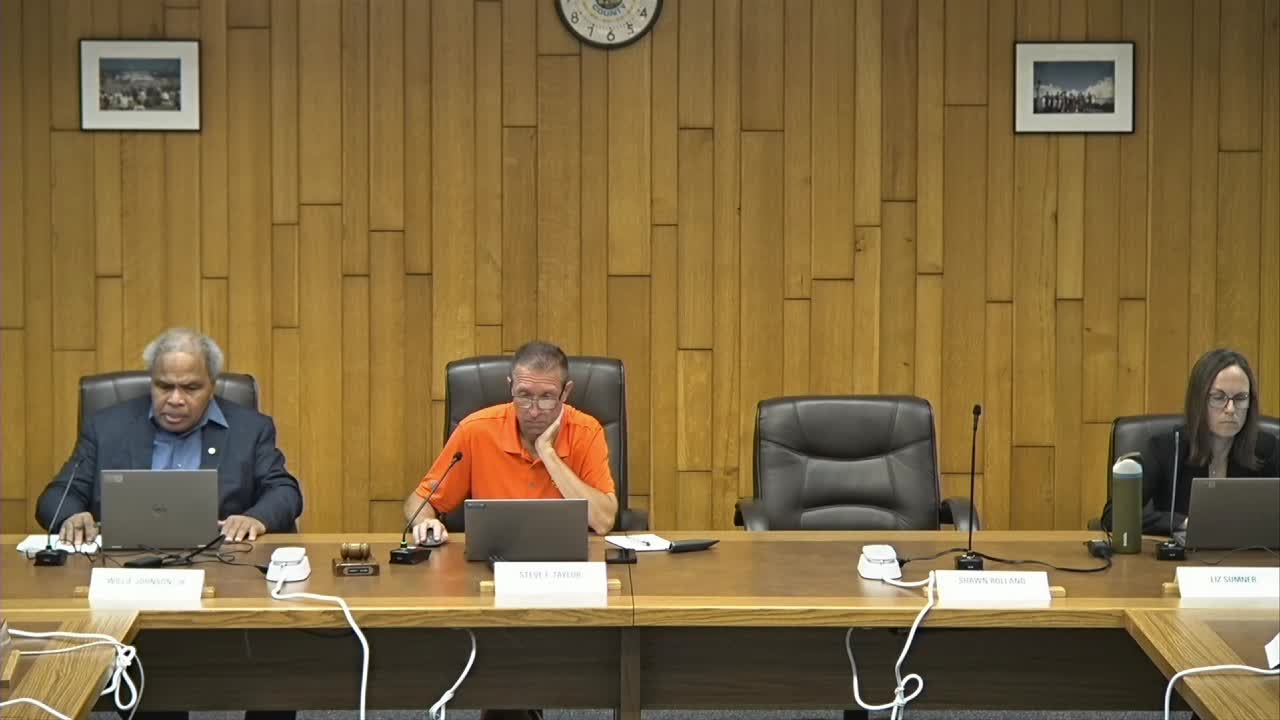
Milwaukee County—5Capital Improvements Committee members reviewed an informational presentation Aug. 19, 2024, on the committee—9s capital project scoring criteria and the use of a design‑first approach in capital budgeting.
The presentation, delivered by a capital improvements staff member, summarized how the committee—9s quantitative scoring matrix assigns points for safety (including a cybersecurity subcomponent), policy and plan compliance, operational impacts (net operating cost, deferred maintenance and ADA issues), non‑county funding, program continuity, racial equity and a newly added climate action component. The staff member said the scoring data is intended to guide — but not replace — policymakers—9 qualitative judgment when the county executive and county board develop the annual capital budget.
The scoring system uses a department ranking multiplier that each requesting department assigns; subcommittee impact points are then applied against that multiplier to produce a composite score. The racial equity measure relies on the latest U.S. Census Bureau American Community Survey data for the project zip code if departments do not supply service area demographic estimates. The building mission category is maintained in the county—9s VFA facility assessment system by Facilities Management Division staff.
“Pursuant to Milwaukee County Ordinance, the CIC is responsible for . . . establishing the capital project scoring criteria and the prioritization of capital projects,” the presenter said, describing how the subcommittee—9s scores are shared with committee members, the county executive and the county board.
Staff emphasized the committee—9s recent additions: a racial‑equity measure added in 2019, a building mission category, and a 2024 board‑adopted climate action component. Committee members were told they could request further narrative or departmental testimony at the CIC—9s second meeting to inform qualitative judgment beyond the numeric scores.
The presentation also laid out the committee—9s design‑first guidance: for most projects, design appropriations should be made in one year and construction appropriations in a subsequent year after a design of at least 90% is complete. The staff member said that completing design before construction reduces the risk of scope changes and high contingency costs, improves cost estimating accuracy and prevents funds from being locked into underdesigned projects.
Staff noted exceptions can be made for lower‑risk projects (for example, playground equipment) or for work addressing immediate life‑safety issues. Departments were encouraged to attend the committee—9s second meeting to present additional information; no action was taken on the item during the Aug. 19 meeting.
The CIC staff said the subcommittee continues scoring work through late July and August, with a second meeting for departmental testimony and a final meeting for advisory recommendations to the county executive and county board.