
Board begins first reading of discipline policy change to allow short‑term suspensions for discriminatory acts with administrative approval
Get AI-powered insights, summaries, and transcripts
Subscribe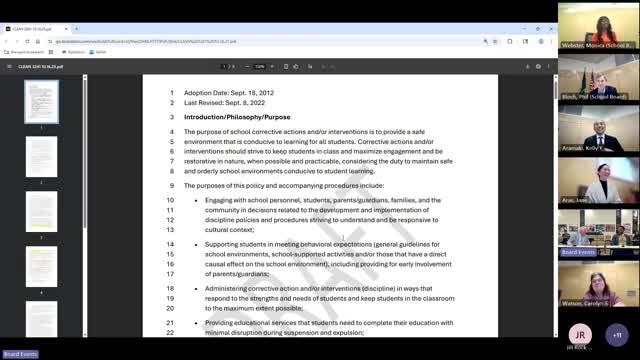
Summary
The board held first reading Oct. 14 on proposed revisions to Policy 3241 (student corrective actions) that would create a narrow exception to a district‑wide ban on short‑term suspensions for incidents involving discriminatory language or acts, if the building leader obtains approval from a central administrator; the policy revision triggers
The Bellevue School District Board of Directors conducted a first reading Oct. 14 on a proposed revision to Policy 3241 (Corrective Actions and Interventions) that would permit a narrow, controlled exception to the district’s previously adopted limits on short‑term suspensions.
District staff said the amendment responds to an increase in reported incidents involving discriminatory language and conduct and to feedback from students, families and affinity groups that schools lacked an effective, consistent tool to address those incidents. The proposed change would allow a building leader to impose a short‑term suspension specifically for “discriminatory language and acts” (a new violation category in district procedures), but only after obtaining approval from either the chief of schools or the director of student engagement, staff said. The policy revision retains a focus on prevention, restorative practices and supports; the new procedural language includes guidance for documentation and for offering restorative responses and supports to victims.
Board members discussed the change at length. Several directors said the policy fills a gap when discriminatory acts do not fit existing bullying or harassment reporting structures — for example, when multiple different students use slurs against the same target on separate occasions and the incidents do not meet the repeated‑actor criteria in the district’s bullying procedure. Directors and staff emphasized the importance of survivor‑centered responses and that any restoration or learning processes be voluntary for harmed students. Several board members asked staff to ensure representation from students and families who are disproportionately affected by discipline when the district appoints members to appeal or advisory groups; staff agreed to refine language to address representation.
No vote was taken; the board held a first reading and invited written feedback before a planned second reading and action at a later meeting. Several board members praised the equity design team’s use of engagement work and said they supported an approach that pairs consequences with restorative and educational interventions.