
Walled Lake board hears legal guidance on disciplining students with disabilities
Get AI-powered insights, summaries, and transcripts
Sign Up Free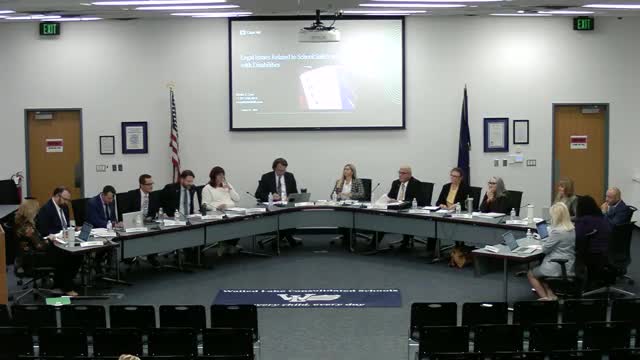
Summary
An attorney for the district briefed the Walled Lake Consolidated Schools board on federal and state rules that constrain disciplinary actions for students with disabilities, emphasizing documentation, timelines for review and the limited circumstances for unilateral removals.
Vicki Coe, an attorney with Clark Hill and Associates, gave the Walled Lake Consolidated Schools Board of Education a legal overview of discipline for students with disabilities and fielded questions from board members and staff.
Coe said the Individuals with Disabilities Education Act (IDEA) and Section 504 of the Rehabilitation Act take priority over state rules and school codes when a student's disability is implicated. "Federal law is always gonna trump state law," she said, adding that guidance (agency letters) can strongly influence how districts are expected to act even though guidance itself is not law.
The presentation summarized several procedural protections and time limits that school staff must observe. Coe reviewed general due-process protections recognized in case law (citing Goss v. Lopez) and told the board that removals of more than 10 days trigger additional procedural steps for all students; for students eligible under IDEA, removal can amount to a "change in placement" and requires a manifestation-determination process. "If we're gonna remove a kid for more than 10 days out of school, we can't do that unless we're giving them a right to an evidentiary hearing," she said.
Coe described the IDEA's specific timelines and narrow exceptions: where conduct involves a weapon (as defined by the IDEA), drugs, or serious bodily injury, the district may impose a unilateral removal of up to 45 school days without parent agreement so long as the district continues to provide FAPE in the interim. She emphasized that those federal definitions — for "dangerous weapon" and "serious bodily injury" — are narrower than some local conduct codes and turn on facts such as age, strength and the realistic ability of an object to cause serious harm.
Coe pointed board members to Office for Special Education and Rehabilitation Services (OSERS) guidance (noting letters from 2016 and 2022) and to Office for Civil Rights (OCR) reporting showing that students with disabilities are disproportionately represented in restraint, seclusion and suspensions. She said the federal data she discussed covered the 2020–21 reporting period and included preschool and K–12 figures that, in her words, show a significant disparity in exclusionary discipline for students with disabilities.
Her advice repeatedly stressed documentation and training: when staff believe a student's behavior is "unduly disruptive" there is rarely a single statutory definition, she said, and districts should "show your work" (document what made the behavior unduly disruptive, which interventions were tried, and why the district took the action it did). She warned that poor documentation or failure to follow required processes exposes districts to civil-rights litigation and damages under Section 504, the ADA and 42 U.S.C. § 1983-type claims.
On specific practices Coe discussed: - Manifestation-determination reviews (MDRs) must occur promptly; she said MDRs and related hearings generally should be held within 10 school days of a disciplinary decision that may change placement. - Unilateral 45-school-day removals under IDEA are limited to weapons, drugs and serious bodily injury; other safety pathways include court orders or expedited administrative hearings (each with a high evidentiary burden on the district). - Shortened school days and virtual placements are legally sensitive; MDE guidance requires such schedules be necessary for the student's disability, short term, and include a plan for returning the student to a full day. - Counting removal days: MDE recommends using attendance to count disciplinary removals, but Coe cautioned that inaccurate attendance records can complicate compliance.
Board members and staff asked follow-up questions about definitions (for example, "unduly disruptive," "threat to safety," and "serious bodily injury"), how threat assessments are incorporated and what measures districts can take to protect other students when a student found to have a disability-related manifestation must remain in school. Mr. Seigler (school staff) described the district's threat-assessment protocols and noted that the team considers age and context in assessing statements that might sound threatening.
Superintendent-level staff and administrators on the dais said the district already relies on outside counsel when difficult due-process questions arise and that administration typically handles MDRs and hearing preparations so the board does not receive every case. Coe advised that, when districts consider court orders or expedited administrative removals, they must be prepared to present robust data showing interventions, fidelity of implementation and the need for removal.
The presentation concluded with Coe urging preventative steps: invest in staff training, implement interventions with fidelity, accurately report restraint and seclusion data, and prepare documented safety and transition plans before resorting to exclusionary discipline. "If we are the problem, then we need to fix it," she said.
The board did not take formal action on discipline policy at the meeting; the session was a legal briefing and Q&A.