Get Full Government Meeting Transcripts, Videos, & Alerts Forever!
Get email alerts on the Land Use topic
No spam. Unsubscribe anytime.
York supervisors continue controversial zoning amendments debate to Sept. 16 after questions on cluster subdivisions, parking and buffers
Summary
The York County Board of Supervisors on Aug. 19 continued the public hearing on a set of zoning ordinance amendments that would raise mandatory recreational-area requirements in planned developments and change cluster subdivision rules, asking staff for more data on parking, buffers and walkability before a Sept. 16 public hearing reconvenes.
The York County Board of Supervisors on Aug. 19 voted to continue the public hearing on proposed zoning amendments that would raise recreational-area requirements in planned developments and change performance standards for cluster subdivisions, temporarily pausing a planned reduction in the minimum acreage required to use cluster subdivision rules.
The board’s unanimous motion continued the public hearing to Sept. 16 so staff can return with more analysis of the cluster provisions — particularly the proposal to lower the minimum developable acreage to use cluster subdivision standards from 10 to 5 acres — and related concerns about parking, sidewalks, stormwater/permeable surfaces and transitional buffers.
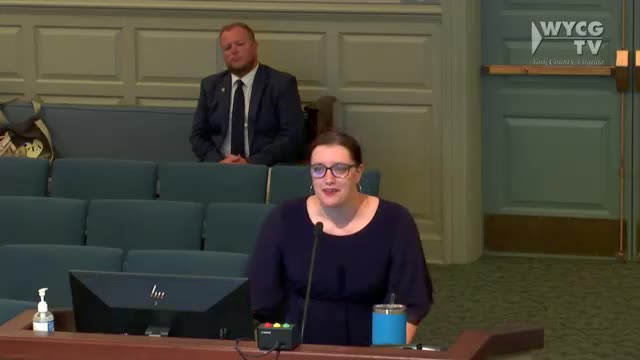
Planning staff presented the package, ZT21125, as two linked sets of changes: one to add clarity and raise the required recreational area inside residential planned developments (PDR) from 10% to 15% of a development’s land area and to tighten what can be counted as recreation; the other to update performance standards for cluster (open‑space) subdivisions and to reduce the minimum acreage threshold for using cluster rules. Caitlin, a planning staff member who led the presentation, said the changes were intended to reflect problems seen in earlier developments and to give developers more flexibility while ensuring open space serves residents.
“Recreation area is where you’re doing your active recreation — trails, playgrounds, ballfields — and the open space is the larger preserved area,” Caitlin said during the presentation. She told the board that staff and the planning commission had sought to prevent developers from counting wetlands, steep slopes or purely stormwater basins as usable recreation space without additional intentional amenities.
Why it matters: Several supervisors said many of the proposed edits reflected lessons learned from earlier subdivisions — misplaced playgrounds, recurring maintenance cost problems for large but underused amenities, and paved or insufficient walkways — but they also warned that lowering the minimum acreage for cluster subdivisions could have unanticipated consequences. Supervisor Doug Holroyd asked how the county would prevent overdevelopment or later rezoning requests that increase density, and raised the recurring complaint that homeowners sometimes park on sidewalks or in yards when developments don’t provide adequate spaces.
“We’ve got to know what we’re getting ourselves into,” Holroyd said. “I don’t want to change the rules and later find we created widespread parking on sidewalks and other public-safety problems.”
Supervisor Tom Sheppard pressed staff about how the county would ensure recreational facilities are sited and sized so they’ll be used. Caitlin said staff’s approach was to require categories of amenities (active and passive) and safe pedestrian access, plus clearer cross‑section standards for walkways (no mulch paths; stone dust or paved all‑weather surfaces required).
Public comment: The York County Conservation Foundation’s Ron Struble told the board the foundation supported most of the amendments but asked that buffer standards and parking be carefully considered. He said past subdivision approvals sometimes left narrow or ineffective buffers at property lines.
Board action and next steps: After more than two hours of questioning and public comment, Supervisor Holroyd moved — and the board unanimously approved — reopening and continuing the ZT21125 public hearing to the Sept. 16 meeting so staff could provide additional materials. The board specifically asked staff to return with: - a summary of parking outcomes and problems in comparable cluster developments, including whether reduced road length or narrower rights‑of‑way had produced on‑street or sidewalk parking issues; - example cross‑sections and cost estimates for “all‑weather” pedestrian trails and sidewalks; - clarification of what may be counted as preserved open space versus recreational area (and what is explicitly excluded, e.g., steep slopes and utility easements); - examples and recommendations for transitional buffers (species, plant sizes, minimum screening performance) to prevent the problem of exposing marginal tree stands; and - examples from other localities that have reduced the acreage threshold and any known problems they encountered.
Votes at a glance: The motion to continue the public hearing and to reopen the hearing for continued public comment passed on a recorded roll call: Doug Holroyd — yes; (Supervisor) Tom Drury — yes; (Supervisor) Roan — yes; (Supervisor) Sheppard — yes; Chairman Noel — yes.
Ending: Staff said McGill Associates will finish data collection for Parks & Recreation’s comprehensive plan in mid‑September and present a draft in December; the board’s request for a more detailed report on MAC usage and on-site event counts was recorded as a direction separate from ZT21125 and will be provided directly by county staff.