Get Full Government Meeting Transcripts, Videos, & Alerts Forever!
Get email alerts on the Zoning C And D Facility topic
No spam. Unsubscribe anytime.
Tiverton council narrows scope of proposed C&D recycling zoning after months of public opposition
Summary
After a three-hour public hearing and extensive expert and public testimony, the Tiverton Town Council amended a proposed zoning change to remove construction-and-demolition (C&D) recycling as an allowed use in the Plan Development Park and struck the draft performance standards, keeping only a definition in the code for future work.
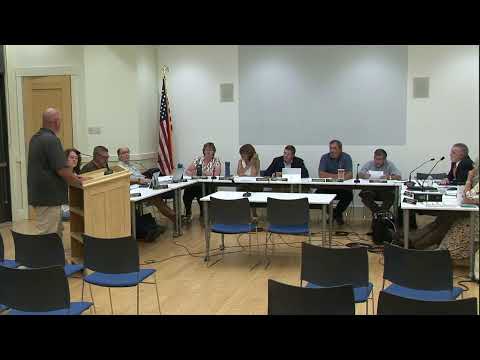
TIVERTON, R.I. — After more than three hours of testimony from an expert witness, dozens of residents and representatives of the applicant, the Tiverton Town Council on Aug. 12 voted to remove authorization for construction-and-demolition (C&D) recycling facilities from the town's Plan Development Park zoning overlay and to delete the proposed performance-standards text from the draft ordinance, while retaining a written definition of "construction and demolition processing facility" for future drafting work.
The move came after an extended public hearing during which the applicant's representative and a retained engineer outlined controls they said would reduce dust, noise and fire risk, while residents, conservation and regional water officials warned the council that Stafford Pond and neighborhood health could be threatened if the use were allowed.
Michael Monti, an attorney speaking for Ryan DeMello and RD Recycling, opened the hearing by asking that the council hear technical evidence about how a modern C&D facility would operate. The council allowed an expert witness outside the usual public-comment time. Laura Bugay, executive vice president of Green Seal Environmental and a registered professional engineer, described enclosed buildings, atomized misting systems for dust control, building-level fire suppression and thermal-imaging monitoring as typical controls for indoor C&D operations. "With proper controls, good design, it can be operated safely, cleanly without nuisance conditions," Bugay said.
The hearing included repeated concerns from residents and civic groups about proximity to Stafford Pond, traffic and fire risk. Scott Burns and a letter read for Ambassador David Carden warned of possible groundwater impacts and urged the council to complete more environmental due diligence before enabling the use in local law. Multiple speakers documented recent multi-alarm fires at recycling or scrap facilities in the region and questioned whether state permitting and enforcement alone would protect Tiverton residents.
Council members debated the draft change at length. The draft ordinance submitted by the planning board would have permitted C&D processing in the Plan Development Park (PDP) subject to special-use performance criteria; it also included a numerical starting limit of 100 tons per day in the proposed language. During council deliberations the president moved to change the PDP line for "construction and demolition processing facility" from a special-use marker (S) to not permitted (N) and to strike the proposed special-use performance criteria in their entirety; the motion was seconded and approved by the council. The effect was to leave a definition in the zoning code but remove the proposed path that would have allowed commercial C&D processing in the PDP under the present draft.
Supporters of the proposed facility had argued that an indoor, well-operated C&D facility would divert construction waste from landfill, recover usable material and reduce regional hauling. Bugay noted differences between the proposal and a much larger Providence-era outdoor operation; she said the draft ordinance's tonnage level (100 tons per day) is far smaller than the Providence site's 1,500 tons-per-day permit and that the nearest residential receptor to the proposed PDP parcels is roughly 1,500 feet away, based on her GIS checks. "The building also will provide dust control," she said, adding that stormwater could be directed away from the pond and that sprinklers and thermal imaging can detect and suppress hot spots early.
Opponents repeatedly pressed the council to require independent hydrogeologic and environmental review before any zoning change and pointed to state law and planning practice that expect municipalities to evaluate local conditions in addition to state permitting. "If we contaminate our water, it's lights out for Tiverton," the letter attributed to Ambassador David Carden said during public comment.
Before and after the zoning debate the council heard other routine items: it approved a sound-variance request for a series of outdoor car-show dates at the Longplex Family & Sports Center (the council voted to grant the variance) and accepted a resignation from a local commission. The zoning action on the C&D language was the night's most consequential policy change: by removing the special-use path and striking the draft criteria the council left the town without a local permitting path for commercial C&D processing in any zone under the draft as amended that evening.
What the council did not do on Aug. 12 is ban municipal C&D activity or preclude the town itself from operating any municipal facility; council-owned projects remain a separate category under local law. The council also did not adopt an alternative set of performance standards that would allow an indoor, limited-scale facility to proceed. Council members and staff said they expect to return the matter to the planning board or a future council for rewriting of a definition and for any proposed performance standards should the town want to regulate such uses in the future.
Laura Bugay and other technical witnesses recommended several topics the council could address in any future ordinance: a clear indoor-only requirement for separation and processing; mandatory training and licensing for on-site inspectors; dust-control standards (including indoor atomized misting systems); fire-suppression design and contingency planning for large fire-water volumes; specific limits or triggers for tonnage increases; and a required remediation or cleanup financial assurance to ensure the town would not inherit cleanup costs.
Council President (presiding) framed the council's action as an exercise in caution: the change preserves a definition in the code while preventing the proposed special-use pathway from becoming active until the council and planning board develop clearer, more enforceable standards. Council members said they were responding to the volume of public concern and to gaps in the draft performance standards as presented.
The council vote to remove the special-use pathway and strike the criteria carried; the transcript records the motion, a second and "Motion carries," but does not include a roll-call list of individual yea/nay votes in the public record excerpt.
Votes at a glance - Sound-variance request: Longplex Family & Sports Center (Fast Friday/"Skip Hall / Rise Up Racing") for outdoor DJ/music on several dates in Aug-Oct, 5 p.m. to 10 p.m. Motion to grant by Councilor Perry; second by Councilor Paul. Councilor Burke announced opposition; the motion passed. (Transcript: motion, discussion, "all in favor?" answer recorded, outcome approved.) - Zoning amendment (Plan Development Park): council amended the draft by changing the C&D line from special-use to not permitted and struck the special-use performance criteria; the council retained the definition of C&D processing. Motion made by Council President (presiding); seconded by Councilor Paul; "Motion carries" recorded in the transcript. (No detailed roll-call tallies provided in the transcript excerpt.)
What comes next Town staff and the planning board will likely receive the council's direction to rework the zoning text if the body wants a narrowly defined, indoor-only C&D processing path with escrowed cleanup funds, clearer fire-water and stormwater containment standards, and mandatory inspection or licensing requirements. Several councilors urged that any future draft include hydrogeologic review, quantified limits and enforceable operating controls before such a use is permitted in the PDP or any other zone.
(Reporting note: quotes are attributed to speakers who appear in the hearing transcript and are cited in the provenance below.)