Get Full Government Meeting Transcripts, Videos, & Alerts Forever!
Get email alerts on the Council Rules Procedures topic
No spam. Unsubscribe anytime.
Wausau committee advances rule changes on public comment, civility and packet deadlines
Summary
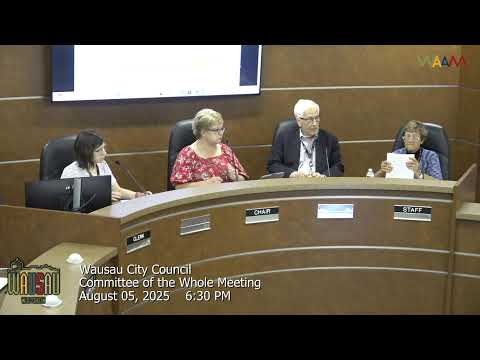
The City of Wausau Committee of the Whole voted Aug. 25 to recommend several revisions to council rules — including required standing-committee public comment, a civility statement, relocation of mayoral communications and a 7-day packet deadline — forwarding the measures to the council for final action.
The City of Wausau Committee of the Whole voted on Aug. 25, 2025, to forward several changes to council rules to the full City Council, including a requirement to agendize public comment on standing committee agendas, adoption of a civility statement for public commenters, direction to move mayoral communications later in the agenda and a clarified packet-deadline for materials.
The action matters because the changes aim to standardize when residents may speak, clarify expectations about decorum, reduce last-minute agenda additions and set clearer notice requirements for mayoral communications.
At the meeting, the presiding officer opened discussion by describing the rules-review committee’s multi-step process and invited Alder Gisselman, chair of the rules review committee, and city legal staff to explain the proposed edits. The committee debated four principal items: (A) agendizing public comment on standing committee agendas (rule 13(f)(4)); (B) a public civility statement to be read at council meetings and included on public-comment forms; (C) revised order of business that would move “communications and recommendations from the mayor” away from the start of the meeting; and (D) a clarified “introduction of business” packet rule that sets a final filing cutoff at the close of the preceding week while allowing narrow exceptions for good cause.
On item A the committee approved a motion to recommend that public comment regarding agenda items be agendized on every standing committee agenda and directed the clerk to implement the same practice for committees, commissions and boards when the city’s new agenda software is rolled out. The motion (mover: Martin; second: Lukens) carried by voice vote; the committee recorded the motion as carrying and noted the directive to the clerk for broader implementation.
Committee members debated practical effects: some supported placing public comment at the top of committee agendas to simplify expectations for attendees, while others said chairs should retain discretion to accept additional comment during item discussion. Anne, city attorney, described the package edits and confirmed an insertion clarifying that “a citizen may address a standing committee under rule 13(f)(4),” aligning rule 16 with the standing-committee change.
On item B the committee voted to adopt the proposed civility statement to be read during council meetings and placed on public-comment registration materials. The motion to approve (mover: Larson; second: Tierney) carried by voice vote. Discussion centered on whether the statement should use the word “may,” “shall” or “will” when describing the chair’s authority to interrupt or terminate a disruptive speaker. Several members, including Alder Killian, argued chairs should retain discretion; others said stronger language might deter repeated disruptions. The committee approved the statement as proposed and directed that it be added to the sign-up form and website guidance for public commenters.
Item C addressed the order of business and the placement of mayoral communications. The committee debated whether the mayor’s brief communications belong at the start of the meeting (where speakers feared the item had prompted dramatic openings) or at the end (to prioritize completing business). After discussion, Alder Larson moved — and Alder Martin seconded — a motion to renumber and move the mayor’s communications item to later in the agenda (staff will renumber as needed). The motion carried by voice vote with one recorded opposition; the committee instructed staff to finalize placement and packet language so subjects are identified on the agenda and, when substantive, filed in writing with the clerk seven days in advance.
On item D members approved a revised “introduction of business” rule to set clearer expectations for packet materials. The adopted language states that written materials (ordinances, resolutions, presentations, proclamations and similar communications) should be filed with the clerk no less than seven days before the meeting; it also specifies that no packet materials will be accepted after the close of business on the preceding week with a limited waiver allowed by the council or the chair “for good cause” if pre-filing is impossible or impractical. The motion to adopt the packet/deadline changes (mover: Tierney; second: Larson) carried by voice vote.
Members and staff discussed implementation details. Committee members emphasized that the rule is intended to make late additions rare, not impossible; several said the city should rely on special meetings when urgent matters arise rather than routinely presenting high-dollar contracts or other complex materials on short notice. Staff noted the rule gives clerks a clear cutoff (close of business on the preceding week) and the waiver language preserves narrow flexibility for pressing, time-sensitive matters (for example, negotiations or closed-session materials that cannot be distributed early).
Votes at a glance
- Item A — Agendize public comment on every standing committee agenda; direct clerk to implement across committees/commissions/boards with new agenda software. Motion carried (mover: Martin; second: Lukens). Outcome: forwarded to council (motion carries; numeric tally not specified; voice vote recorded). Notes: directive to clerk included.
- Item B — Adopt public civility statement to be read at meetings and placed on registration forms. Motion carried (mover: Larson; second: Tierney). Outcome: forwarded to council (voice vote; numeric tally not specified).
- Item C — Move mayor communications (communications/recommendations) later in order of business and require subjects not on the agenda to be clearly identified in advance. Motion carried (mover: Larson; second: Martin). Outcome: forwarded to council (voice vote; one recorded opposition; numeric tally not specified).
- Item D — Revise “introduction of business” to require written communications and similar materials be filed with the clerk at least seven days before the meeting; no packet materials accepted after close of business on the preceding week; limited waiver for good cause. Motion carried (mover: Tierney; second: Larson). Outcome: forwarded to council (voice vote; numeric tally not specified).
Committee members said the package will appear on the council agenda in September; if the council adopts the changes, staff and clerks will start using the revised rules immediately. Several members asked staff to publish the civility statement on the public-comment sign-up form and on the city website, and to confirm that technical clarifications (for example the distinction between public comment and statutorily required public hearings) remain consistent with state open meetings law.
Alder Killian, reflecting on chairs’ roles in meetings, said: "We elect the chairs of our committees because they're capable people, and I think we need to allow them the discretion of making a decision as to whether something is appropriate or inappropriate." That view informed several members' votes to preserve chair discretion on managing comment and decorum.
The meeting concluded with the committee voting to forward the package to the council for final consideration and adjourning shortly thereafter. Staff and members signaled an intent to monitor implementation and return for refinements if parts of the new rules produce unintended effects.