Get Full Government Meeting Transcripts, Videos, & Alerts Forever!
Get email alerts on the Community Development topic
No spam. Unsubscribe anytime.
Grants Pass council adopts 2025–29 CDBG consolidated plan and Year 1 annual action plan
Summary
On Aug. 8 the Grants Pass City Council approved the city’s 2025–29 consolidated Community Development Block Grant plan and the Year 1 annual action plan and authorized staff to submit the documents to HUD.
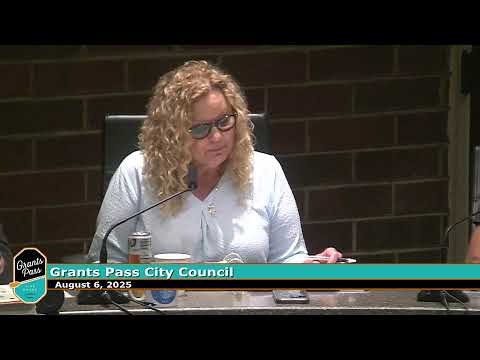
Grants Pass City Council on Aug. 8 approved a resolution adopting the city’s 2025–29 CDBG consolidated plan and the Year 1 annual action plan and authorized staff to submit the packet to the U.S. Department of Housing and Urban Development by Aug. 15.
City staff presented the plan at the meeting as a public-hearing item. The plan describes proposed projects and funding allocations for the federal Community Development Block Grant program, which the city expects to use to support affordable housing, homelessness interventions, public facilities and limited public services. Staff said $351,555 has been appropriated for the city’s 2025 award and that allocations will be adjusted if the final HUD award differs.
The consolidated plan guides use of HUD CDBG funds and is the mechanism for the city to request the annual award. Under program rules the city must direct a large share of funds to benefit low- and moderate-income (LMI) households and must limit public‑service spending. Staff told the council that CDBG national objectives include decent housing, suitable living environments and expanded economic opportunity for LMI persons, and noted program limits mentioned in the presentation: a minimum percentage of funds must primarily benefit LMI persons, up to 20% may be used for planning and administration, and up to 15% may be used for public services.
In the presentation staff summarized recent outreach and the public-comment process: a community survey in February, a needs-and-priorities briefing to council on April 16, and a public-comment period that ran June 9–July 14. Staff reported there were no public comments during the public-comment period. The packet distributed to council shows current program-year activity including 19 homes rehabbed and two facilities completed so far in program year 2024; staff said one additional home remains to be completed using 2023 funds and two more homes remain on the 2024 rehab waiting list.
Councilors asked staff how community organizations learn about the program and about eligible sidewalk projects. Staff said notices are posted on the city Facebook page, the city website, the Daily Courier and at the library; sidewalk work could be funded from the public‑improvements category (staff identified $14,000 in the public‑improvements line and $58,000 remaining for public‑facility renovations and ADA upgrades in the 2024 program year). Staff emphasized the statutory HUD threshold the city must meet for spending and drawdowns and said the city monitors that ratio and reallocates funds as needed to avoid HUD enforcement letters.
Councilor Indra moved to approve the resolution as presented; Seth seconded. The resolution passed on a roll‑call vote with all councilors voting yes.
The council directed staff to file the adopted consolidated plan and Year 1 annual action plan with HUD by the program deadline so the city can receive federal funds and begin project implementation.