Get Full Government Meeting Transcripts, Videos, & Alerts Forever!
Get email alerts on the Veterans Memorial Wall topic
No spam. Unsubscribe anytime.
Jacksonville officials weigh moving Veterans Memorial Wall as riverfront and stadium projects advance
Summary
City council members, parks staff and veterans’ representatives debated whether to keep, renovate or relocate the Jacksonville Veterans Memorial Wall during an Aug. 4 meeting, raising questions about cost, damage risk, parking, Purple Heart Trail continuity and budget timing.
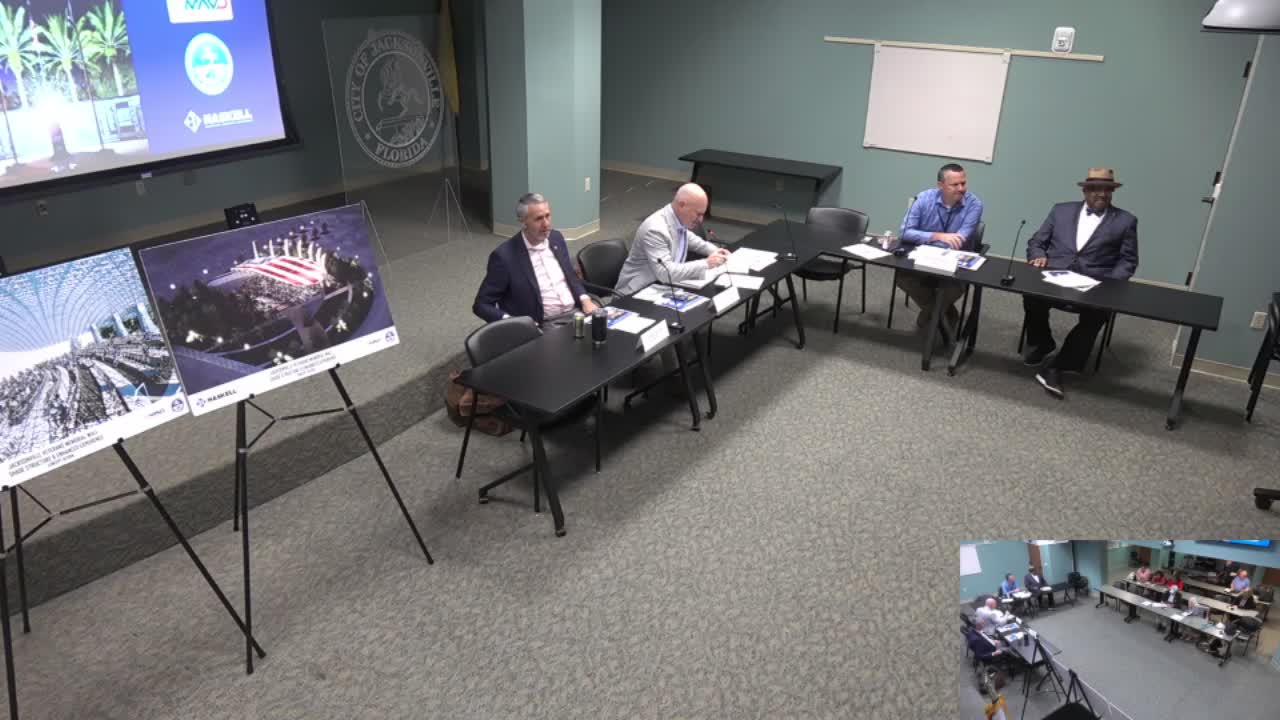
Jacksonville city council members, parks staff and veterans’ advocates met Aug. 4 to review plans for a proposed shade structure and broader options to repair, enhance or relocate the Jacksonville Veterans Memorial Wall as downtown redevelopment and a stadium renovation proceed.
The discussion, held during the city’s budget season, produced no formal decision. Council and staff agreed to gather more detailed cost and feasibility information — including three quotes from professional riggers to assess risks of moving the memorial — before finalizing whether to spend proposed funds or change the site.
The meeting focused on four linked issues: a shade/cover design already rendered for the wall, funding in the mayor’s proposed budget, the long-term suitability of the wall’s current stadium‑parking location, and the possibility of relocating the wall to a riverfront site near MOSH (the Museum of Science & History) or the Shipyards West parcel. The mayor’s proposed budget includes $2 million toward the shade structure; staff and council members said initial design work estimated the full structure could cost between $6 million and $7 million, with additional site‑preparation costs for an alternative riverfront parcel estimated in early staff comments at $15 million to $20 million.
Councilman Will Lane, District 3, said he and Councilman Chris Miller used discretionary funds to pay for design and preliminary engineering and that the completed renderings show options that range from a rain‑proof metal shield with seven columns to a programmable mesh canopy. “We provided the money for the design … the very specific quote of between $6 and $7,000,000 depending on what options that we went with,” Lane said.
Harrison Conyers, who described himself as long involved with the wall and its ceremonies, said the monument has taken on large public significance over 30 years and that Memorial Day attendance has grown into the thousands. “We’ve added hundreds of names to the wall over those 20 years,” Conyers said, noting the wall honors all seven branches and that Memorial Day observances have reached 1,900 to more than 3,000 attendees in recent years.
Supporters of relocation argued a riverfront site could create a more solemn, dedicated park, increase everyday visitation by linking the site to MOSH and the Riverwalk, and provide a permanent plaza and parking strategy rather than the current stadium lot setting. One council member highlighted a narrow parcel controlled by the Downtown Investment Authority (DIA), near MOSH and a proposed veterans exhibit, as a potential “Gold Star Family Park” that could be designed around the wall.
Staff and others raised counterpoints: moving the wall would require rebuilding plaza seating and site infrastructure; MOSH and the adjacent parcels will require new parking and ADA accommodations for large events such as Memorial Day; the Shipyards West area contains historically significant shipyard ground but also potential environmental and geotechnical complications; and salt‑water exposure at the riverfront could increase long‑term maintenance needs for granite monuments. Daryl Joseph, director of parks for the City of Jacksonville, described the riverfront park projects already under way and put the total approved riverfront parks program at about $150 million, with more than half of that encumbered.
Cost and timing were central. Daryl Joseph gave a high‑level estimate that preparing an undeveloped parcel to receive a monument — grading, drainage, ADA work, footings and basic utilities — could be in the $15 million to $20 million range. Joseph also noted the city has multiple riverfront projects underway that could be rescoped if council prioritizes relocation.
Several public commenters with military and veterans ties urged relocation to a more waterfront, ceremonial setting. William Harrell, who identified himself as a veteran and Gold Star family member, proposed consolidating the veterans museum, memorial wall and the ship (the local museum ship referenced during the meeting) at the Shipyards West site to concentrate costs and programming. “You could consolidate an awful lot of money,” Harrell said.
Other speakers pressed practical concerns: Robert Hernandez asked whether the Shipyards parcel had been cleared or certified for redevelopment and warned that saltwater would increase maintenance; Pat Mulvihill, formerly of the Rotary Club, urged caution and said, “If it’s not broken, don’t fix it.” Rich Pausert called potential damage during moving a major worry for many families.
Council members and staff agreed on next steps rather than a final outcome. The group on Aug. 4 requested additional engineering and cost studies, parking and ADA analyses tied to large‑event needs, and three independently solicited rigging quotes to assess whether the memorial could be moved without damaging the structure. Councilors also noted the timing of budget hearings in August creates an opportunity to align any decision about the proposed $2 million in budget funding for the shade structure with the wall’s final location.
No formal motion or vote to relocate, renovate or fund construction was adopted at the meeting. Instead, staff and council members said they would return with costed options that include: (1) build the shade/structure at the current stadium site using the existing renderings; (2) study and, if feasible, move the memorial to the DIA parcel adjacent to MOSH or to a Shipyards West plan while accounting for site prep and parking; or (3) defer major work pending more precise engineering and budget scenarios. The meeting concluded with council leadership saying they would collect the technical quotes and present recommended next steps to inform the budget process later in August.
The discussion explicitly referenced the council’s prior year resolution declaring Jacksonville a “Purple Heart City,” and council and staff discussed how a relocated wall would tie to the Purple Heart Trail and existing commemorative signage. Officials stressed any relocation would need to preserve ceremonial links and access for Gold Star families and veterans’ organizations.
Next steps listed by staff and council included engineering studies of candidate sites, formal cost estimates for the shade/cover options for the current site, three rigging quotes to test the technical feasibility and risk of moving the monument, a parking and ADA analysis for large‑event days, and a city parks‑led assessment of whether rescoping parts of the riverfront capital program could fund relocation without increasing net city spending.