Get Full Government Meeting Transcripts, Videos, & Alerts Forever!
Get email alerts on the Tax Increment Financing topic
No spam. Unsubscribe anytime.
Council holds public hearing on proposed Pearl District tax‑increment financing plan
Summary
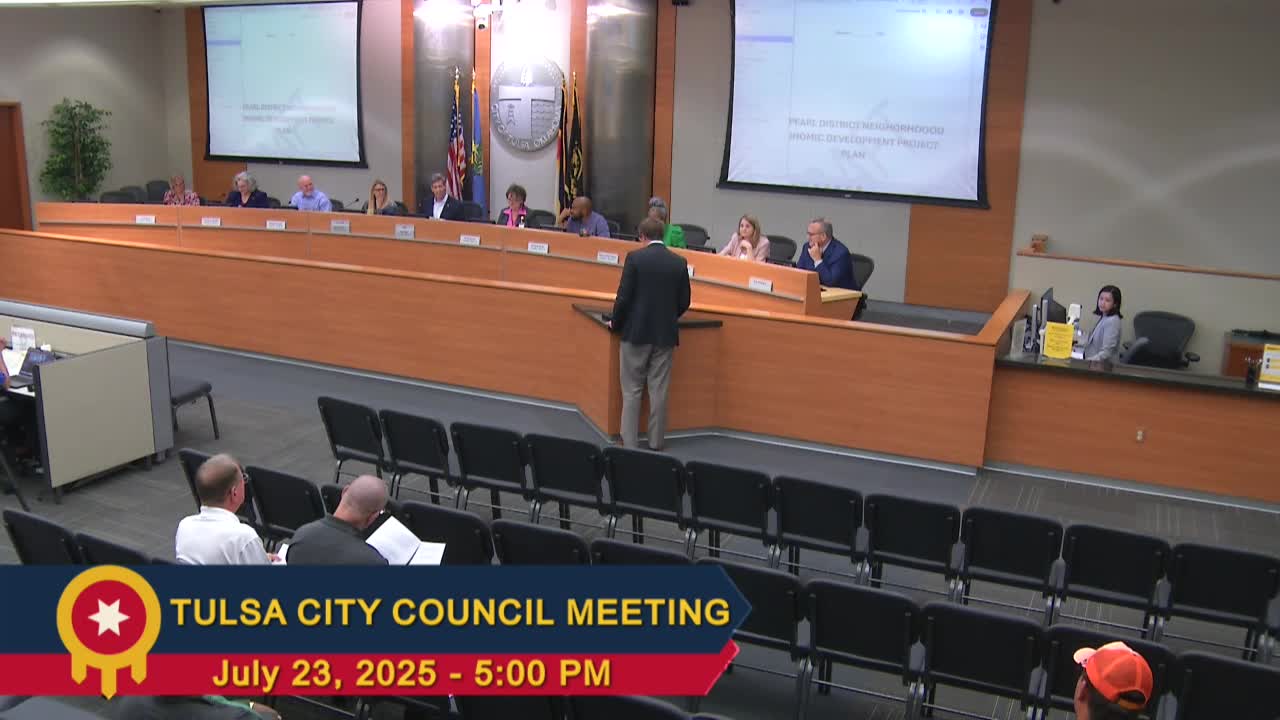
Partner Tulsa representatives described a proposed tax‑increment financing plan for the Pearl District and answered questions during a public hearing before the Tulsa City Council.
Partner Tulsa representatives described a proposed tax‑increment financing plan for the Pearl District and answered questions during a public hearing before the Tulsa City Council. The plan would create a single ad valorem increment district covering the neighborhood just east of downtown, prioritize housing and mixed‑use development, and use increment revenue to pay for infrastructure and developer assistance.
The presentation, delivered by Jeff Sabin of the Center for Economic Development Law on behalf of Partner Tulsa, said the project area covers the Pearl District between Kendall‑Whittier and the Market District. Sabin said the plan relies primarily on pay‑as‑you‑go financing rather than upfront borrowing, though he acknowledged some property owners sometimes seek conduit debt to accelerate projects. The plan as described would run for the 25 fiscal‑year maximum allowed under the state TIF enabling statute and delegates revenue oversight to the Tulsa Authority for Economic Opportunity (TAO) and a staff advisory committee, with the city designated as the administrative entity.
Sabin presented the plan’s financial projections: up to about $200 million in private redevelopment over the 25‑year period, generating as much as $96 million in incremental ad valorem tax revenue; the draft budget would cap TIF‑eligible expenditures at $83 million. Proposed allocations in the draft budget include roughly one‑third for public infrastructure improvements, roughly one‑third for development financing assistance to private projects, and a 10 percent set‑aside of increment to Tulsa Public Schools, which the presenter said is standard for city TIF districts to help offset school revenue impacts after state aid adjustments.
Sabin said affected taxing jurisdictions participated on the review committee and voted in favor of the project during that review, and that the Tulsa Metropolitan Area Planning Commission (TMAPC) recommended the plan as consistent with the city’s comprehensive plans, including a 2019 sector plan and an associated small area plan that identified priorities of residential stabilization and affordability, commercial retention and growth, safety improvements, and targeted infrastructure investments.
No council vote to adopt the Pearl District project plan was recorded at the meeting; the item was presented in a public hearing for information and comment. Partner Tulsa staff remained available in the chamber to answer follow‑up questions. The council exited the public hearing at the end of the presentation.
Context: Tax‑increment financing districts are local tools that capture increases in property tax revenues within a defined area to fund public improvements or incentives for private redevelopment. The plan’s 25‑year term and a school district set‑aside reflect practices used in other Tulsa TIF districts, according to the presenter. Questions that would determine next steps — including whether the council will schedule a formal adoption vote or request changes to the draft budget or boundaries — were not recorded in the meeting minutes.