Get Full Government Meeting Transcripts, Videos, & Alerts Forever!
Get email alerts on the Infrastructure Water Sewer topic
No spam. Unsubscribe anytime.
Worcester County endorses Route 589 regional water and sewer study
Summary
The Worcester County Commissioners unanimously endorsed a study outlining recommended water and sewer infrastructure for the Route 589 corridor, a planning step to guide future development but not a commitment to build facilities.
Worcester County Public Works Director Dallas Baker presented a county-commissioned study on a proposed regional water and sewer framework for the Route 589 corridor and the commissioners voted to endorse the study at their Aug. 5 meeting.
The study, prepared by GMB, evaluates water main sizes, force main routing and lift-station needs for the corridor south of Pennington Commons and north of U.S. 50 where no planned county water or sewer currently exists. "Our goal with this study is to answer that question, provide a framework so that as developers come in, they're aware of what the county's needs are," Baker said.
The plan aims to standardize pipe sizing and pump-station locations so individual developments do not build undersized systems that must be replaced later, Baker told the commission. He said the county also intends to limit the number of pump stations because each adds long-term maintenance costs for pumps and generators.
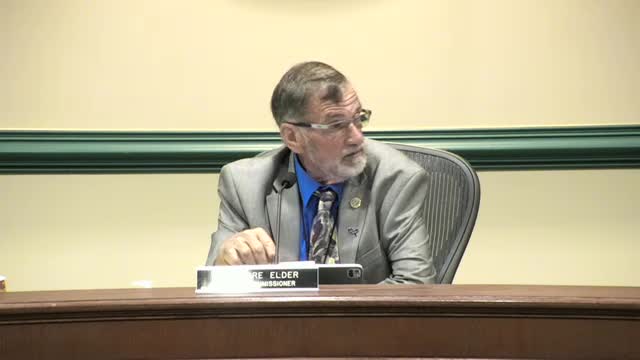
Commissioner Metresick moved to endorse the Southern Maryland 589 Regional Water and Sewer Plan; Commissioner Fiore seconded. Commissioners voted unanimously in favor with one commissioner absent.
The endorsement is an advisory action, not a construction authorization. Baker said the county will share the plan with prospective developers so they understand expected pipe sizes and fire-flow requirements; he explicitly described the document as a planning framework rather than a commitment to build mains or stations.
The vote came as part of a regular agenda item; commissioners had no substantive debate after Baker's presentation and expressed support for getting ahead of development pressures on the corridor.
Short-term next steps are procedural: the endorsed study will be made available to developers and used as a guide in permitting and plan review. Any actual public construction or county-funded extensions would require separate budget approvals and project-level decisions in the future.