Get Full Government Meeting Transcripts, Videos, & Alerts Forever!
Get email alerts on the Municipal Budget topic
No spam. Unsubscribe anytime.
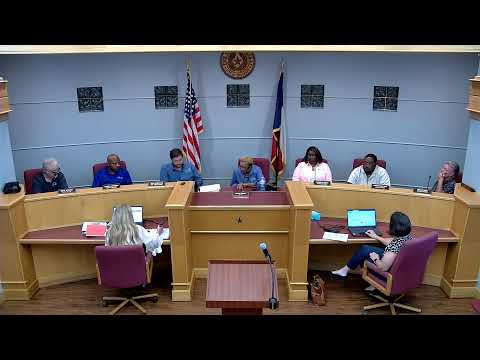
Crockett council approves proposed tax rate and reviews draft 2026 budget; water, streets and staffing highlighted
Summary
The Crockett City Council voted to approve a proposed tax rate (the voter-approval rate) and heard a staff presentation on the draft fiscal-year 2026 budget that would fund streets, utilities debt and limited new staffing, while leaving most capital requests unfunded.
The Crockett City Council voted to approve a proposed tax rate and reviewed a draft fiscal-year 2026 budget that city staff said would preserve operations while leaving most capital requests unfunded.
City Administrator John Angerstein said the city's draft maintenance-and-operations (M&O) rate in the budget is 0.4795 and that the no-new-revenue rate calculated for the city is 0.4747. "The maintenance and operations budget required to fund this budget from taxes is 2,052,000," Angerstein told council during the discussion. He said the voter-approval rate allowed by state law could be set higher and that adopting that rate would yield roughly "$170,000" in additional money that could be appropriated to capital items such as streets or new positions.
The draft budget as presented allocates a dedicated street-construction line and a mix of general fund and utility fund changes. On utilities, staff proposed raising the consumption rate on water from 54.9 per 100 gallons to 63 per 100 gallons to generate roughly $157,000 to cover bonds tied to the wastewater treatment plant and a water well; Angerstein said the change would increase the average residential customer's bill by about $3.19 a month.
Why it matters: Council members and staff framed the tax-rate decision and the utility-rate proposal as trade-offs between preserving a lean operating budget and funding multi-year infrastructure needs, especially street repairs and debt service on water and sewer projects.
Council discussion and budget priorities Staff told council that the current budget cannot support most of the capital requests submitted during the capital process. "There's not enough money in our tax rate to fund any of the capital requests," Angerstein said. He said capital items such as firefighter positions, police officer positions and cost-of-living adjustments were not included in the draft that matched the no-new-revenue assumptions.
Staff outlined the street funding picture in detail. The draft appropriates about $410,000 for street construction; staff said a $100,000 allocation would allow roughly eight streets to be chip-sealed, with the remainder split roughly as about $50,000 per precinct for construction needs. Angerstein pointed to rising materials costs: "The cement that we buy ... went from 4,200 to 6,000 in 1 year," he said, arguing that holding spending flat reduces the city's purchasing power.
Staff and council also discussed using existing non-tax funding sources for one-time capital projects, including ARPA balances and other reserves, rather than recurring tax revenue.
Public safety and staffing Council heard from the police chief and staff about a possible part-time downtown officer focused on parking enforcement and safety on the square. Angerstein said some of the funds could be reallocated internally (for example, by reducing a municipal court clerk position to part time) to pay for a part-time officer without raising taxes.
Utility billing and debt The council reiterated earlier direction to fund water- and wastewater-related debt from utility revenues rather than property taxes. Staff presented the proposed consumption-rate increase (54.9 to 63 per 100 gallons) as the primary way to cover approximately $157,000 in utility debt service; staff said this method would limit impacts on fixed-income residents because the charge is tied to usage.
Council action Council voted to approve a proposed tax rate at the meeting; the motion to "approve the proposed tax rate" (presented to the council as the voter-approval rate option) passed after a motion and second. The council set the proposed tax rate for public notice and scheduled a public hearing to finalize the rate at the next meeting.
What stayed out of the budget Staff said it removed several normally recurring replacements and discretionary items to reach the no-new-revenue threshold: planned mower replacements and the purchase of a new shredder were postponed, internal painting and some annual maintenance items were deferred, and a previously proposed parts/equipment replacement line was reduced.
Outlook Staff asked the council to prioritize streets and other capital items ahead of the public hearing and noted that if the council wanted to appropriate more one-time funds to capital requests it could consider supplementing with ARPA or reserves. The council also invited members to meet with staff for a line-item review ahead of the published public hearing.
Ending: Council signaled interest in at least considering the voter-approval tax rate to fund additional street work and limited staffing, and scheduled a public hearing and final adoption steps in accordance with state notice requirements.