Get Full Government Meeting Transcripts, Videos, & Alerts Forever!
Get email alerts on the Budget topic
No spam. Unsubscribe anytime.
Laredo unveils $1.01 billion proposed FY2026 budget; council adopts related policy resolutions including 10% administrative fee
Summary
City staff presented a proposed FY2026 consolidated budget of roughly $1.01 billion and accompanying financial resolutions. Council approved budget policies as amended, including an administrative overhead fee set at 10 percent for enterprise funds, and scheduled follow‑up budget hearings in August and September.
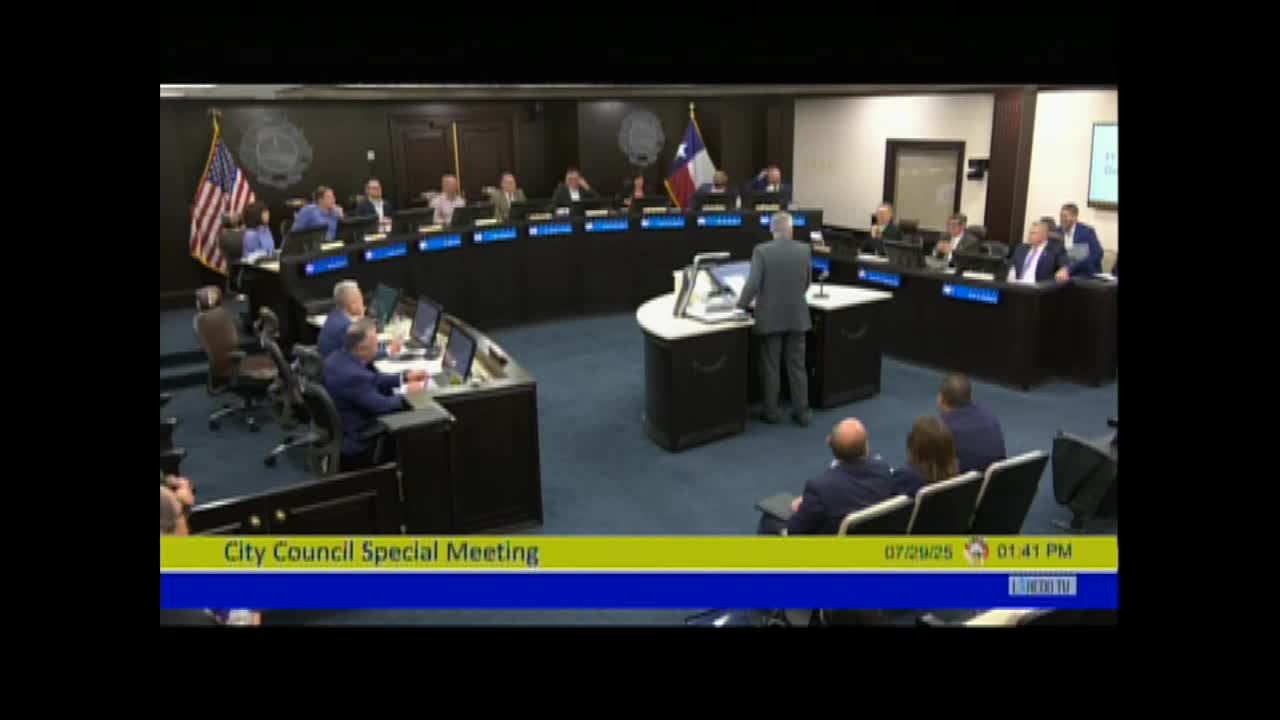
City staff presented the proposed fiscal year 2026 consolidated budget to the Laredo City Council July 29, describing a $1,010,000,000 proposal that staff said represents a 2.8% increase over the prior year and includes roughly $82 million in general‑fund project investments funded through certificates of obligation, tax notes and PPFCOs.
Jesus Esparza of the budget department pointed council members to the itemized projects in the budget book: a proposed certificate of obligation issue of $32,900,000, a proposed tax note for $25,600,000 and a PPFCO issuance of $24,000,000. Staff said printed and USB copies of the budget were provided to the council and a public summary in English and Spanish would be posted on the city website by the following morning.
Council members discussed schedule and deadlines. Staff said the charter requires the manager to present a proposed budget at least 60 days before the fiscal year end; council staff identified August meetings for budget discussion and noted that the final readings and tax‑setting meetings must be completed before the end of September or in a special October session if needed.
A prominent topic in the staff report and discussion was an administrative overhead fee the budget includes to allocate indirect costs from enterprise funds back to the general fund. Staff explained this “administrative fee” covers functions such as the city manager’s office, human resources and finance when those services are provided to enterprise funds.
Council and staff debated the fee’s level and method. Staff said the budget was built with the administrative fee set at 10%. Council members asked whether a higher or lower percentage would affect residents or federal grant reimbursement. Staff said the fee is typically justified either by an indirect‑cost study or a percentage method recognized by federal guidance; they said 10% was conservative compared with some federal indirect‑cost allowances but intended to balance enterprise fund impacts and general‑fund recovery.
During the consent‑agenda and policy discussion, the council considered several financial resolutions that staff described as directives to guide future budgets, including debt management standards, reserves policies and a council district support fund policy for district‑level project funding. Council members asked staff to sharpen policy language and return with more detailed definitions and procedures when appropriate.
The council took a motion on the budget‑related resolutions and policies as amended (the record shows the motion was seconded and the measure passed with an expressed opposition). The motion included staff direction to return with expanded policy language, comparables and further detail where members requested it. Several council members said they wanted clearer language on fund balance usage and surplus transfers.
What they approved and next steps: Staff presented the budget proposal as required by the charter; the council approved the related policy resolutions as amended on July 29 and directed staff to provide additional policy details and schedule follow‑up budget workshops in August. Staff said the full budget book would be posted on the city website and that the council would proceed with required introductory and final readings in August and September to meet statutory deadlines.