Get Full Government Meeting Transcripts, Videos, & Alerts Forever!
Get email alerts on the Police Retention topic
No spam. Unsubscribe anytime.
Laredo council hears police retention pleas, directs staff to continue contract talks
Summary
After public testimony from local and statewide police associations and the police chief, the Laredo City Council held an executive session and directed staff to continue negotiations and develop retention incentives for the Laredo Police Department.
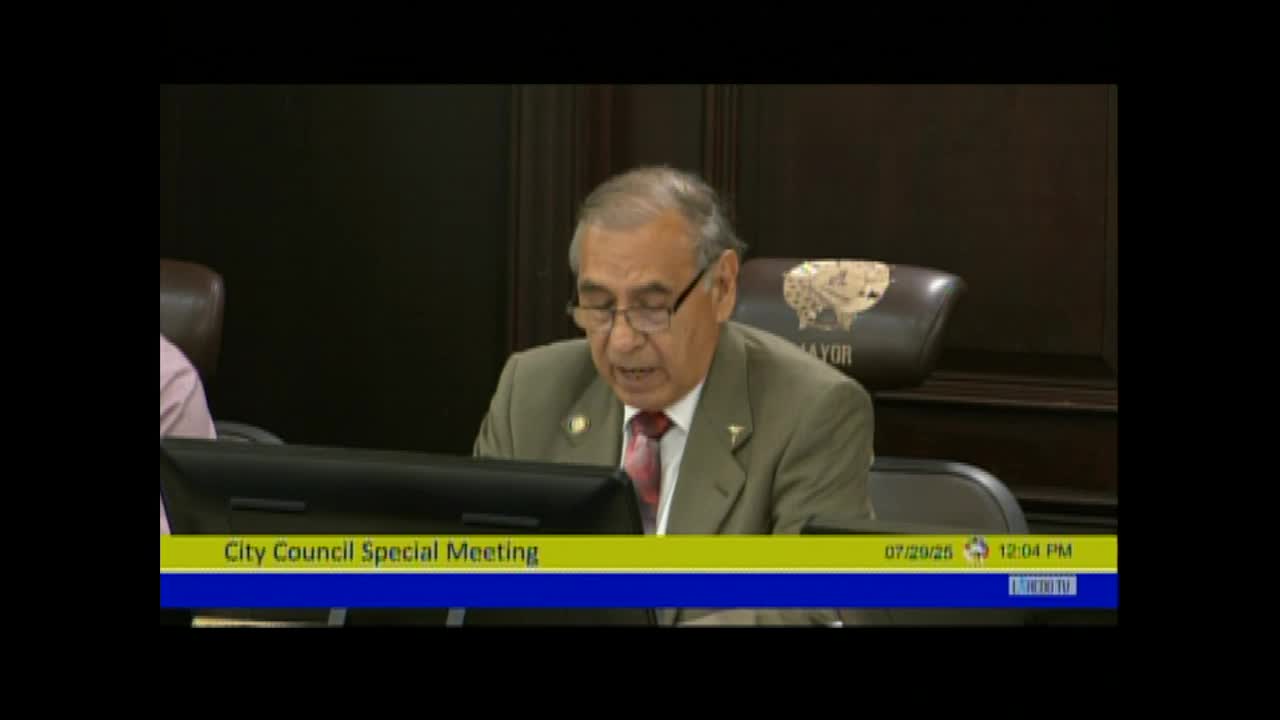
Mayor David Ramos opened a special meeting July 29 to ask the City Council to consider directing management to strengthen incentives and retention policies for the Laredo Police Department after the city lost its “safest city” ranking in some recent studies.
The council received public comment from police union and statewide association representatives who called for multi‑year contracts and competitive pay to curb an outflow of officers. Sergeant Alberto Ablosa, president of the Laredo Police Officers Association, told the council the department is “losing officers” and urged investment in retention: “We cannot afford to lose more experienced officers or fail to attract new ones.”
The nut of the discussion centered on a proposed directive from Mayor Ramos asking management to create or reinforce retention policies that could include multi‑year contract terms for newly hired officers. The mayor framed the issue as tied to public safety, citing measures such as traffic deaths, violent crime and officer retention where other cities have outperformed Laredo.
Speakers emphasized the financial and operational cost of turnover. Scott Leighton, president of the Combined Law Enforcement Associations of Texas, said it takes “almost 2 years” and substantial expense to replace an officer and that it takes about five years to make an officer “fully rounded.” Robert Leonard, executive director of CLEAP (Combined Law Enforcement Associations of Texas, per the transcript), told the council there are “about 70 open positions in the Laredo Police Department.”
Chief Rodriguez described staffing shortfalls in patrol and said the department’s patrol strength should be about 240 officers but is “about 210 at the patrol level” because of retirements, resignations and other separations. The chief said the department has seen double‑digit increases in some crime categories year‑to‑date and described ongoing changes to shift structures and technology investments intended to reduce response times.
Following the public comments the council voted to enter an executive session “pursuant to 5 5 5 1.071” for attorney consultation as part of the discussion the mayor described as a policy discussion rather than bargaining. After returning from executive session, the council reported that “discussions and policy were done” and that staff were directed to proceed with recommendations and to continue negotiations with the association. Council members said no final contract decision was made in the executive session; instead the council issued direction to management to continue talks and to develop retention proposals.
What this means for officers and budgets: witnesses at the podium warned that federal and other agencies are recruiting aggressively, sometimes offering signing bonuses and higher starting steps. Speakers and the chief asked the council for multiyear contract options to give the city and the department stability. Mayor Ramos and council members said they heard the testimony and will discuss the matters in follow‑up negotiations.
The council also allowed four public comments on the item before going into executive session and acknowledged those remarks would be considered in the continuing negotiations.
Staff direction and next steps: The council’s recorded action was a directive—staff were instructed to continue negotiations and to prepare recommendations for retention incentives and related policies. No final, council‑approved employment contract was adopted at the July 29 special meeting.