Get Full Government Meeting Transcripts, Videos, & Alerts Forever!
Get email alerts on the Thriving Mind Data Governance topic
No spam. Unsubscribe anytime.
Thriving Mind presents safety‑net Baker Act data; board debates bylaws, presentation limits and a communications subcommittee
Summary
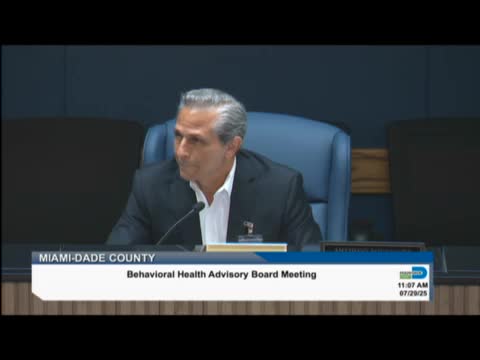
Thriving Mind staff presented safety‑net Baker Act and crisis stabilization data to the Miami‑Dade Behavioral Health Advisory Board on July 29, and advisory board members followed with questions about data scope, systemwide tracking and internal governance.
Thriving Mind staff presented safety‑net Baker Act and crisis stabilization data to the Miami‑Dade Behavioral Health Advisory Board on July 29, and advisory board members followed with questions about data scope, systemwide tracking and internal governance.
Lauren Neredo of Thriving Mind summarized the dataset the board had requested. The packet focused on the safety‑net population (uninsured and underinsured patients the managing entity serves) and did not include all private‑sector crisis data. Thriving Mind reported that among the dataset provided: males outnumbered females in crisis encounters (1,374 males v. 770 females in the dataset cited), the average length of stay in crisis stabilization units was six days, and readmission within 30 days for those units was 12%. The presentation noted that ZIP codes with the largest counts in the safety‑net dataset included 33134 and 33055; presenters cautioned that incident location and CSU location can affect ZIP‑code tallies.
Thriving Mind staff and DCF representatives warned the board the dataset was incomplete for the countywide picture and said the department’s datasets and the new e‑Baker Act process can provide expanded reports on public and private facilities on request. Lourdes Dorado (DCF) told the board there are 17 adult Baker Act receiving facilities in Miami‑Dade County (four public CSUs and eight private) and four child receiving facilities (one public CSU and three private), and that ongoing efforts could add additional capacity.
Board discussion then shifted to internal rules and communications. Members proposed limiting external presentations so the board can reserve more time for strategic decisions. Several members recommended a maximum of two presentations per meeting and a 15‑minute total allotment (presentation plus Q&A) for each, and suggested forming a communications subcommittee to craft a unified public messaging strategy (for example, NAMI’s 988 awareness campaign and county‑level outreach). Some members urged the board to defer a final vote on bylaws and presentation rules until the board chair could participate; others asked that staff provide a draft bylaws document before the next meeting so the board can focus discussion on components specific to this advisory board.
Formal motions and votes recorded in the meeting included the following actions: the chair ruled that the item to defer the vice‑chair appointment would be moved to the next meeting and the board approved that deferral in a voice vote; the minutes from the April 21 meeting were moved by Judge Naseem Saifie and seconded by Alfredo Hernandez and approved as amended (the clerk will change some names and correct a wording about an involuntary Baker Act case); and the board moved to adjourn at meeting end. Board members asked staff to circulate a draft bylaws document and calendar invites for future meetings.
Why it matters: the board is the county’s advisory body on behavioral health. The Thriving Mind safety‑net dataset gave members an operational snapshot of crisis stabilization outcomes and limits, and the board used the meeting to set process priorities — data aggregation, messaging and a proposed rules framework — that will shape future oversight and advice to county commissioners.
Next steps: staff were asked to prepare draft bylaws, circulate calendar invites for the coming year and return with additional systemwide metrics on follow‑up care and transitions out of CSUs.