Get Full Government Meeting Transcripts, Videos, & Alerts Forever!
Get email alerts on the Mobile Response Team topic
No spam. Unsubscribe anytime.
WestCare mobile response team says it diverted 80% of calls, reports 3,175 crisis calls in fiscal year
Summary
WestCare Florida presented operations and outcomes for its Miami‑Dade mobile response team (MRT), reporting 3,175 crisis calls in the most recent fiscal year, average response times under 60 minutes, a 23% Baker Act rate and peer‑specialist follow‑up showing a 92% success rate for non‑hospitalized clients.
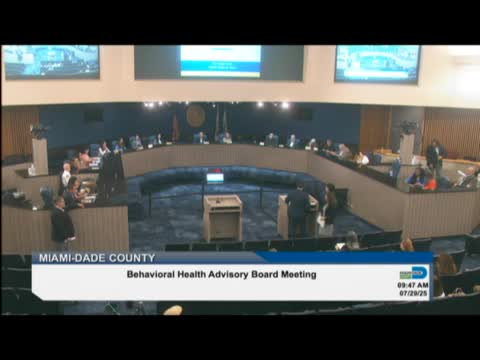
Claudio Perez, acting chair of Miami‑Dade County’s Behavioral Health Advisory Board, on July 29 heard a presentation from WestCare Florida about its 24/7 Mobile Response Team (MRT) in Miami‑Dade County.
WestCare officials said the MRT received 3,175 crisis calls in the most recent fiscal year and aims to arrive within 60 minutes of a dispatch. “We have been able to respond within the hour,” said Luciana Beltran, program director for the MRT, during the presentation. Staff described a three‑team county deployment (north, central and south), master‑level dispatchers, licensed clinicians and peer specialists who perform in‑person crisis assessment, de‑escalation and continuity of care.
The presentation summarized outcomes and system metrics. WestCare reported that 80% of MRT calls were resolved without hospitalization and that 23% of calls resulted in a Baker Act involuntary examination (630 people), of whom the provider said 241 were minors and 389 were adults. WestCare said roughly 80% of Baker Act transports are completed via the MRT’s contracted ambulance service, MCT Express, and about 20% are transported by law enforcement. The program’s follow‑up model assigns a peer specialist to each case for outreach within 24 hours; presenters said 92% of peer follow‑ups were successful and the program’s recidivism (repeat callers) rate was about 8%.
Presenters noted rising call volume. "From April 2023 to April 2025 we saw a 68% increase," Beltran said, and presenters described predictable peaks at the start and end of school terms. WestCare described demographic and referral patterns: approximately 63% of calls involved adults and 37% children; referral sources included family/friends (about 38%), schools (23%), law enforcement (10%) and self‑referrals (5%).
WestCare and board members detailed the team’s co‑responder pilot with the City of Miami police department: a law‑enforcement officer and clinician team dispatched to 911 calls that, according to presenters, reduced Baker Act rates on those calls from about 90% to roughly 30% in one month. Danny Blanco, chief operating officer for WestCare Florida, said the model initially operates limited hours but has shown “tremendous success” in lowering hospitalizations on those dispatches.
Board members asked for additional systemwide metrics. Vicky Sabaral of the Public Health Trust and Public Defender Carlos Martinez pressed WestCare on whether the MRT can document downstream hospital admissions, arrests or injuries tied to responses; presenters said the MRT’s recidivism metric is internal to the agency and that broader, aggregated data are not yet available to WestCare but are a target for future dashboards. "That is 1 thing that we're gonna be working on as we look to the future — to bring collaboration and an aggregation of data so our whole entire system of care can be monitored on a dashboard," Blanco said.
Funding and sustainability were raised. Presenters and board members said the MRT is currently funded entirely by the state. "It's a 100% state funded" program, a presenter said; board members urged exploring braided funding from the county and school system to maintain response times and service quality as call volume grows.
Board members also asked operational questions about safety and outcomes. WestCare staff said there have been no arrests associated with MRT responses during the program’s two years of operation and no staff or client injuries reported. They described criteria for police support when a scene is unsafe and said teams coordinate with law enforcement when needed.
Why it matters: board members and providers told the advisory board that timely, community‑based crisis response can reduce emergency department burden, lower involuntary hospitalizations and provide follow‑up that keeps people connected to care. Presenters requested ongoing partnerships, stated plans to improve cross‑agency data sharing, and encouraged local funding diversification to preserve the 60‑minute response standard as demand rises.
The board’s next steps included requests for more aggregated outcome data and consideration of funding diversification. WestCare left contact information and offered to provide additional data to the board and county partners.