Get Full Government Meeting Transcripts, Videos, & Alerts Forever!
Get email alerts on the Police Drones And Uas topic
No spam. Unsubscribe anytime.
Carlsbad Police describe drone program, uses and privacy safeguards
Summary
Lieutenant Sean Lawton outlined the police department's drone program, describing equipment, recent deployments, examples of successful uses for searches and events, FAA authorizations and privacy mitigations.
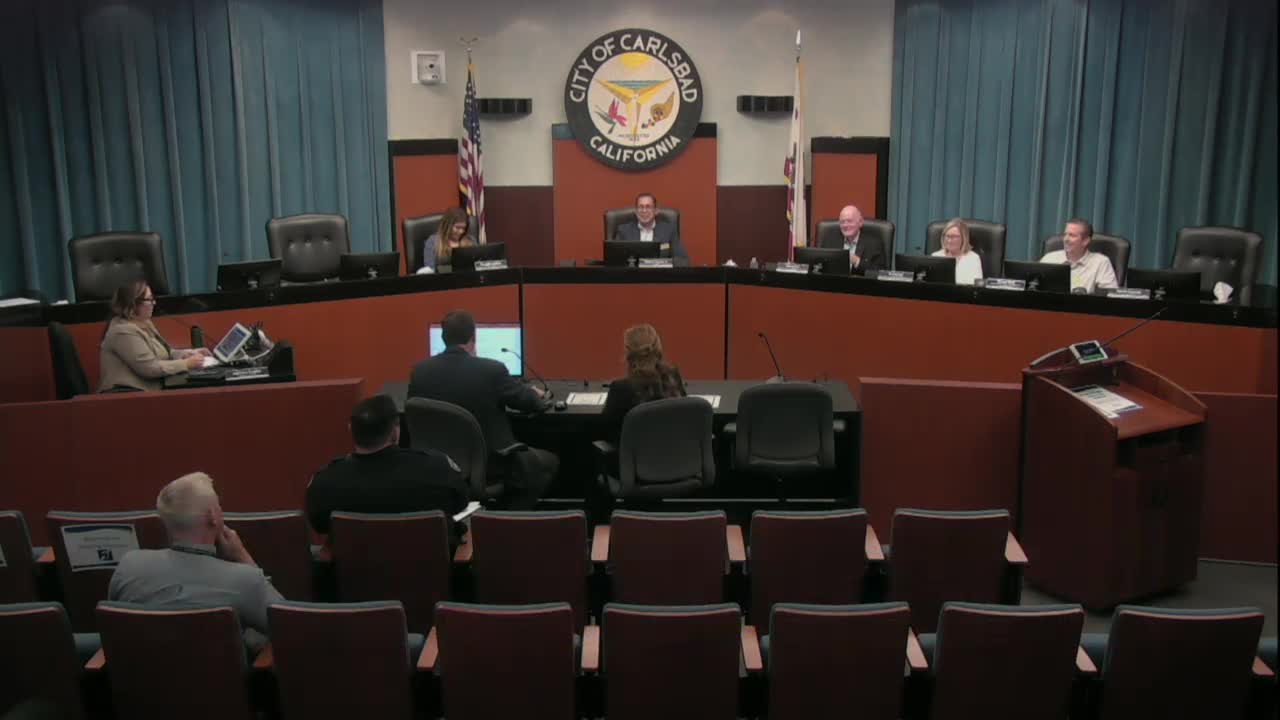
Lieutenant Sean Lawton, who oversees the Carlsbad Police Department's drone program, briefed the Public Safety Commission on the department's unmanned aerial systems, training and recent uses.
Lawton said Carlsbad's drone program began after a 2017 SWAT incident and has grown from tactical support for specialized teams into an operational asset used by patrol and rangers. The department uses multiple platforms (examples cited: DJI Mavic models and smaller indoor drones such as the Avata 2) and a streaming integration with Axon so live video can be shared with dispatch, patrol and incident commanders.
Lawton described training and regulatory requirements: pilots complete FAA Part 107 certification and the department operates using Part 107 waivers rather than a Certificate of Authorization (COA). He noted airspace constraints near Palomar Airport and that the department coordinates with tower or follows airspace rules when appropriate.
He gave operational examples: locating a suicidal person on a trail and identifying a weapon, discovering a suspect concealed above a shower curtain in a motel bathroom, locating suspects after residential thefts and assisting fire partners with thermal imaging to direct firefighting resources. Lawton said the department has trained operators across patrol shifts and rangers; he listed deployment totals reported to the commission for recent years (as presented in the meeting) and said the department currently has 12 certified pilots.
Lawton addressed privacy and legal questions from commissioners: the department does not record video unless it is related to a case or investigation; when recordings are made they are entered into the department's evidence system. Flight telemetry, gimbal angle and flight paths are logged so staff can audit what the drone observed during missions. He described mitigations used with automated or "drone as first responder" (DFR) pilots, including programming gimbal orientation to avoid looking down during transit until the drone reaches the scene.
Commissioners asked about equipment life, backups and technical details. Lawton said manufacturers and practitioners commonly plan for roughly a two-year lifecycle for airframes given rapid technology turnover and that batteries and rotors are routinely swapped; operators carry multiple batteries and teams will swap drones during long incidents. He discussed beyond-visual-line-of-sight capability (satellite/GPS and cellular telemetry) and said some vendor systems provide automated docks and autonomous launch-and-recover capability; he named Skydio as a U.S.-made option and said Axon provides the department's evidence-streaming platform. He also noted the department is aware of public concerns and works to keep community safeguards in place.
The commission had no further questions after the presentation.