Get Full Government Meeting Transcripts, Videos, & Alerts Forever!
Get email alerts on the Onsite Wastewater Systems topic
No spam. Unsubscribe anytime.
Coconino County outlines on‑site wastewater requirements, alternatives for Valley properties
Summary
Zachary Burth, an environmental quality specialist for Coconino County, told a Valley audience that shallow soils and bedrock make conventional septic systems impractical for much of the area and explained the county's permitting and site investigation process and the on‑site wastewater alternatives the county commonly permits.
Zachary Burth, an environmental quality specialist for Coconino County, told a Valley audience that shallow soils and bedrock make conventional septic systems impractical for much of the area and explained the county's permitting and site investigation process and the on‑site wastewater alternatives the county commonly permits.
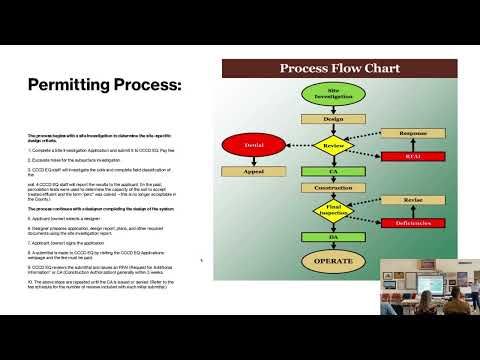
Burth said Coconino County issues a construction authorization and, after installation and final inspection, a discharge authorization that allows a residence to be connected. "Once I get that the DA is issued. So again you're good to flush is what the operate means," he said.
Why it matters: Valley parcels often lack the 48 inches of native soil required beneath a conventional disposal field under current Arizona rules, Burth said. That shortfall drives the frequent use of pretreated, alternate systems such as aerobic treatment units with chlorination or UV disinfection, mound systems, composting toilets and, in limited cases, vault‑and‑haul tanks.
Burth described the site investigation the county requires before design: a minimum of three test holes (two in a proposed primary disposal area and one reserve), dug to refusal (bedrock), with soil horizons logged and a soil absorption rate assigned from standard texture tests. "Three test holes are required," he said. He explained that each test hole typically defines tested soil for roughly a 30‑foot radius and that holes are often placed about 50–60 feet apart.
On why conventional systems are uncommon, Burth said the county's rule requires 48 inches of native soil beneath conventional leach fields. "Out here we're not getting that much soil so we have to pretreat that which allows you to shrink that 48 inches down to a lot of times 6 inches before you hit a limiting layer," he said, describing why aerobic or other pretreated systems are used in Valley.
Options and tradeoffs: Burth said the most common alternate units are aerobic treatment units (ATUs) that introduce oxygen to speed treatment, followed by a disinfection step (chlorine tablets or UV) before discharge to the disposal field. He described the components: solids (trash) tank, aeration chamber (blower or agitator, on a timer and requiring electricity), and a treatment/chlorination or UV chamber.
He cautioned that ATUs have moving parts and maintenance needs: the aeration equipment and the disinfection tablets require periodic replacement. "That aeration...is a moving part. So eventually it would fail," he said, adding that treatment equipment and tablets often have 15–20 year service lives but that upkeep varies by use.
Burth summarized other alternatives: gray water systems (allowed in Arizona with restrictions and must stay on the property and be diverted back to the wastewater system in non‑irrigation months), permitted composting toilets (allowed but only certain ADEQ‑approved proprietary models are on the state list), and vault‑and‑haul tanks as a last‑resort option because of ongoing pumping costs.
He gave examples of design numbers used in review: the county's smallest conventional tank size cited is 1,000 gallons; a 3‑bedroom home under alternate sizing could be treated with a tank on the order of 270 gallons after a 40% footprint reduction when a composting toilet removes some black water; vault‑and‑haul systems are sized at roughly 10 times the design flow (Burth used a 450 gallons‑per‑day design flow example that would call for a 3,000‑gallon tank). He called the vault‑and‑haul option expensive to operate and therefore a last resort.
Pilot project and outreach: Burth said he has applied for technical assistance through the EPA's Closing America's Wastewater Access Gap program to develop a more affordable on‑site system for the area and is working with ADEQ on concept approval. "I applied for some technical assistance through EPA's Closing America's Wastewater Access Gap and I'm receiving that technical assistance now," he said. He asked residents to complete a brief anonymous survey (paper or QR code) about household water use to help tailor any proposed pilot system.
Practical notes and resources: Burth reviewed practical site requirements such as the minimum 10‑foot setback from any foundation for components, recommended pipe slopes (about a quarter‑inch per foot for house‑to‑tank sewer), and the county's three‑review permit process (permits may be denied after three incomplete review cycles). He pointed attendees to a county online resource list of excavators, designers and septic installers and encouraged homeowners to consult designers and suppliers.
Burth closed by offering follow‑up contact and said county staff are available for questions. "I brought my business cards too," he said, adding he would be conducting many inspections during the busy season.
Ending: The presentation focused on how geological limits in Valley force reliance on alternate on‑site wastewater approaches, the county's permitting and inspection steps, and a forthcoming effort to seek pilot funding for lower‑cost systems. Burth invited residents to provide household water‑use information to inform any pilot design.