Portland presents draft Urban Forest Plan with 45% canopy goal, 660,000-tree target
Loading...
Summary
City staff presented a public draft of the Portland Urban Forest Plan proposing a citywide canopy goal of 45 percent, an estimated 660,000 additional trees to reach that target, and a set of actions including a street-tree maintenance pilot funded by the Portland Clean Energy Fund.
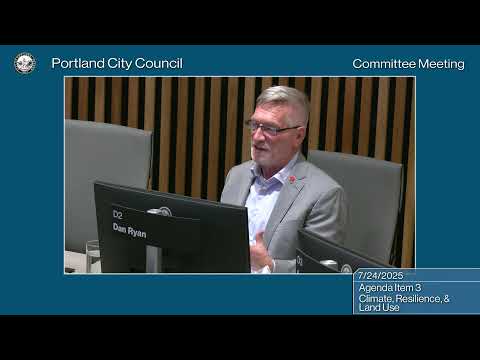
Portland Parks & Recreation and the Public Works service area presented a public draft of the Portland Urban Forest Plan to the Climate Resilience and Land Use Committee on July 24, laying out a community-led vision and more than 60 recommended actions to preserve, grow and care for the city’s trees.
The draft plan proposes a citywide tree canopy goal of 45 percent (current canopy roughly 30 percent) and estimates the equivalent of about 660,000 new trees would be needed to reach that goal. The plan establishes subarea goals to prioritize low-canopy, low-income neighborhoods and outlines actions for multiple bureaus, including Portland Parks & Recreation, Portland Bureau of Transportation, Bureau of Environmental Services, Portland Permitting and Development, and Portland Fire & Rescue.
Jen Cairo, the city forester and manager of the Urban Forestry Division, said the plan was developed after two years of community engagement, technical analysis and coordination with regional partners. "The Portland Urban Forest Plan is our road map to address these challenges and grow and care for trees equitably," Cairo said.
Key plan elements presented: a goal of planting the equivalent of 660,000 trees (approximately one tree per Portland resident), subarea canopy targets to prioritize the most undercanopied neighborhoods, and an emphasis on equity and community involvement through expanded volunteer programs and partnerships with community-based organizations.
Funding and programs: Portland Clean Energy Fund (PCEF) dollars are already supporting an expansion of the city’s tree planting work, including a ramp-up toward planting about 10,000 trees per year and contracts with 32 planting contractors, up from three three years ago. PCEF funds also support a planned pilot to shift responsibility for street-tree maintenance from adjacent property owners to the city; that pilot is expected to start next year.
Cairo and project manager Belinda Udelman said the draft plan does not itself amend Title 11 (the city’s tree code) but is intended to guide future code amendments. The city plans to recruit members for a new or reconstituted Urban Forestry Commission this fall and to begin code amendment work after plan adoption. "While the plan does not call for specific code amendments, it does set a vision and management goals and includes community feedback to guide those code changes," Udelman said.
Data and monitoring: staff described an ongoing inventory program and partnerships that will track canopy and tree health. Methods include an inventory of street and park trees, an Urban Canopy Inventory and Assessment partnership with the U.S. Forest Service using 200 sample plots, and lidar-based canopy measurements across the city.
Public testimony: nine speakers offered comments during the public hearing. Testimony reflected broad support for stronger, faster action to protect and expand canopy, particularly in East Portland and other low-canopy neighborhoods, and urged financial support for tree maintenance so residents are not burdened with costs. Bruce Nelson, a six-year member of the Urban Forestry Commission, urged "courageous action" and city responsibility for street-tree maintenance. Tanya Hartnett of the Working Waterfront Coalition asked for flexibility for heavy-industrial sites, noting safety, operational and regulatory constraints and suggesting off-site canopy investments as alternatives for some properties. Several speakers, including Noelle Studer Spivak (Shade Equity Coalition), emphasized the health and life-saving benefits of trees during extreme heat events.
Committee members asked technical questions about causes of canopy decline, how subarea goals are set, data collection and cross-bureau governance. Staff said canopy loss stems from multiple factors — development, climate stress and natural-area mortality — and reiterated that subarea goals are set by neighborhood and by the city’s comprehensive-plan “pattern areas,” with East Portland designated as its own pattern area and prioritized accordingly.
Next steps: staff will incorporate public comments and return a final draft as a resolution to the Climate Resilience and Land Use Committee in mid-September; the committee then will forward the resolution to full City Council for adoption. The committee and staff emphasized that amendments to Title 11 will be developed after plan adoption and that the street-tree maintenance pilot funded by PCEF is a five-year increment intended to inform future, larger-scale citywide programs.